PNG to JPG
PNG to JPG is a free tool that converts a PNG image file into the JPG format entirely within your browser.
How do I convert a PNG file to JPG?
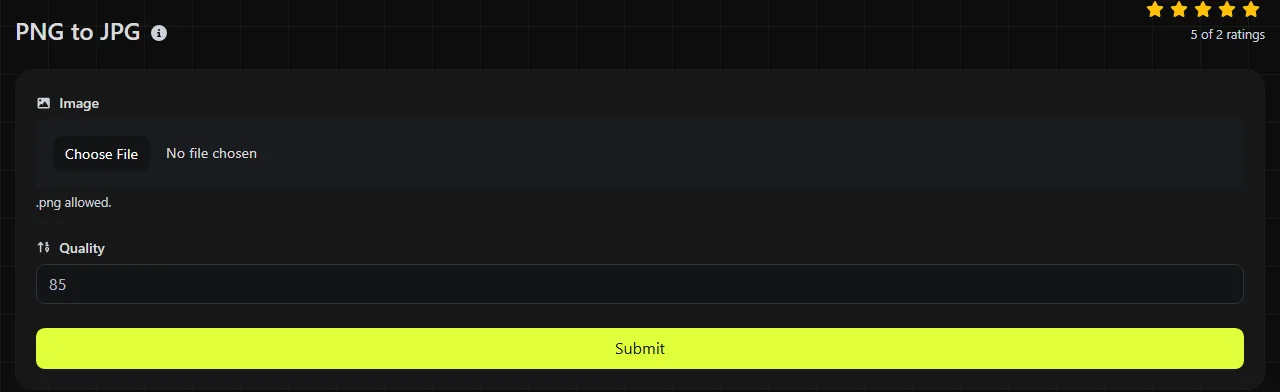
Select the PNG file you want to convert, let the browser process it, then save the resulting JPG file. The conversion takes place entirely in your browser. Your image is never uploaded to a server.
- Choose the PNG image that you want this converter to turn into a JPG.
- Run the conversion and save the JPG output.
- Open the saved JPG and check how former transparent areas and fine detail look, then compare its file size with the original PNG.
Keep the source PNG until you have checked the JPG for compression artefacts and lost transparency. JPG compression discards image data, so converting the JPG back to PNG later will not restore the original quality or transparency.
What changes when PNG is converted to JPG?
The image changes from a lossless PNG representation to a lossy JPEG representation, and any alpha transparency can no longer be stored. The main differences are:
- Compression: PNG uses lossless compression, which preserves the stored pixel data. JPG uses lossy compression and removes some visual information to reduce file size.
- Transparency: PNG can contain fully or partly transparent pixels. JPG has no alpha channel, so the converted file cannot remain transparent. The converter's published behaviour does not specify which colour it uses in place of transparent areas, so inspect the result.
- Animation: Standard PNG files are static, although animated PNG files, known as APNGs, also exist. JPG is a static format and cannot retain animation. This tool does not state how it handles an APNG or which frame it would use.
- Visual detail: JPEG artefacts may appear around lettering, icons, sharp edges and blocks of flat colour. They are usually less conspicuous in photographs and images with gradual tonal changes.
- Support: Both formats work in mainstream browsers and common desktop and mobile software. JPG is also widely accepted by document systems, email services, photo-printing services and sites that do not accept PNG uploads.
Will the JPG file be smaller than the PNG?
The JPG will often be smaller when the source is a photograph, but a smaller file is not guaranteed. The result depends on the image dimensions, its content, the PNG's existing compression and the JPEG encoding settings used during conversion.
A large PNG photograph normally gives JPG more scope to reduce the file size because photographic noise and subtle colour changes are expensive for lossless compression. A small diagram, logo or interface icon may already compress efficiently as PNG. Converting that sort of image can produce only a modest saving, while adding visible ringing or blurred colour around edges.
Do not estimate the output size by changing the extension or comparing two unrelated images. Save the converted JPG and compare its actual size with the source PNG in File Explorer on Windows, Finder on macOS, or the file information view on your phone. If web performance is the aim, inspect the converted JPG for JPEG artefacts as well as comparing the number of kilobytes. The Image optimizer may help when you need to reduce a file without changing its basic use.
When should I convert PNG to JPG?
Convert PNG to JPG when broad JPG compatibility or a smaller photographic file matters more than lossless pixels and transparency. Typical cases include placing a screenshot in a system that accepts only JPG, sending a large photo by email, or preparing an opaque image for a photo-printing service.
Keep PNG when the image contains transparency, pixel art, a QR code, small text, a line drawing or a logo with hard edges. Lossy compression can make these elements less distinct. PNG is also the safer working format when the file will undergo further editing and repeated exports.
Conversion is not a repair method. If the PNG was created from a low-quality JPG, saving it as JPG again introduces another lossy encoding stage. The PNG encoding may have preserved the decoded, already damaged raster pixels losslessly, but it cannot contain detail that was lost before the PNG was made.
For a website, JPG remains suitable for ordinary opaque photographs. If you need modern web compression or transparency, compare the result with PNG to WebP instead. The need for PNG transparency or JPG compatibility should decide the format rather than file size alone.
Examples and awkward source files
These examples show outcomes of encoding PNG input as JPEG. Exact JPG byte sizes and quality levels cannot be predicted from the PNG filename.
- Input: product-photo.png, containing an opaque photograph. Output: a JPG-encoded image. It will commonly be smaller, though the saving cannot be known until it is converted.
- Input: logo.png, containing transparent pixels. Output: a JPG with no transparency. Check the former transparent area before using it on a coloured page.
- Input: animated-banner.png in APNG form. Output constraint: JPG cannot contain the animation. Do not use this conversion when motion must be preserved.
Spaces, punctuation, numbers and accented characters in a filename do not affect the PNG or JPEG encoding itself, although a particular website or operating system may rename the downloaded file.
Preservation of PNG text chunks and EXIF fields in the converted JPG is not specified, so check them independently if they matter to your workflow.
Frequently asked questions
Are JPG and JPEG different formats?
No. JPG and JPEG refer to the same image format. The three-letter .jpg extension became common on systems that historically restricted filename extensions, while .jpeg is the longer form.
Can I make a JPG by renaming .png to .jpg?
No. Renaming changes only the filename, not the encoded image data. Software that checks the file signature will still identify it as PNG, and some upload forms will reject the mismatch.
Why does small text look blurred after conversion?
JPEG compression is designed mainly for continuous-tone imagery such as photographs. Its treatment of colour detail can soften coloured text and create artefacts beside high-contrast edges. Retain the PNG for diagrams, interface captures and text-heavy graphics.
Will the converted JPG keep location or camera information?
Do not assume that PNG text chunks, EXIF fields or other metadata will be copied into the JPG. Metadata handling is not specified for this converter. Check the saved file with your operating system's properties panel or a suitable metadata reader before relying on it.
Is browser-based conversion safe for confidential images?
The image is processed in your browser and is never uploaded to a server by this tool.
Final checks
Open the saved JPG at full size and inspect text, edges, gradients and every area that was transparent. Confirm that the receiving website or application accepts JPG, compare the file size with the original PNG, and keep the source file if you may need transparency or further editing later.
Similar Tools
Convert PNG image files to WebP format easily with our PNG to WebP converter tool for efficient image compression.
Convert PNG image files to BMP format easily with our PNG to BMP converter tool for high-quality image outputs.
Easily convert PNG image files to GIF format with our PNG to GIF converter tool for animated images.
Popular Tools
Create your own custom signature and download it easily with our signature generator tool for personalized e-signatures.
Calculate the size of any text in Bytes (B), Kilobytes (KB), or Megabytes (MB) using our text size calculator tool.
Use the reverse IP lookup tool to find the domain or host associated with any IP address quickly and easily.
Use our ping tool to check the status and response time of any website, server, or port quickly and efficiently.
Digily Link's IP lookup tool provides detailed information about any IP address. Use this free online service to get comprehensive IP data.
Generate your free WhatsApp link instantly with our WhatsApp Link Generator. Add a custom message and start chats in one click. No login or coding required.