PNG to WebP
PNG to WebP is a free tool that converts PNG image files into WebP files in your browser.
How do I convert PNG to WebP?
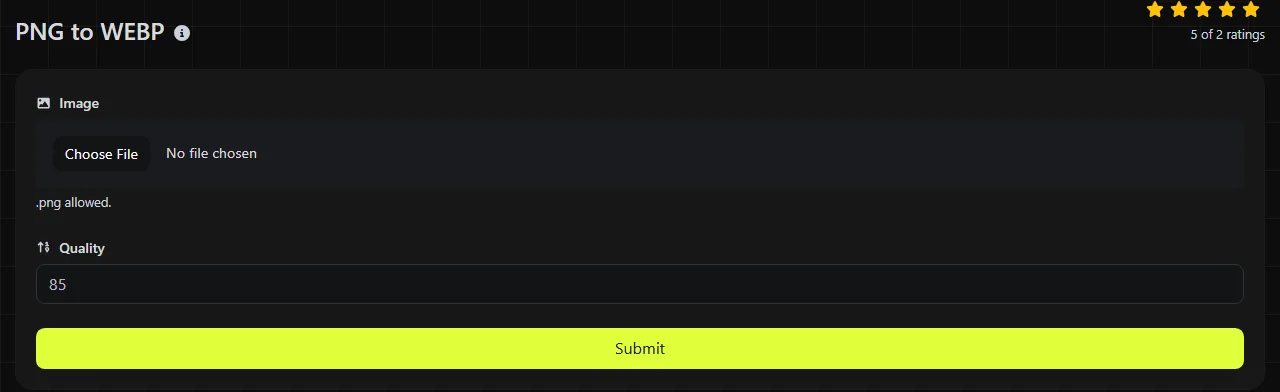
Add the PNG file, run the conversion and save the resulting WebP file. The work takes place entirely in your browser. Your image is never uploaded to a server, which is useful when the file contains private artwork, internal screenshots or material that has not yet been published.
- Select the PNG image you want to convert.
- Convert it and save the generated WebP file to your device.
Open the saved WebP file to verify the converted output before replacing the original. Check transparent areas, fine text, gradients and sharp edges at normal viewing size. Keep the source PNG until the WebP has worked correctly on the website, content management system or application where you intend to use it.
What changes when PNG becomes WebP?
The image moves from PNG's lossless compression format to WebP, a web-focused format that supports both lossless and lossy compression. The converter's published details do not specify which WebP encoding mode it uses, so do not assume that the result is lossless without checking it.
| Property | PNG | WebP |
|---|---|---|
| Compression | Lossless compression using the PNG format | Supports lossless and lossy compression |
| Transparency | Supports full alpha transparency | Supports alpha transparency |
| Animation | PNG supports static and animated images, while ordinary static PNGs contain only one image | The format supports animation |
| Typical file size | Often larger for photographs and detailed website images | Often smaller, particularly when lossy compression is suitable |
| Support | Accepted by almost all image software, browsers and publishing systems | Supported by current major browsers, but some older or specialist software may not accept it |
Converting a static PNG does not create an animation. Likewise, format conversion cannot add missing detail. If a photograph was previously compressed as a JPG and then saved as PNG, converting that PNG to lossless WebP will not restore the quality removed by the earlier JPG compression.
How much smaller will the WebP file be?
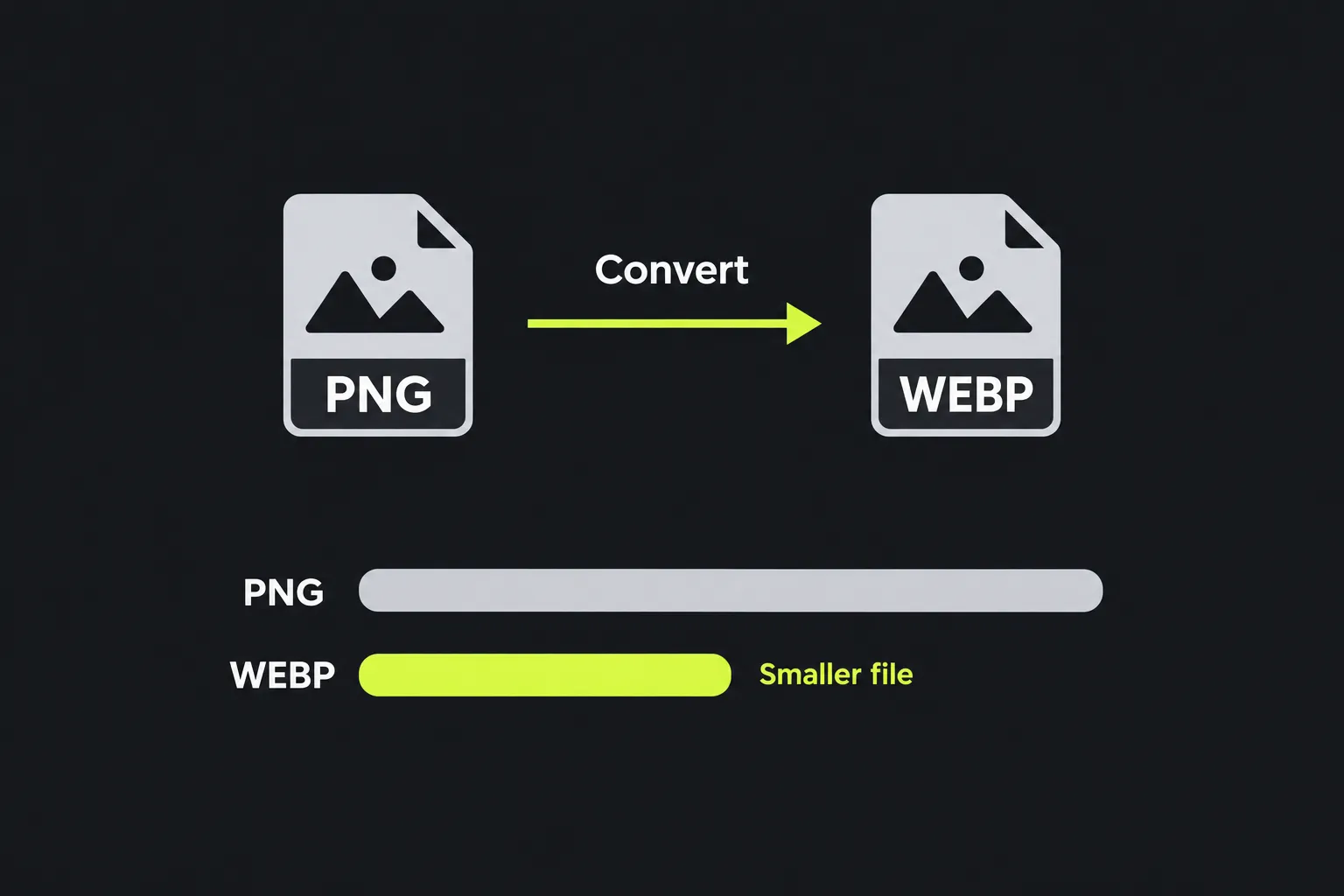
The WebP file will often be smaller than the PNG, but there is no fixed percentage and the result can occasionally be similar in size or larger. Image content, dimensions, transparency, colour complexity and the encoder's compression settings all affect the result.
- A large photograph stored as PNG will commonly see a substantial reduction because PNG is inefficient for continuous photographic detail.
- A user-interface screenshot with flat colours and sharp text may already compress well as PNG, so the reduction may be modest.
- A tiny logo or icon may save only a few kilobytes, making compatibility more relevant than the raw saving.
- An image containing noisy textures, grain or complex transparency can remain relatively large in either format.
For example, an input named product-photo.png produces an image in WebP format, but its exact byte size cannot be calculated from the filename or pixel dimensions alone. Compare the saved sizes directly and inspect the WebP for visible artefacts before publishing it.
When should I convert PNG images to WebP?
Convert PNG to WebP when a website needs smaller image downloads and every part of the delivery chain accepts WebP. Typical cases include product photographs exported as oversized PNG files, large article illustrations, dashboard screenshots and repeated thumbnail images.
WebP is usually a sensible delivery format for current web browsers. It may reduce transfer size, which can help pages containing several large images. If you are changing many website assets, use an Image optimizer afterwards to check whether further resizing or compression is appropriate.
Conversion makes less sense when PNG is required by a design handover, document template, legacy application or upload system. PNG may also remain preferable for a master copy because its lossless storage and broad software support make later editing straightforward. For photographs that do not need transparency and must work in older systems, PNG to JPG may be a more compatible route.
Awkward PNG input and compatibility
Some PNG files need extra checking because the formats support similar features in different ways. Transparency is supported by WebP, but fine semi-transparent edges can reveal unwanted halos if an encoder handles colour information differently.
Indexed-colour PNG files, embedded colour profiles, unusually high bit depths and metadata may also be represented differently after conversion. The tool's published information does not state whether metadata or colour profiles are preserved. Do not delete the original if those details form part of a print, archive or colour-managed workflow.
APNG files need particular care. Although APNG uses the PNG extension, it can contain multiple animation frames, and support for APNG input is not stated for this converter. Very large, damaged or incomplete files may also exceed browser resources or fail to decode, even though ordinary PNG images open normally.
Frequently asked questions
Can I rename a .png file to .webp?
No. Changing the filename extension does not change the image encoding, so software will still find PNG data inside the file. The image must be decoded and encoded in WebP format by a converter.
Why does a website reject my WebP image?
The website may restrict allowed file types, check the media type or process uploads through an older image library. Confirm that it accepts image/webp, rather than relying only on browser support. If WebP is not accepted, keep the PNG or use another permitted format.
Will converting to WebP remove EXIF or other metadata?
WebP can contain metadata such as EXIF, XMP and ICC profile information, but converters do not always retain it. Metadata preservation is not specified for this tool. Check the resulting file with a metadata reader if copyright, camera or colour-profile data must remain attached.
Is WebP suitable for printing?
It can hold printable image data, but some print bureaux, office applications and older layout packages do not accept WebP. Confirm that the recipient accepts WebP before sending artwork. Retaining the original PNG gives you a broadly compatible source from which to produce another copy.
Final checks
- Compare the PNG and WebP at the same zoom level.
- Inspect transparency against both light and dark backgrounds.
- Confirm that the destination accepts WebP and displays it correctly.
- Check the actual file-size reduction rather than assuming conversion helped.
- Keep the source PNG when quality, metadata or future editing matters.
Similar Tools
Convert PNG image files to JPG format easily with our PNG to JPG converter tool for versatile image usage.
Convert PNG image files to BMP format easily with our PNG to BMP converter tool for high-quality image outputs.
Easily convert PNG image files to GIF format with our PNG to GIF converter tool for animated images.
Popular Tools
Create your own custom signature and download it easily with our signature generator tool for personalized e-signatures.
Calculate the size of any text in Bytes (B), Kilobytes (KB), or Megabytes (MB) using our text size calculator tool.
Use the reverse IP lookup tool to find the domain or host associated with any IP address quickly and easily.
Use our ping tool to check the status and response time of any website, server, or port quickly and efficiently.
Digily Link's IP lookup tool provides detailed information about any IP address. Use this free online service to get comprehensive IP data.
Generate your free WhatsApp link instantly with our WhatsApp Link Generator. Add a custom message and start chats in one click. No login or coding required.