SHA-3/512 generator
SHA-3/512 generator is a free tool that converts a string into a 512-bit hash using the standard SHA3-512 function.
What is SHA-3/512 and how secure is it?
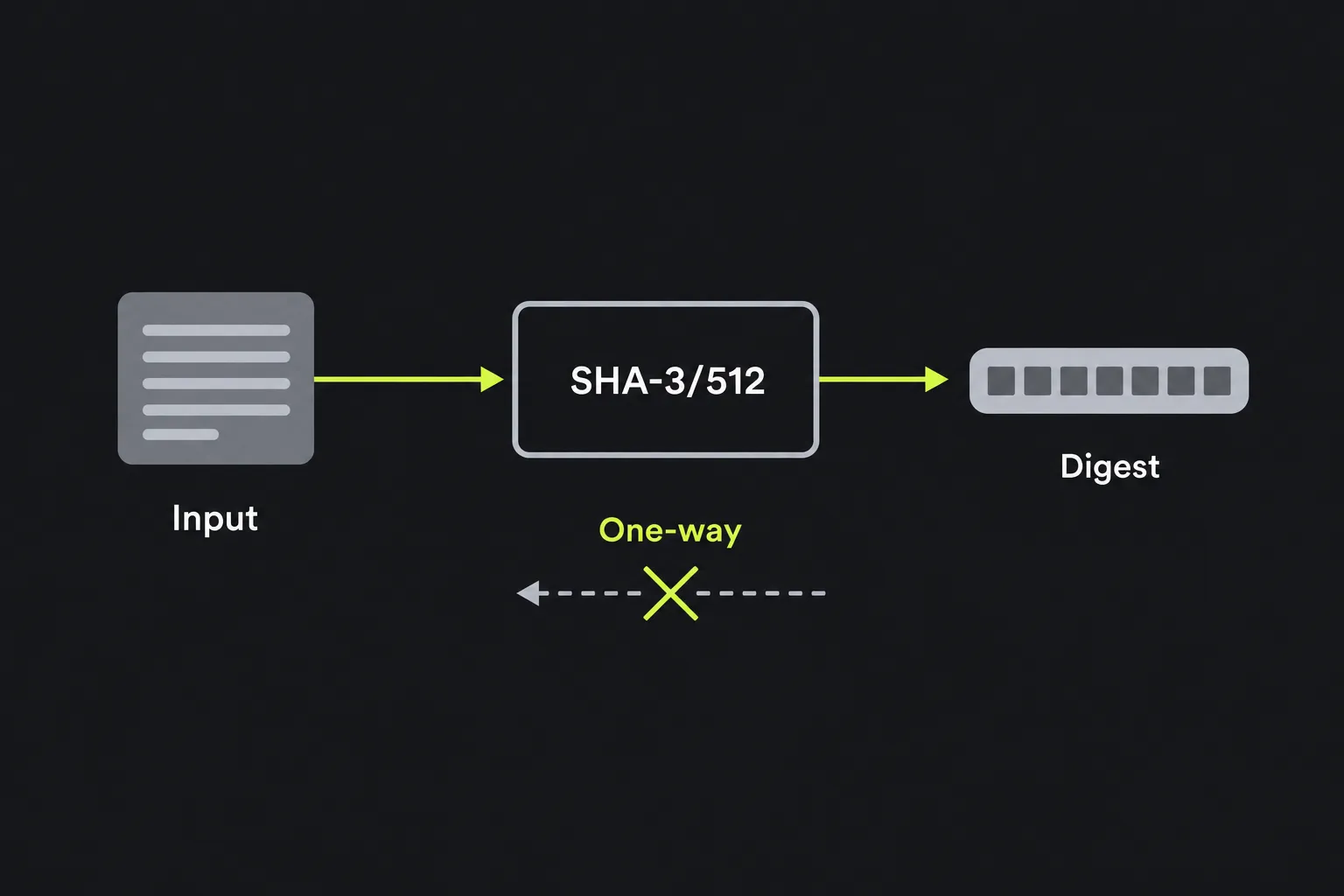
SHA3-512 is a cryptographic hash function that produces a fixed-length 512-bit digest, regardless of the amount of input.
SHA-3 is based on the Keccak algorithm designed by Guido Bertoni, Joan Daemen, Michaël Peeters and Gilles Van Assche. Keccak won NIST's SHA-3 competition in 2012, and NIST published the SHA-3 standard in 2015.
SHA3-512 is still considered secure for cryptographic hashing. It is not known to be broken or deprecated. Its ideal collision resistance is 256 bits, meaning that finding two inputs with the same digest should require work of the order of 2 to the power of 256 operations. The output contains 64 bytes and is normally written as 128 hexadecimal characters.
How do I generate a SHA-3/512 hash?
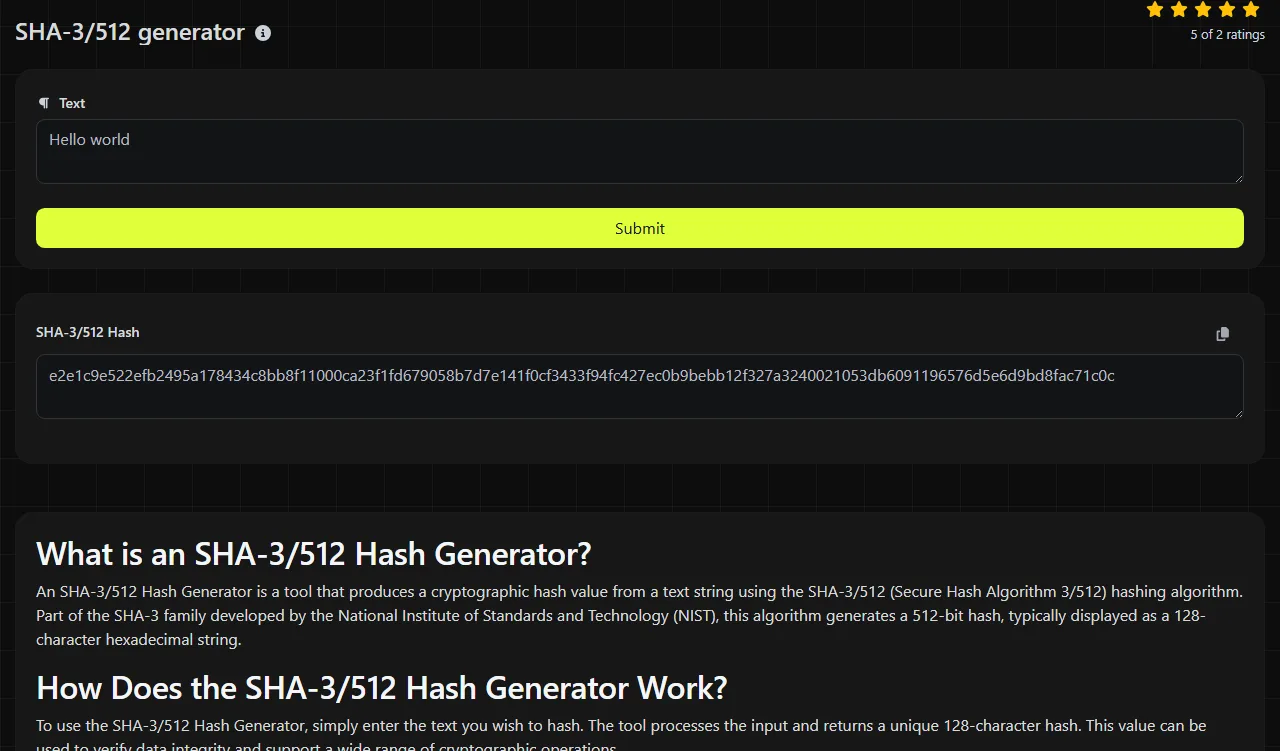
Provide the exact string you want to hash, then read the generated value from the SHA-3/512 Hash result field. The calculation takes place on the server. Your input travels to the server over HTTPS and is not stored.
- Copy the 128-character hexadecimal digest from the result field.
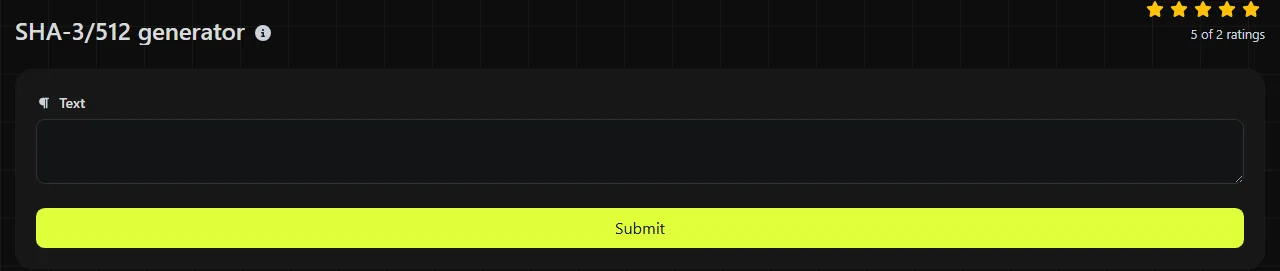
For example, an input such as invoice-2026-09 produces a SHA-3/512 result containing exactly 128 hexadecimal characters. Changing the input to invoice-2026-10 produces a different digest. The output cannot be inferred by editing part of the first result.
Can SHA-3/512 be decrypted or reversed?
No, a SHA3-512 hash cannot be decrypted because hashing does not create encrypted data with a decryption key. The digest does not contain a reversibly encrypted copy of the input.
With a plain SHA3-512 digest, an attacker can still guess possible inputs, hash each guess and compare the results. This works particularly well against short or predictable values such as common passwords, postcodes or six-digit codes. A 512-bit digest does not make weak input unpredictable.
For that reason, SHA3-512 must not be used directly to store passwords. Unlike a plain SHA3-512 digest, password storage needs a deliberately expensive password-hashing function with a unique salt. The Bcrypt generator is the relevant option when you specifically need a bcrypt password hash.
When should I use SHA-3/512?
Use SHA3-512 when a specification requires it, when you need a large SHA-3 digest, or when both systems involved explicitly support the same algorithm. Legitimate uses include the following.
- Recording checksums so that later changes to text or data can be detected.
- Identifying duplicate content where accidental collisions must be exceptionally unlikely.
- Maintaining compatibility with an existing database, API or archive format that stores SHA3-512 values.
- Building identifiers from data when exposing the original content is unnecessary, provided the input is not easily guessed.
SHA3-512 is less widely used for general file checksums than SHA-256, so check the receiving system before choosing it. A longer digest also needs more storage and bandwidth. SHA3-256 produces a 64-character hexadecimal digest, while SHA3-384 produces 96 characters. Choose SHA3-512 only when its 128-character output and security level suit the protocol or data model.
A plain SHA3-512 digest does not authenticate who created a message. If an attacker can alter both the data and its published checksum, they can calculate a new checksum too. Authenticated applications therefore normally use a keyed construction such as HMAC rather than this generator's plain SHA3-512 digest.
Input details and result format
SHA3-512 hashes bytes, so every character that contributes different bytes affects the result. Spaces, punctuation and capital letters are significant. The strings Report, report and report therefore produce three unrelated digests.
- Empty input has a defined SHA3-512 digest at algorithm level, although a form may require a value before submission.
The displayed digest is hexadecimal, using the digits 0 to 9 and letters a to f. Hexadecimal is an encoding of the 64-byte binary digest, not an additional hashing step.
Frequently asked questions
Is SHA-3/512 the same as SHA-512?
No. SHA3-512 belongs to the SHA-3 family and uses the Keccak sponge construction, while SHA-512 belongs to the older SHA-2 family. Both produce 512-bit results, but the same input gives different digests and the names are not interchangeable.
Do uppercase and lowercase hash characters represent different values?
No. In hexadecimal notation, an uppercase A and a lowercase a represent the same four-bit value. A system performing a case-sensitive text comparison may still report them as different strings, so converting both digests to one case can prevent a false mismatch.
Can I use this generator to check a downloaded file?
Only if you can provide exactly the same bytes as a string, which is unsuitable for most binary files. A file-checksum utility or an operating-system command that reads the file directly is more reliable for byte-for-byte checking because this tool accepts string input rather than file bytes.
Why does my hash differ from the value produced elsewhere?
Common causes are a different algorithm or different input bytes rather than a fault in SHA3-512. First confirm that the other system uses standard SHA3-512 rather than SHA-512 or the original Keccak-512 variant, which is not byte-for-byte identical to standard SHA3-512. Check for trailing spaces, a final newline and differing character encodings. For multiline input, also check Windows versus Unix line endings. Check for a Unicode byte-order mark only when one is present or may have been introduced.
Is it safe to hash confidential text online?
The input is sent to this server over HTTPS and is not stored, but it still leaves your device for processing. If policy or regulation prohibits transmitting the text to an external server, use a locally installed SHA-3 implementation instead. Before relying on a result, verify the exact input, algorithm name and expected 128-character format.
Popular Tools
Create your own custom signature and download it easily with our signature generator tool for personalized e-signatures.
Calculate the size of any text in Bytes (B), Kilobytes (KB), or Megabytes (MB) using our text size calculator tool.
Use the reverse IP lookup tool to find the domain or host associated with any IP address quickly and easily.
Use our ping tool to check the status and response time of any website, server, or port quickly and efficiently.
Digily Link's IP lookup tool provides detailed information about any IP address. Use this free online service to get comprehensive IP data.
Generate your free WhatsApp link instantly with our WhatsApp Link Generator. Add a custom message and start chats in one click. No login or coding required.