BMP to WebP
BMP to WebP is a free tool that converts bitmap image files into the WebP format for smaller, web-friendly images.
How do I convert a BMP file to WebP?
You can convert a BMP to WebP, and the file is processed entirely in your browser. The input image is never uploaded to a server, which is useful when it contains confidential artwork, internal screenshots or customer information.
Keep the original BMP until you have checked the converted image in the browser, content management system or application where it will be used. The WebP extension is normally written as .webp.
What changes when BMP is converted to WebP?
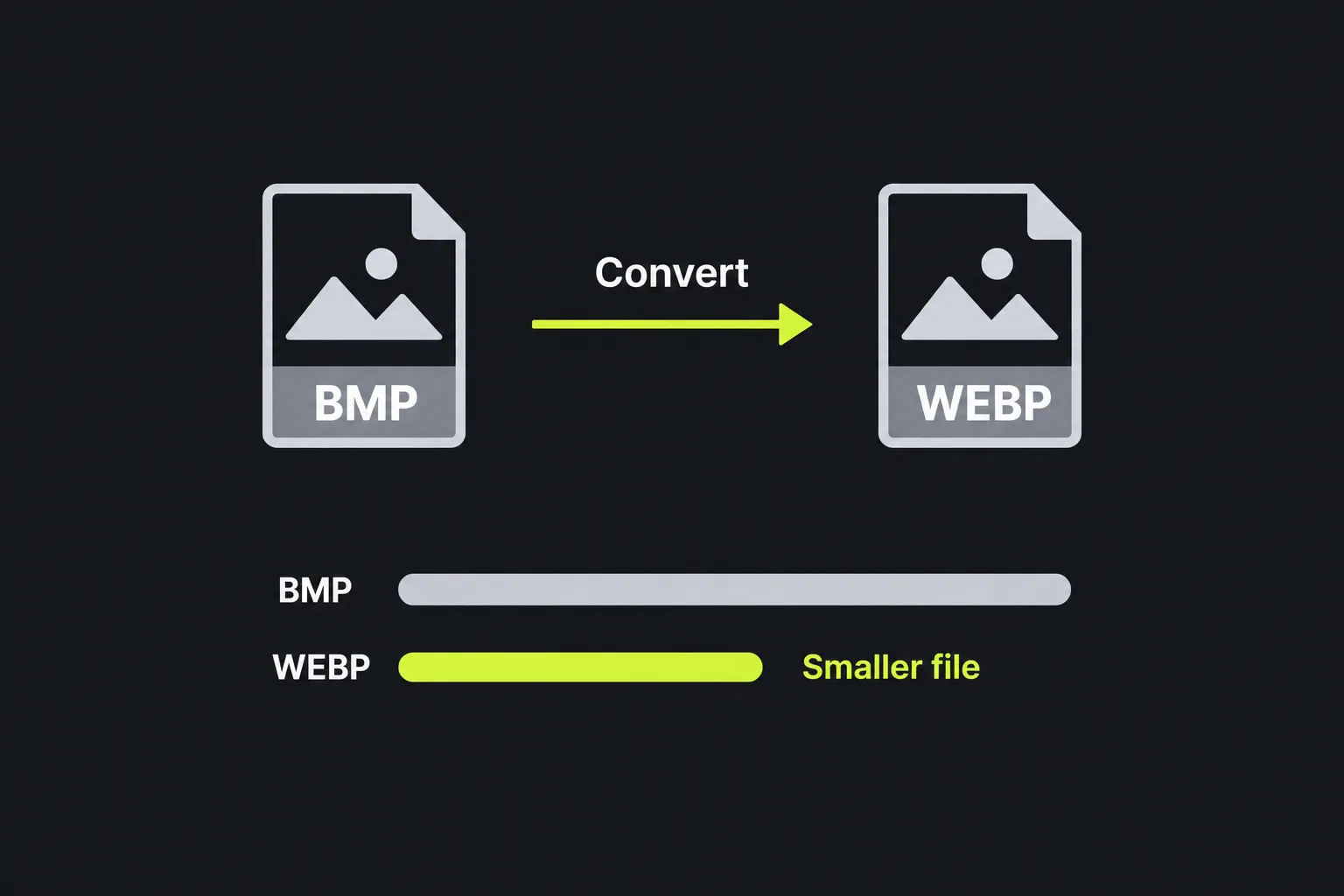
The image data is re-encoded using WebP compression instead of BMP's usual bitmap storage. That normally reduces the file size considerably, although the exact result depends on the BMP, its dimensions, its colour detail and the WebP encoding settings.
| Property | BMP | WebP |
|---|---|---|
| Compression | Commonly uncompressed, although some BMP variants use run-length encoding | Supports both lossy and lossless compression |
| Transparency | Some variants can contain an alpha channel, but support is inconsistent between applications | Supports alpha transparency |
| Animation | Does not provide standard multi-frame animation | The format supports animation |
| Typical file size | Often large because pixel data may be stored with little or no compression | Usually smaller for the same visible image |
| Browser use | Not a practical general-purpose web image format | Supported by current mainstream browsers |
| Desktop compatibility | Long-established and widely recognised by image software | May require a newer application or operating system component |
A single BMP contains one static image, so converting it cannot create an animation. WebP supports animated images as a format, but animation requires multiple frames and timing information from another source.
Transparency also needs checking after conversion. WebP can represent transparent and partly transparent pixels, but preservation depends on the source BMP's alpha data and how the converter interprets that BMP variant.
When does converting BMP to WebP make sense?
Conversion makes sense when a BMP needs to be displayed on a website or delivered with less storage and bandwidth overhead. BMP files are often produced by older Windows software, screen-capture systems, scanners or specialist applications, but their size makes them awkward as web assets.
- Convert interface graphics before adding them to a website or web application.
- Replace large BMP downloads in documentation with smaller browser-readable images.
- Prepare screenshots exported by legacy software for an online knowledge base.
- Reduce the storage used by a collection of bitmap images while retaining a web-compatible format.
Conversion is less suitable when another system explicitly requires BMP, such as an older application, embedded device or import process with a fixed file specification. Keep BMP in that workflow rather than assuming WebP will be accepted.
Converting a poor-quality or previously compressed image to lossless WebP does not restore missing detail. Lossless encoding preserves the pixels supplied to it; it cannot reconstruct texture, sharp edges or colour information already removed by an earlier lossy conversion.
What file size should I expect after conversion?
You should usually expect the WebP file to be smaller than the BMP, but there is no fixed reduction ratio. An uncompressed 24-bit BMP stores three bytes per pixel, plus headers and row padding. A 1,920 × 1,080 image therefore contains roughly 6 MB of raw pixel data before allowing for those structural details.
WebP compresses repeated colours, patterns and other image information rather than storing every pixel in the same direct form. Flat diagrams and screenshots may compress differently from photographs, grainy scans or images containing noise. A BMP that already uses run-length compression may show a less dramatic reduction than an uncompressed BMP.
WebP's lossy and lossless encoding modes also affect size. Lossy encoding generally produces a smaller file by discarding some image information. Lossless WebP retains the decoded pixel values but may be larger than a lossy version.
How should I check the converted image?
Open the WebP in its intended destination and compare it with the BMP at normal size and at higher magnification. Pay particular attention to text, thin lines, gradients and transparent edges, as these areas make conversion problems easier to spot.
- Confirm that the converted WebP contains the whole BMP image and has the same orientation.
- Look for halos or coloured fringes around transparent objects.
- Check small lettering for blur or block-like compression marks.
- Test the converted WebP in the target browser, website builder or content management system.
- Compare the BMP and converted WebP file sizes rather than assuming the WebP is smaller.
If the destination does not accept WebP, BMP to JPG may suit photographs and other opaque images. BMP to ICO is the relevant route when the source is intended for a Windows icon or favicon workflow.
Frequently asked questions
Can I make a WebP file by renaming .bmp to .webp?
No. Changing a BMP file's extension to .webp does not change the image encoding, so software will still find BMP data inside the file. The pixels must be decoded from BMP and encoded again as WebP.
Will WebP preserve the colour profile and image metadata?
WebP can carry some metadata, including EXIF, XMP and ICC profile information, but converter support varies.
Why does an older program refuse to open the WebP?
The application may pre-date WebP support or may rely on an older image-decoding component. Try opening the file in a current browser or image editor; if the receiving system cannot be updated, use a format it explicitly supports.
Can a monochrome or indexed-colour BMP be converted?
WebP does not preserve the BMP's original storage structure merely by conversion. A one-bit or palette-based source may be represented differently after encoding even when it looks the same, so do not use the WebP as a substitute where exact bit depth or palette indexes form part of a technical requirement.
Should I delete the BMP after converting it?
Keep the BMP if it is the original source, is needed by legacy software or may be converted again later. Store the WebP as the delivery copy and retain the source separately until compatibility, transparency and visual quality have been checked.
Similar Tools
Easily convert BMP image files to GIF format with our BMP to GIF converter tool for creating animated images.
Easily convert BMP image files to PNG format with our BMP to PNG converter tool for high-quality images.
Easily convert BMP image files to JPG format with our BMP to JPG converter tool for versatile image usage.
Popular Tools
Create your own custom signature and download it easily with our signature generator tool for personalized e-signatures.
Calculate the size of any text in Bytes (B), Kilobytes (KB), or Megabytes (MB) using our text size calculator tool.
Use the reverse IP lookup tool to find the domain or host associated with any IP address quickly and easily.
Use our ping tool to check the status and response time of any website, server, or port quickly and efficiently.
Digily Link's IP lookup tool provides detailed information about any IP address. Use this free online service to get comprehensive IP data.
Generate your free WhatsApp link instantly with our WhatsApp Link Generator. Add a custom message and start chats in one click. No login or coding required.