BMP to ICO
BMP to ICO is a free tool that converts a BMP image into an ICO file for use as a Windows icon or website favicon.
How do I convert a BMP file to ICO?
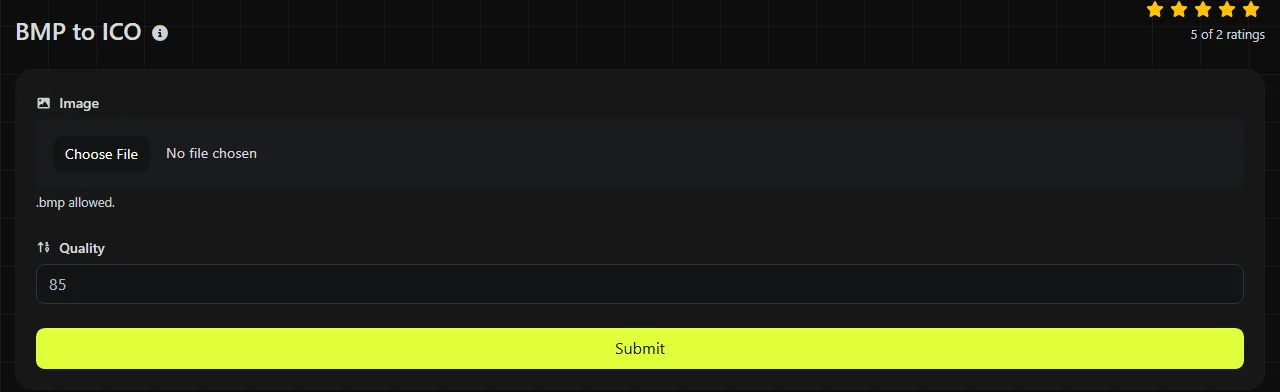
Choose the BMP image, run the conversion, then save the resulting ICO file to your device. The BMP-to-ICO conversion takes place entirely in your browser, and the BMP file is never uploaded to a server.
- Select the BMP file you want to convert.
- Start the BMP-to-ICO conversion.
- Save the generated ICO file and check it in the application or browser where you intend to use it.
For a favicon, begin with a square image. A rectangular source may be stretched, cropped or padded by icon software, depending on how it is later processed and displayed. Simple shapes and clear edges are usually easier to make out at small icon sizes than photographs or detailed illustrations.
What changes when BMP is converted to ICO?
The image is placed into the ICO icon format, which is designed to hold icon images and can support several resolutions and colour depths in one file. A BMP is usually a single bitmap image, commonly stored without compression, although some BMP variants use run-length encoding.
- Transparency: ICO supports transparent areas, which are useful around a non-rectangular logo or symbol. BMP transparency varies by BMP version and application support. Converting an opaque BMP does not automatically identify and remove its background.
- Animation: Standard BMP and ICO files are not animated. Windows uses other formats, such as ANI, for animated pointers and cursors.
- Compression: BMP files are commonly uncompressed. An ICO file is a container whose images may use DIB-formatted image data or PNG data. The exact internal encoding depends on the converter.
- Browser use: ICO has long-standing support as a favicon format. BMP is not a sensible favicon choice because support and handling are less consistent, and its uncompressed data can be wasteful.
- Platform use: ICO is closely associated with Windows application, shortcut and folder icons. Other operating systems may display ICO files, but often use their own preferred icon formats.
For example, a 32 × 32 pixel BMP of a simple application mark can become an ICO suitable for an icon slot. The output has an ICO file structure rather than a standalone BMP structure. Conversion alone does not guarantee that the file contains additional sizes such as 16 × 16 or 48 × 48 pixels.
When does converting BMP to ICO make sense?
Conversion makes sense when you need to use an existing bitmap with software that expects an ICO file. Common cases include a Windows desktop application, a shortcut icon, a legacy website favicon or a development project whose build process requires an .ico asset.
It is less suitable when the BMP is a photograph or contains fine detail. Small icons have very little room, so thin text and intricate imagery may become unclear. Editing and simplifying the source before conversion usually gives a more usable result.
Converting to ICO also does not improve the original picture. If the BMP was created from a low-quality JPEG, saving it in a lossless icon representation cannot restore detail removed by the earlier lossy compression. Any blockiness, ringing or blur remains part of the pixels.
What file size should I expect?
The ICO file will often be smaller than an uncompressed BMP if its image data uses PNG compression, but there is no fixed size reduction. Dimensions, colour depth, transparency, internal encoding and the number of stored icon sizes all affect the result.
A single small icon may occupy little space, while a multi-resolution ICO containing 16 × 16, 32 × 32, 48 × 48 and 256 × 256 images can be larger because it stores several representations. Even then, it may work better in Windows because the system can select an appropriate image instead of scaling one bitmap for every context.
If file size is the main concern and the image is for a web page rather than an icon slot, ICO may not be the right target. BMP to WebP is more appropriate for general web imagery, while BMP to PNG suits lossless images that need reliable transparency.
Favicon and Windows icon checks
Check the actual output at small sizes rather than judging it only in an enlarged preview. Icon defects often become visible only when the file is placed in a browser tab, Windows shortcut or application title bar.
- Use a square source and keep the main symbol away from the outermost pixels.
- Avoid small lettering, hairline strokes and low-contrast details.
- Check whether the background should be transparent before conversion.
- Keep the original BMP in case you need to edit the artwork or create another icon size.
- Do not rename image.bmp to image.ico. Changing a BMP extension to ICO does not change the file structure.
Favicons can also be cached by browsers. If an updated ICO appears unchanged, clear the relevant site data, use a private browsing window or temporarily change the favicon filename in the page markup.
Frequently asked questions
Can one ICO file contain several icon sizes?
Yes. The ICO format can contain multiple images with different dimensions and colour depths. However, do not assume every converter creates a multi-resolution file, so inspect the result with an icon editor if several sizes are required.
Can I create transparency from a BMP with a white background?
Not merely by changing the format. The white pixels must be deliberately marked or edited as transparent, otherwise they remain white in the ICO. For clean edges, edit the source in an image application that supports an alpha channel before creating the icon.
Why does my ICO look blurred in Windows?
Windows may be scaling an icon image because the ICO does not contain the size needed for that particular view. Creating separate, carefully adjusted images for common icon dimensions generally produces clearer results than relying on automatic scaling.
Does ICO support 256 × 256 images?
Yes. Modern ICO files can include a 256 × 256 image, commonly stored internally as PNG data. Older software may prefer smaller DIB entries, so a multi-size ICO is often needed when compatibility with legacy applications matters.
Does an ICO contain a complete BMP file?
Not when it uses a DIB entry. DIB-formatted image data resembles the image data in a BMP, but it omits the standalone BMP file header and is stored within the ICO container. ICO can alternatively store PNG data.
Will changing the file extension create a valid ICO?
No. BMP and ICO have different headers and internal structures, even though ICO may contain DIB-formatted image data. A real conversion is required before software can reliably recognise and use the file.
Similar Tools
Easily convert BMP image files to GIF format with our BMP to GIF converter tool for creating animated images.
Easily convert BMP image files to PNG format with our BMP to PNG converter tool for high-quality images.
Easily convert BMP image files to JPG format with our BMP to JPG converter tool for versatile image usage.
Popular Tools
Create your own custom signature and download it easily with our signature generator tool for personalized e-signatures.
Calculate the size of any text in Bytes (B), Kilobytes (KB), or Megabytes (MB) using our text size calculator tool.
Use the reverse IP lookup tool to find the domain or host associated with any IP address quickly and easily.
Use our ping tool to check the status and response time of any website, server, or port quickly and efficiently.
Digily Link's IP lookup tool provides detailed information about any IP address. Use this free online service to get comprehensive IP data.
Generate your free WhatsApp link instantly with our WhatsApp Link Generator. Add a custom message and start chats in one click. No login or coding required.