Email extractor
Email extractor is a free tool that finds email addresses in text and reports how many matches it found.
How do I extract email addresses from text?
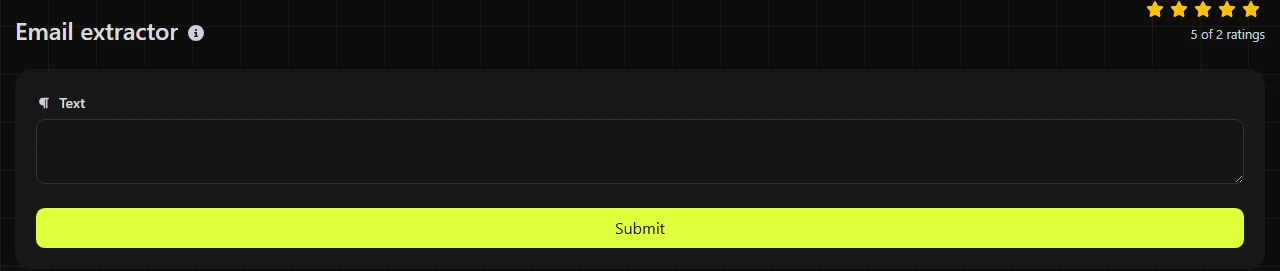
Paste or enter the source text, run the extraction, then review the returned addresses and the Count value.
- Copy the text containing the email addresses.
- Check the matches before copying them into a spreadsheet, contact system or mailing platform.
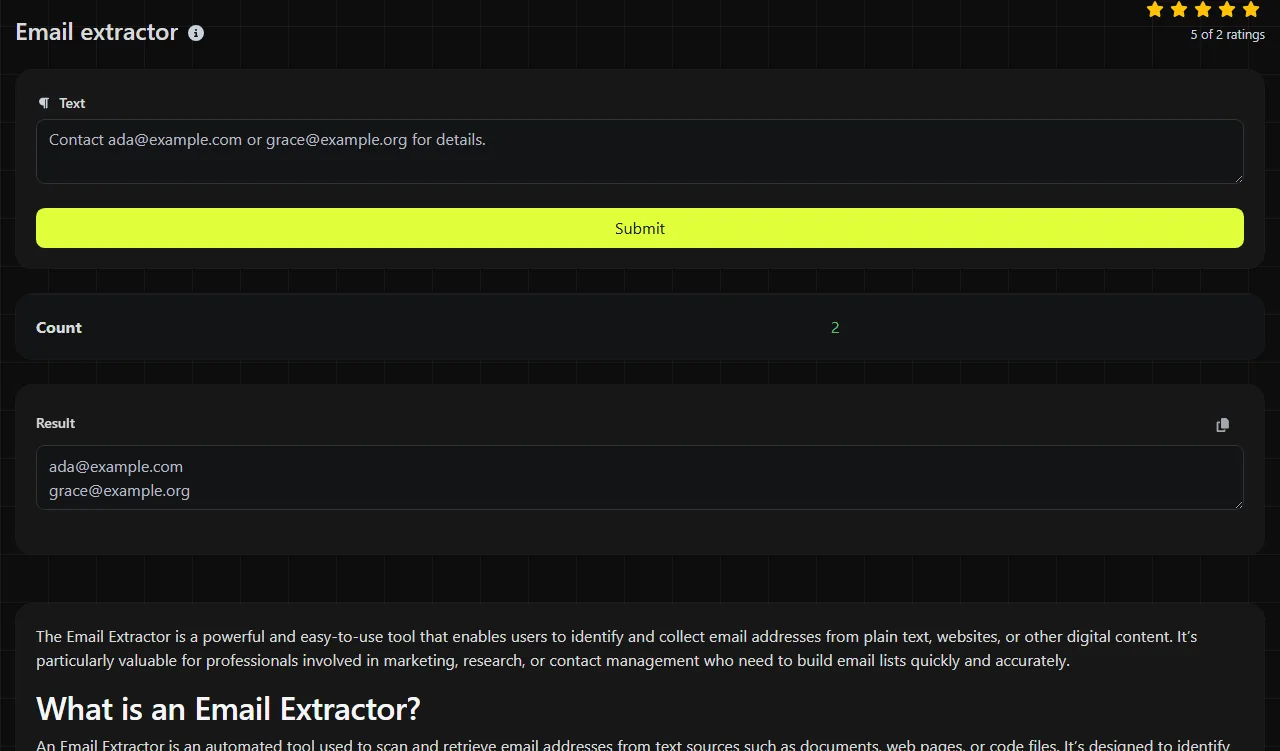
For example, the input "Accounts accounts@example.com, support support@example.co.uk" contains two conventional email addresses. The extracted list should contain accounts@example.com and support@example.co.uk, with a count of 2.
Keep an untouched copy of the source text until you have checked the extracted email addresses. If an address looks incomplete, the original line often shows whether punctuation, a line break or formatting caused the problem.
Where does an email extractor save time?
It saves time when addresses are mixed with names, notes, log entries or other text that would otherwise need to be searched line by line.
- Excel and Google Sheets exports may contain names, telephone numbers and email addresses in the same notes column. Extract the addresses before preparing a separate email column.
- Microsoft Word mail merge requires a suitably structured data source and, for email merges, a field containing recipient addresses. Extraction can help turn copied correspondence or registration notes into a list for review.
- Gmail and Outlook message headers can contain several addresses among display names and routing details. Paste only the relevant header text rather than an entire sensitive conversation.
- WordPress form exports sometimes include labels and free-text answers around contact details. Extraction isolates address-shaped strings before import elsewhere.
- Support and server logs may contain addresses inside longer entries. Review the context afterwards because logs can include test accounts and automated senders.
If the same address appears on several lines, use Duplicate lines remover after arranging the extracted results one per line. Text separator may help when a destination system expects commas or another delimiter.
How should I read the result?
The Count field shows how many email-address matches the extraction returned. It does not establish that every address belongs to a different person, is currently active or can receive mail.
Extraction is pattern matching, not mailbox verification. A correctly formed address may refer to a closed account, a mistyped domain or a non-existent mailbox. Conversely, unusual but valid email syntax may fall outside the regular expression used by a simple extractor.
Awkward input and false matches
Email addresses commonly appear beside brackets, commas and full stops. A matching pattern normally aims to identify the address rather than the surrounding prose, but you should still inspect punctuation at the beginning and end of each result.
Numbers are valid in many parts of an address, and plus addressing such as name+receipts@example.com is widely used. Accented characters, internationalised domain names, quoted local parts and other less common forms need more careful handling. Support for them depends on the exact matching pattern, so do not assume every technically valid address will be recognised.
Obfuscated text such as "name at example dot com" is not a literal email address and may not match. Addresses split by line breaks can also be missed. Very long input may be checked in smaller sections when you need to trace each extracted email match back to its source.
Is my text sent to a server?
Yes, the work is done on the server. Your input travels to the server over HTTPS and is not stored.
Email addresses can be personal data, and source text may also contain names, account details or private messages that are unrelated to the extraction task.
Frequently asked questions
Can I extract addresses from HTML source?
You can paste HTML as text, and literal addresses may appear inside content or mailto values. An address written with HTML entities, generated by JavaScript or deliberately concealed may not exist as one continuous match.
Does an extracted address mean I can add it to a marketing list?
No. Finding an address does not provide consent or another lawful basis for using it. Check the UK GDPR and Privacy and Electronic Communications Regulations requirements that apply to your purpose and recipient type.
Should email addresses be converted to lower case?
Domain names are case-insensitive, but the part before the @ sign is technically allowed to be case-sensitive. Standards require the case of the part before the @ sign to be preserved, so automatically changing every address is not guaranteed to be safe. Preserve the original form unless the receiving system has a documented normalisation rule.
Why was an international email address missed?
International email addresses can contain Unicode characters or an internationalised domain. Many extraction patterns focus on familiar ASCII forms. Where appropriate, using an internationalised domain's IDNA A-label form may make the domain easier to process in systems with limited Unicode support.
Final checks
Remove duplicate extracted email addresses, compare a sample of the extracted addresses with the original text and check the destination system's required email-address format. Before sending mail, confirm that each address is relevant, lawfully obtained and suitable for the intended message.
Popular Tools
Create your own custom signature and download it easily with our signature generator tool for personalized e-signatures.
Calculate the size of any text in Bytes (B), Kilobytes (KB), or Megabytes (MB) using our text size calculator tool.
Use the reverse IP lookup tool to find the domain or host associated with any IP address quickly and easily.
Use our ping tool to check the status and response time of any website, server, or port quickly and efficiently.
Digily Link's IP lookup tool provides detailed information about any IP address. Use this free online service to get comprehensive IP data.
Generate your free WhatsApp link instantly with our WhatsApp Link Generator. Add a custom message and start chats in one click. No login or coding required.