SHA-3/224 generator
SHA-3/224 generator is a free tool that converts string input into a fixed-length SHA-3/224 cryptographic hash.
What is a SHA-3/224 hash?
The site labels this tool SHA-3/224, while FIPS 202 names the function SHA3-224.
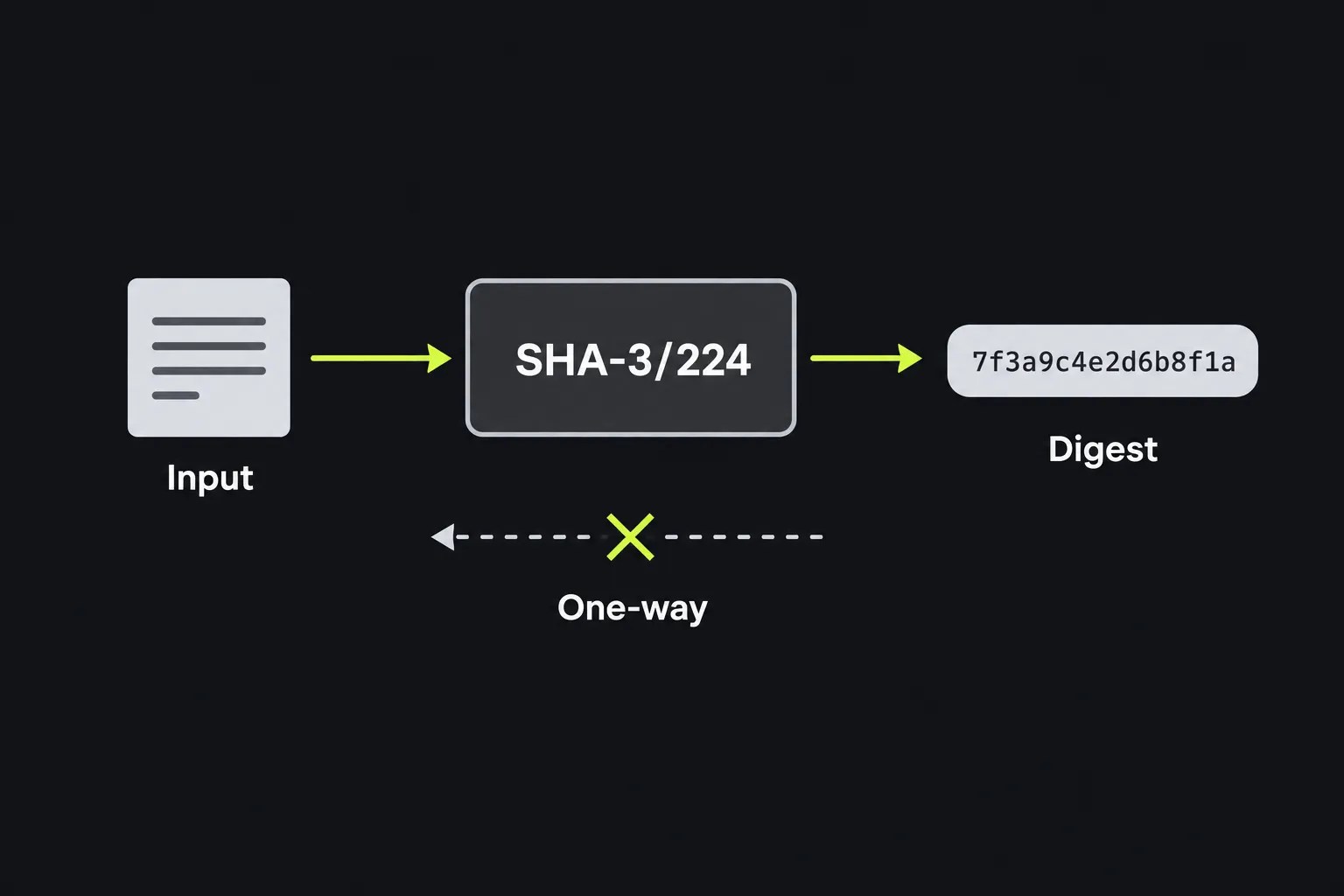
A SHA-3/224 hash is a 224-bit fingerprint calculated from a sequence of bytes. Hashing with SHA3-224 is one-way, so the digest does not contain a recoverable copy of the original text. Whatever the input length, SHA-3/224 always produces 28 bytes, usually written as 56 hexadecimal characters.
SHA-3 comes from Keccak, designed by Guido Bertoni, Joan Daemen, Michaël Peeters and Gilles Van Assche. NIST selected Keccak as the SHA-3 competition winner in 2012 and published the SHA-3 standard in 2015. SHA3-224 uses a sponge construction, which differs from the construction used by SHA-2.
SHA-3/224 is still considered secure for general hashing. There are no known practical attacks that break the full algorithm. Its 224-bit output provides about 112 bits of collision resistance, because collision attacks generally require roughly the square root of the possible output space. Applications needing a larger security margin commonly choose SHA-3/256 instead.
How do I use the SHA-3/224 generator?
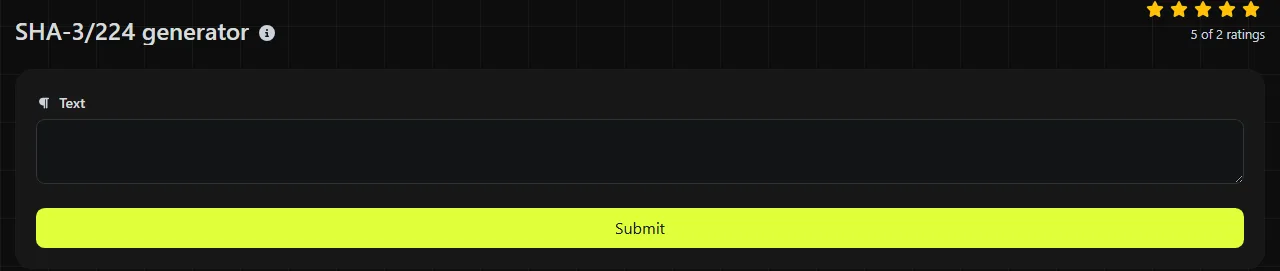
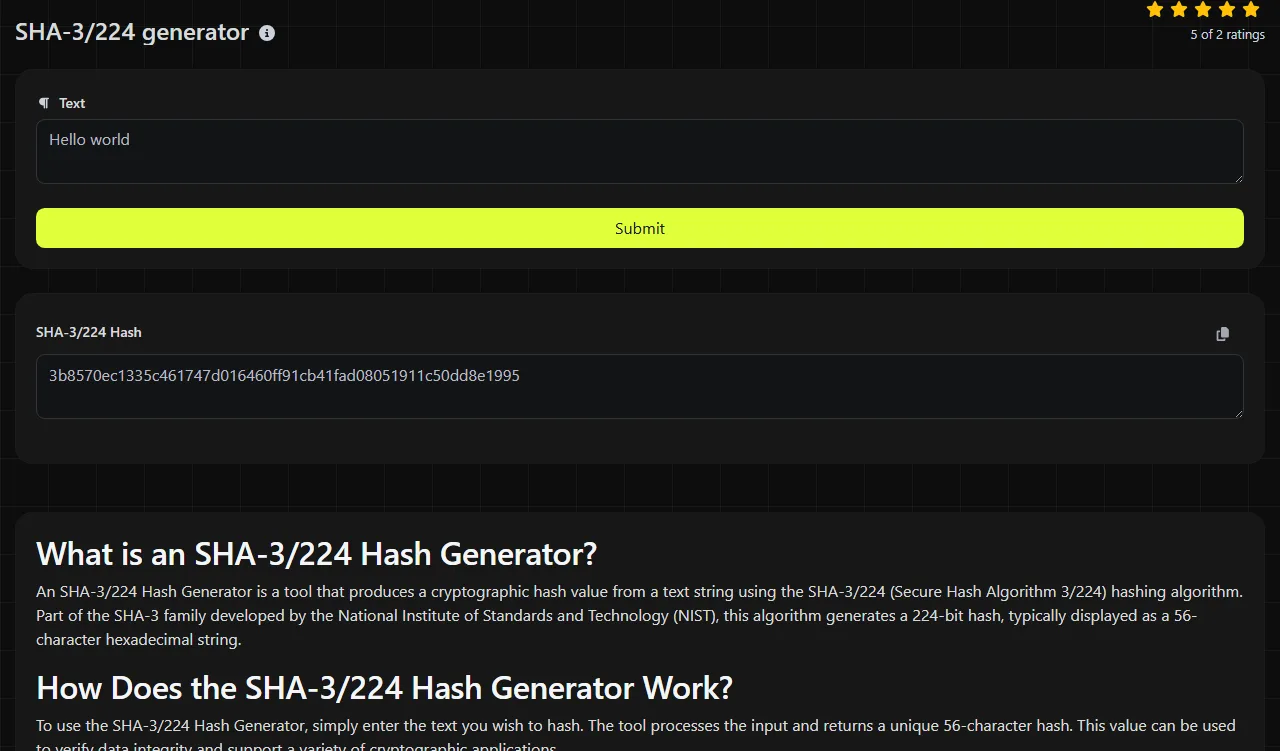
Enter the exact string that needs hashing and generate the result. The tool returns a SHA-3/224 Hash containing 56 hexadecimal characters.
The calculation happens on the server. Your input travels to the server over HTTPS and is not stored. Although HTTPS protects the connection in transit, avoid submitting passwords, private keys, recovery phrases or other secrets to an online hashing tool.
When comparing the 56-character SHA3-224 result with an expected checksum, copy the whole digest. One missing character changes the value and makes the comparison invalid.
Can SHA-3/224 be decrypted or reversed?
No, a SHA-3/224 hash cannot be decrypted because hashing is not encryption and there is no decryption key. The only general way to identify an unknown input from its SHA3-224 digest is to try possible values, hash each one and compare the results.
This distinction matters for short or predictable inputs hashed with SHA3-224. An attacker may guess a postcode, common password or six-digit code even though the algorithm itself has not been reversed. A SHA3-224 hash therefore does not make low-entropy data secret.
Collisions are theoretically possible because unlimited inputs are mapped to a finite 224-bit space. Finding a collision for full SHA-3/224 is not currently practical, but that does not turn the digest into encrypted storage.
When should I use SHA-3/224?
Use SHA-3/224 when a specification, existing system or supplied checksum explicitly requires that variant. Its shorter digest can suit formats with a fixed 224-bit field, but it is less widely encountered than SHA-3/256.
- SHA3-224 checksum verification means calculating a digest and comparing it with a value published by a trusted source.
- Deduplication means identifying matching records or content without repeatedly comparing the full input. Applications using SHA3-224 should still handle the theoretical possibility of a collision.
- Legacy compatibility applies where an existing database, protocol or integration already stores SHA-3/224 values.
- Test fixtures can use known inputs and digests to check that another SHA3-224 implementation has been configured correctly.
Do not use SHA-3/224 to store passwords. SHA3-224 is deliberately fast, which also lets an attacker test guesses quickly. Password storage needs a dedicated, slow password-hashing scheme such as Argon2id, scrypt, bcrypt or PBKDF2 with suitable parameters and a unique salt.
For a new general-purpose checksum format, SHA-3/256 gives a longer digest and is more commonly selected. The SHA-3/256 generator is suitable when no external requirement fixes the output at 224 bits. SHA-512/224 has the same digest length but belongs to the SHA-2 family, so its output is not interchangeable with SHA-3/224.
Exact input and worked examples
For this generator's string input, SHA3-224 processes bytes, so every character and its encoding matter. Two strings that look similar can produce unrelated SHA3-224 digests.
- The input invoice produces a 56-character hexadecimal digest.
- The input Invoice produces a different digest because uppercase and lowercase letters are different bytes.
- The inputs order 42 and order42 differ because the space is part of the data.
- In this generator's input, punctuation and line endings count. paid, paid. and a line containing paid followed by a newline all hash differently.
- An empty input has a valid SHA-3/224 digest. It does not produce an empty result.
- Numbers are hashed as their encoded text when supplied to this generator as a string. 007 and 7 are different inputs.
To reproduce the bytes submitted to this server-side SHA3-224 generator, accented and non-Latin text must use the same character encoding in every system, normally UTF-8. Unicode can also represent some visible characters in more than one byte sequence. If another application normalises text before hashing, both sides must use the same normalisation form.
Input length does not change the output length. A very long string still produces 56 hexadecimal characters, although processing and transmitting it takes more time than handling a short string.
Frequently asked questions
Is SHA-3/224 the same as SHA-224?
No. SHA-224 is a SHA-2 variant, while SHA-3/224 uses the Keccak-based SHA-3 construction. Both produce 224-bit digests, but the values are completely different for the same input.
Does uppercase hexadecimal change the hash?
No. In this tool's SHA-3/224 Hash field, uppercase and lowercase hexadecimal are alternative written forms of the same digest bytes. A comparison may still fail if software treats the text as case-sensitive, so normalise both values to one case before comparing them.
Is SHA-3/224 vulnerable to length-extension attacks?
Standard SHA-3 hashes are not susceptible to the classic length-extension attack that affects certain Merkle–Damgård hashes. SHA3-224's resistance to this attack does not mean a plain hash is always a suitable message authentication code. Use a specified MAC construction where authentication is required.
Can I compare SHA-3/224 results from different programming languages?
Yes, implementations conforming to the formal SHA3-224 algorithm produce the same digest from identical bytes. For this generator's string input, check the character encoding, newline convention and whether either implementation hashes a textual hexadecimal representation rather than the underlying bytes.
Can this generator hash an uploaded file?
The tool is specified for string input, so do not assume that it reads file bytes directly. For a file checksum, use a file-aware hashing utility or command-line implementation and select SHA3-224 explicitly.
Final checks
Confirm that the required algorithm is SHA-3/224 rather than SHA-224, SHA-512/224 or SHA-3/256. Preserve spaces, punctuation, capitalisation and line endings, then verify that the result contains exactly 56 hexadecimal characters. For repeatable checks across systems, record the input encoding and any Unicode normalisation applied before hashing.
Popular Tools
Create your own custom signature and download it easily with our signature generator tool for personalized e-signatures.
Calculate the size of any text in Bytes (B), Kilobytes (KB), or Megabytes (MB) using our text size calculator tool.
Use the reverse IP lookup tool to find the domain or host associated with any IP address quickly and easily.
Use our ping tool to check the status and response time of any website, server, or port quickly and efficiently.
Digily Link's IP lookup tool provides detailed information about any IP address. Use this free online service to get comprehensive IP data.
Generate your free WhatsApp link instantly with our WhatsApp Link Generator. Add a custom message and start chats in one click. No login or coding required.