QR code reader
QR code reader is a free tool that extracts the data stored in a QR code image.
Is my QR code image uploaded?
No. The work is done entirely in your browser, and the input image is never uploaded to a server. This applies to screenshots, downloaded images and photographs selected from your device.
Local processing is useful when a code contains private material such as Wi-Fi credentials, contact details or an internal web address. The decoded content still appears on your screen, so consider who can see the device and avoid copying sensitive results into shared documents or messaging channels.
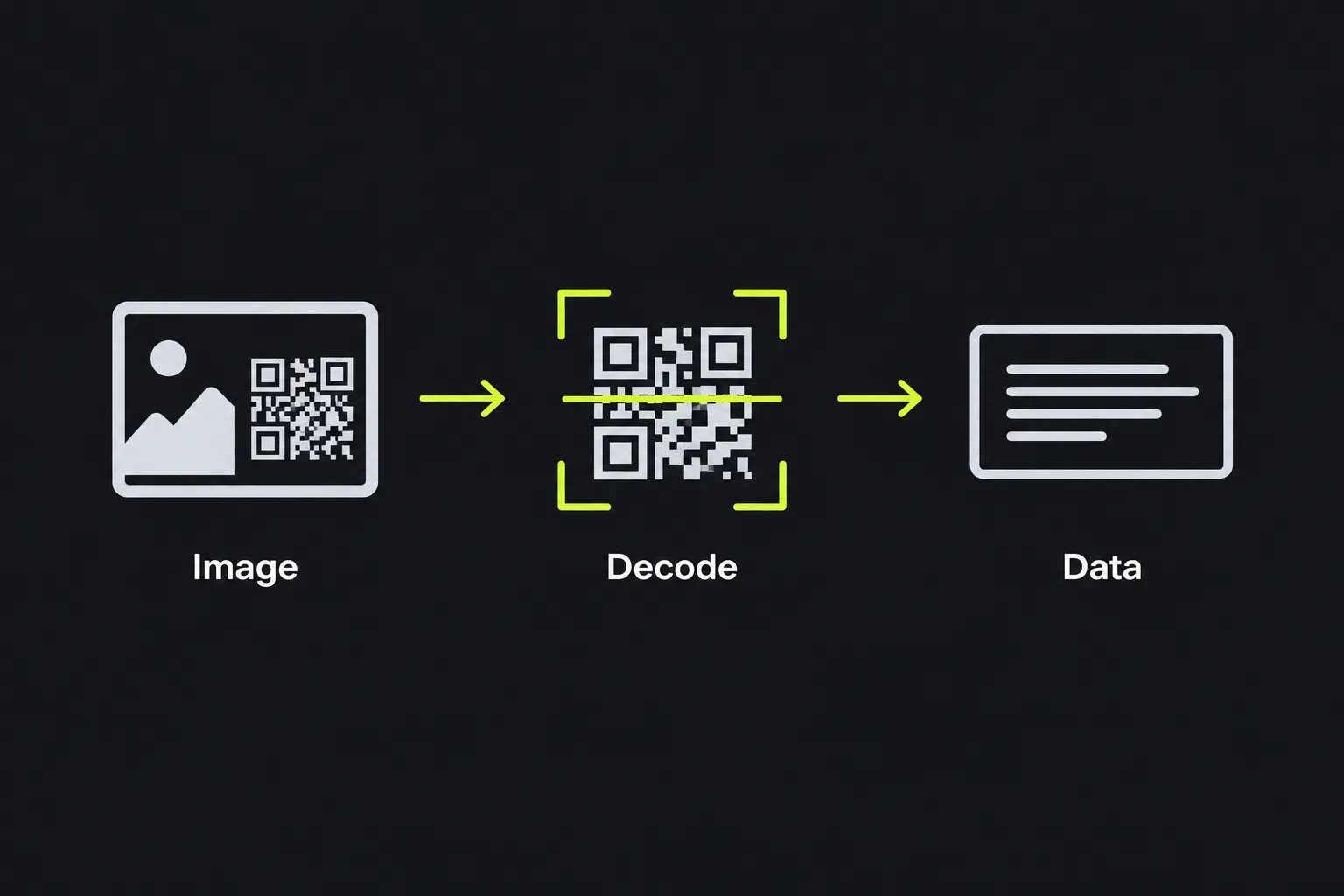
How do I read a QR code from a screenshot or photo?
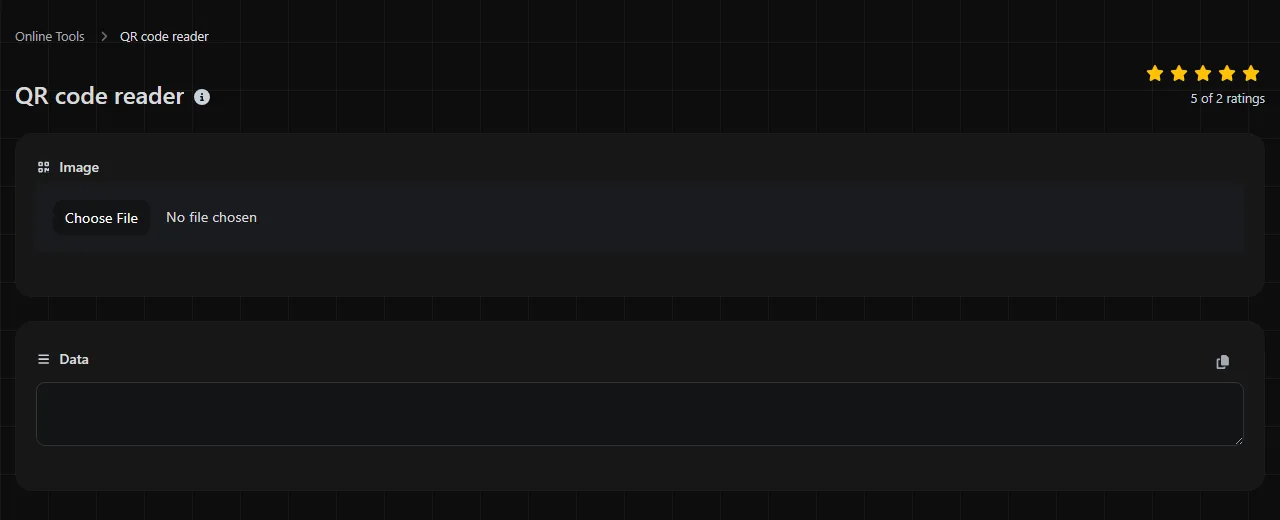
Select the image in the QR code image field, then read the extracted content in the Data result.
- Save the screenshot or photograph as an image file. On a phone, it will normally be available through the device's photo or file picker.
- Select that file in the QR code image field.
- Wait for the QR decoding result.
- Check the Data field before opening, copying or acting on the result.
On a desktop computer, you can take a screenshot of a QR code shown in a document, email or website and select the resulting file. On a phone, take a screenshot when the code is displayed on the same device, then select that screenshot from your photos. For a printed code, take a straight, well-lit photograph with the complete square in view.
If you crop an image, leave some plain space around all four sides of the QR code. This border is called the quiet zone and helps a decoder distinguish the symbol from nearby text and graphics.
What information can a QR code contain?
A QR code can contain text, a web address or a formatted instruction that another application may recognise. The reader extracts the stored data; what happens next depends on the content and the application used to interpret it.
- Web addresses such as https://www.gov.uk/.
- Wi-Fi details, commonly stored in a string containing the network name, security type and password.
- Contact cards in formats such as vCard or MeCard, with names, telephone numbers and email addresses.
- Communication actions using schemes such as mailto:, tel: or sms:.
- Locations expressed as coordinates, sometimes using a geo: address.
- Product identifiers, including a GTIN or other stock number stored as text or in a recognised GS1 format.
- Plain text such as an event reference, collection code, serial number or short set of instructions.
Spaces, punctuation and line breaks are part of the payload rather than decoration. Numbers remain text unless another system chooses to interpret them numerically. Accented letters and non-Latin scripts can be stored as byte data, although poorly specified character encoding can cause garbled text when a generator and reader make different assumptions.
A QR code visible in a photograph does not automatically contain the photograph's camera details. Information such as capture time, camera model or GPS metadata may instead be stored in the image file's EXIF fields. Use an Exif reader when that is the information you need.
Reading the decoded result safely
The Data result shows the content extracted from the symbol. A text payload should remain text, while a URL will normally begin with a scheme such as https://.
For example, a QR code containing https://www.nhs.uk/ should decode to that address. A Wi-Fi code might produce text in the form WIFI:T:WPA;S:GuestNetwork;P:example-password;;. The second result is a formatted instruction, and compatibility depends on whether the receiving device recognises that convention.
A decoded link can lead anywhere. Read the full address before opening it, especially when the code came from a poster, parcel, parking meter or unsolicited message. Shortened links conceal the final destination, while lookalike domain names can replace letters with similar characters. Decoding a URL does not establish that the site is genuine or safe.
Longer payloads create denser QR symbols, particularly when they include mixed punctuation or international characters. Dense codes need a clearer image and more pixels than short numeric codes. An empty or apparently blank result is not useful evidence that the image is harmless, since decoding may have failed or the payload may contain non-visible characters.
Why will my QR code not decode?
A QR code commonly fails to decode because the image is blurred, cropped, damaged, too small or affected by poor contrast. The tool cannot recover data reliably when too much of the symbol is missing.
- Retake the photograph with the camera parallel to the code rather than at a steep angle.
- Move far enough back for the whole square and its quiet zone to fit in the frame.
- Avoid glare across laminated labels and bright reflections on phone screens.
- Use the original screenshot rather than an image compressed repeatedly through messaging applications.
- Remove visual clutter by cropping around the code, but do not cut through its outer edges or quiet zone.
- Try a higher-resolution source when the individual black and white modules have merged into grey blocks.
QR error correction can reconstruct a limited amount of missing information, but it is not a guarantee. A folded label, heavy overprinting or damage across the position markers may still make the symbol unreadable. Decorative codes with low contrast, rounded modules or a large central logo also leave less margin for poor photography.
Frequently asked questions
Does the reader work without an internet connection?
The QR code image is decoded entirely in your browser and is never uploaded to a server. This does not guarantee that the QR code reader page can be loaded without an internet connection.
Can a QR code be password-protected?
The QR format does not provide native password protection. A creator can place encrypted text inside a code, but the decoded result will remain unreadable until compatible software decrypts it with the correct key or password.
Is a QR code the same as a product barcode?
A QR code is itself a two-dimensional barcode and can also be used as a product barcode, including in GS1 applications. However, retail products commonly use linear formats such as EAN-13. If the image contains vertical bars rather than a square grid, use a Barcode reader instead.
Can scanning a code reveal my identity?
Reading the image locally does not send it to a server. Opening a decoded web address is a separate action, and the destination site may receive ordinary connection information or a unique tracking identifier contained in the URL. Check the result first and remove personal or campaign-specific parameters before sharing it with somebody else.
Similar Tools
Upload a barcode image and easily extract the embedded data with our barcode reader tool for quick information retrieval.
Popular Tools
Create your own custom signature and download it easily with our signature generator tool for personalized e-signatures.
Calculate the size of any text in Bytes (B), Kilobytes (KB), or Megabytes (MB) using our text size calculator tool.
Use the reverse IP lookup tool to find the domain or host associated with any IP address quickly and easily.
Use our ping tool to check the status and response time of any website, server, or port quickly and efficiently.
Digily Link's IP lookup tool provides detailed information about any IP address. Use this free online service to get comprehensive IP data.
Generate your free WhatsApp link instantly with our WhatsApp Link Generator. Add a custom message and start chats in one click. No login or coding required.