Meta tags checker
Meta tags checker is a free tool that retrieves and verifies the meta tags of any website so you can review how a page describes itself to search engines and other services.
What does a meta tag check look for?
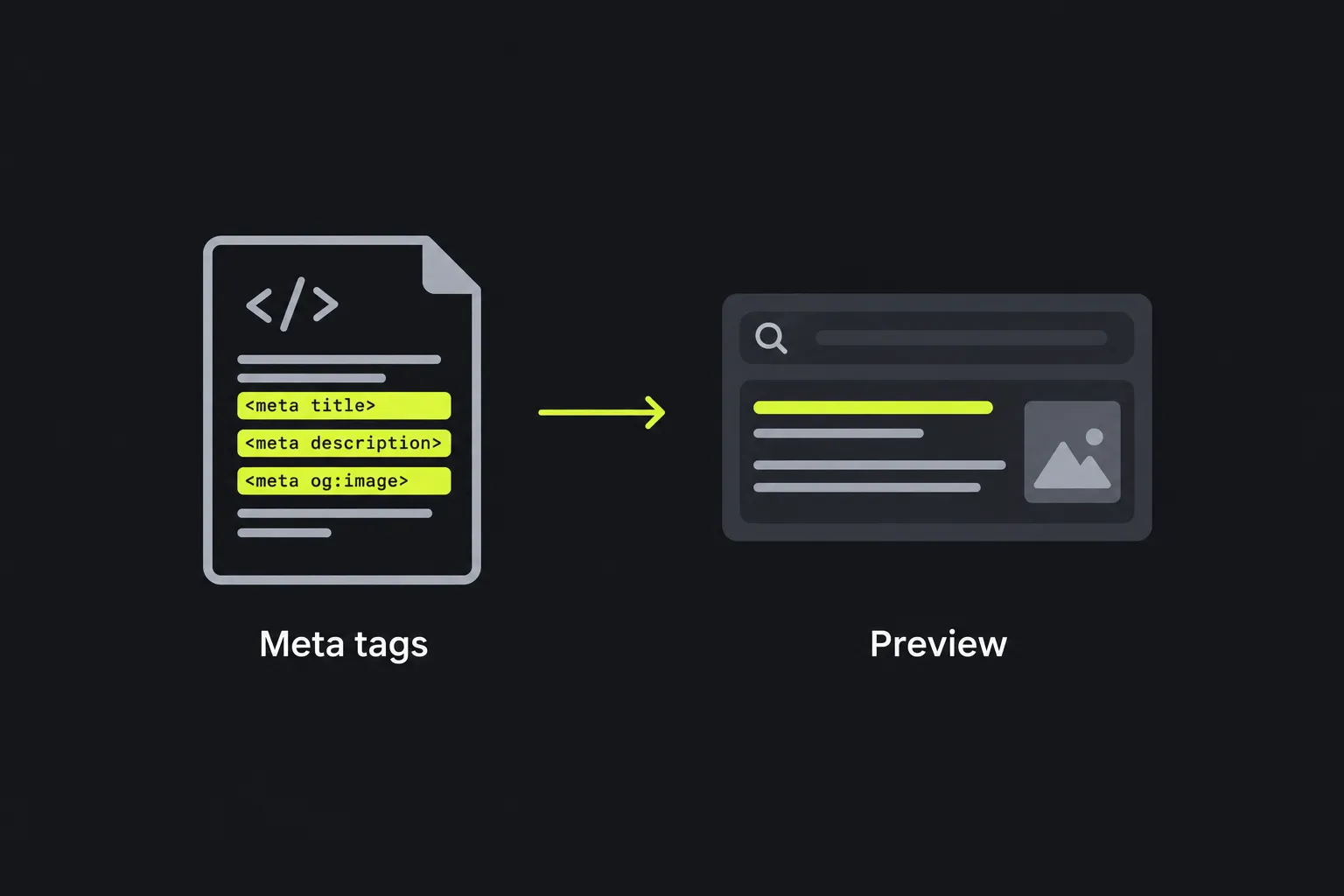
A meta tag check retrieves and verifies meta tags from the HTML of a web page. Metadata gives crawlers and sharing services instructions or descriptive information about the page.
Common items worth reviewing include the meta description, robots directives, viewport settings and social-sharing metadata such as Open Graph tags. A canonical URL is normally supplied by a separate HTML link element and should be reviewed separately. A document title is technically an HTML element rather than a meta tag, although it is often reviewed alongside metadata because search engines may use it as the title of a search result.
These elements can affect visibility or presentation in different ways. A robots directive may prevent indexing. Separately, a canonical link can indicate which version of similar pages should be treated as the main one. Descriptions and social metadata can influence how a link is presented, but search engines and social platforms may generate their own text or image instead.
The old meta keywords tag does not provide a useful optimisation signal for major search engines. Its presence is generally harmless, but spending time filling it with keyword lists is unlikely to improve search visibility.
How do I check the meta tags on a website?
Enter the full public URL of the page you want to inspect, then run the check and review the retrieved metadata. Check the exact page rather than assuming that every page on the same site uses the homepage settings.
- Use the final HTTPS address where possible, including the full path for an article, product or profile.
- Check whether the submitted URL redirects and, if it does, inspect the destination shown in your browser as well.
- Compare the returned values with the page's purpose and intended search appearance.
- Make changes in the website template, content management system or SEO settings, publish them, then run the check again.

The check runs on the server. Your submitted URL travels to the server over HTTPS and is not stored. The target page must be reachable from the public internet for a server-based checker to retrieve it. Private preview links, intranet pages and pages behind a login may not be accessible.
URL details matter. A query string can produce a different response, while a fragment beginning with a hash is not sent to the web server. Spaces are not valid literal URL characters and normally need percent-encoding. Accented or non-Latin domain names may be represented under IDNA as ASCII labels that use Punycode, and non-Latin path characters may appear percent-encoded.
How should I read the result?
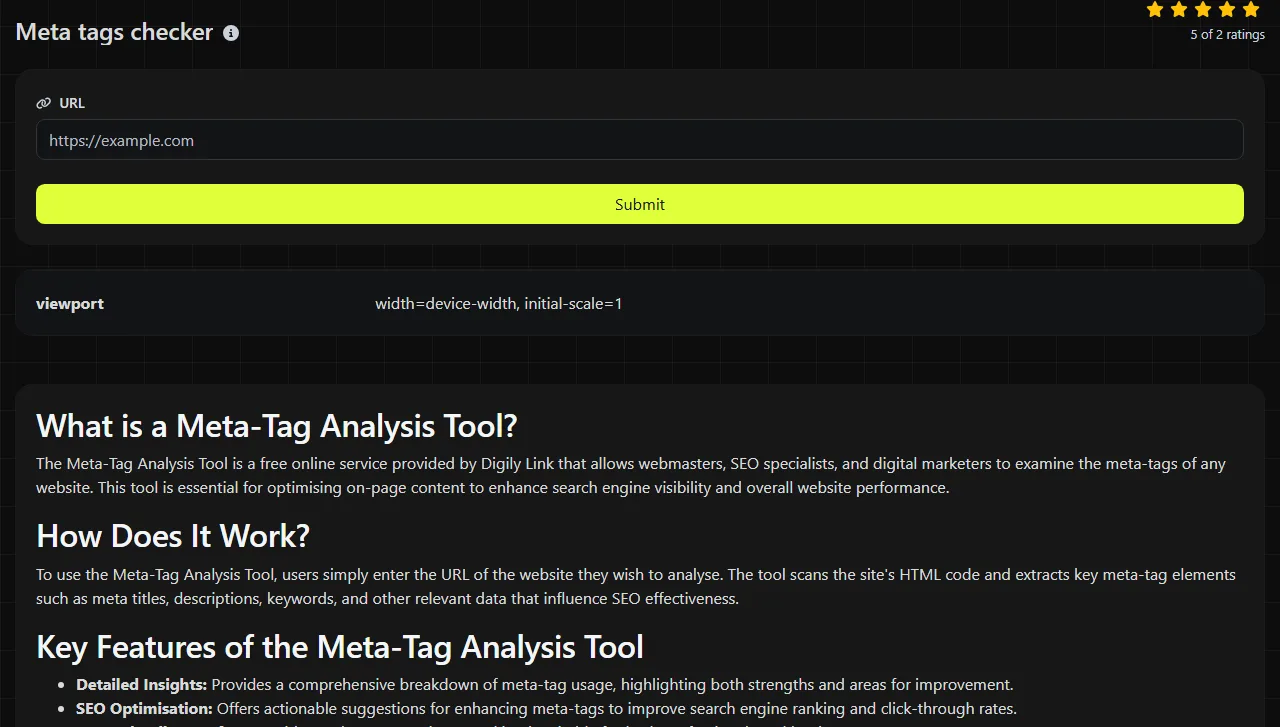
Read each returned meta element by checking its attributes, such as name, property, http-equiv, charset and, where applicable, content, and whether they match the page you submitted. A tag can be present and still be wrong, duplicated or inherited from an unsuitable template.
- Meta description should describe this specific page in natural language. An empty value gives a search engine no proposed summary, although the search engine may still create one from visible text.
- Robots supplies directives that compliant crawlers may follow. For example, robots = noindex, follow asks compliant crawlers not to index the page while still allowing them to follow its links.
- Canonical should be reviewed separately because it is normally an HTML link element, not a meta element. Its href identifies the preferred URL for duplicate or near-duplicate content. It should normally resolve to a valid, indexable page that represents the same content.
- Viewport helps browsers lay out a page on mobile devices. It does not directly describe the page, but a missing or unsuitable value can contribute to poor mobile presentation.
- Open Graph and similar social tags provide a proposed title, description, URL or image when the page is shared. Each platform decides which values it actually uses.
For a worked example, a product page returning description = Red wool scarf with tasselled ends is specific to the item. If the same page returns description = Welcome to our website, the tag exists but gives little useful context. Likewise, when reviewing the canonical link separately, an href of https://example.co.uk/scarves/red-wool-scarf is sensible for that product, whereas a canonical pointing to the shop homepage may cause the product URL to be treated as a duplicate.
No metadata checker can guarantee rankings, indexing or an exact search snippet. Search engines consider the full page, links, crawl access and many other signals, and they may rewrite titles or descriptions to suit a particular query.
Common findings and practical fixes
- Missing description. Add a page-specific description through the content management system or page template. Avoid copying the same sentence across a large group of pages.
- Accidental noindex directive. Remove it from pages intended for search once they are ready to publish. Also check HTTP response headers, as robots instructions can be supplied there rather than in HTML.
- Several copies of the same tag. Find which theme, plug-in or template component adds each copy and keep one authoritative value. Conflicting robots directives or duplicate canonical link elements make diagnosis harder.
- Wrong canonical link. Review this separately from the meta tags and replace a site-wide default with the preferred URL for the current content. Pay attention to HTTP versus HTTPS, hostname variants and unnecessary tracking parameters.
- Old social title or image. Update the page's sharing fields and confirm that the image URL is public. Some platforms cache previews, so a corrected tag may not appear immediately.
- Metadata from another page. Check template variables and publishing workflows. This often occurs when an editor duplicates an existing product, event or article without replacing every field.
Metadata added only after client-side JavaScript runs may not be visible to every crawler or checking service. For metadata that supplies indexing directives and separate link elements that indicate canonicalisation, placement in the server-delivered HTML is generally more dependable.
How often should I check meta tags?
Re-check metadata after publishing a new template, changing an SEO plug-in, migrating domains or editing indexing settings. Routine checks also make sense after bulk content imports and releases that alter page headers.
There is little value in repeatedly checking an unchanged page every few minutes. Re-check after the published HTML has changed, after a redirect has been corrected, or when a platform has had time to clear a cached preview. For a large site, sample several page types rather than checking only the homepage. Include an article, category, product, paginated page and any template that should remain outside search results.
Frequently asked questions
Can a meta tag checker see tags added by JavaScript?
It depends on whether the checking service renders JavaScript rather than reading only the initial HTML response. Do not assume that script-injected tags will be detected. Inspect the server-delivered source when a tag appears in browser developer tools but not in a check.
Why does the checked page differ from the URL I entered?
The submitted address may redirect to another URL because of HTTPS enforcement, hostname canonicalisation, trailing-slash normalisation or a changed page slug, and in some cases because of regional routing or removal of a tracking parameter. Review the final destination because that is the page whose metadata may be retrieved.
Can I check a staging site or password-protected page?
Usually not unless the page is publicly reachable and the checker can access it without credentials. Inspect protected pages locally through their rendered HTML instead.
Should every page have different metadata?
Pages with distinct purposes should generally have titles and descriptions that reflect their own content. Any canonical link, reviewed separately from meta tags, should point to the appropriate preferred URL. Duplicate filtered pages need a deliberate canonicalisation approach. Syndicated copies require handling appropriate to the publication arrangement. Translated pages should use appropriate language annotations rather than being treated as duplicates.
What should I do after fixing a tag?
Publish the change, clear any relevant site cache and check the final public URL again. Then inspect the page in the search engine or social platform's own diagnostic service where one is available, since those services may apply their own rendering, caching and eligibility rules.
Popular Tools
Create your own custom signature and download it easily with our signature generator tool for personalized e-signatures.
Calculate the size of any text in Bytes (B), Kilobytes (KB), or Megabytes (MB) using our text size calculator tool.
Use the reverse IP lookup tool to find the domain or host associated with any IP address quickly and easily.
Use our ping tool to check the status and response time of any website, server, or port quickly and efficiently.
Digily Link's IP lookup tool provides detailed information about any IP address. Use this free online service to get comprehensive IP data.
Generate your free WhatsApp link instantly with our WhatsApp Link Generator. Add a custom message and start chats in one click. No login or coding required.