MD4 generator
MD4 generator is a free tool that creates a 128-bit MD4 hash from any string input and returns it in the MD4 Hash field.
What is an MD4 hash, and is it still secure?
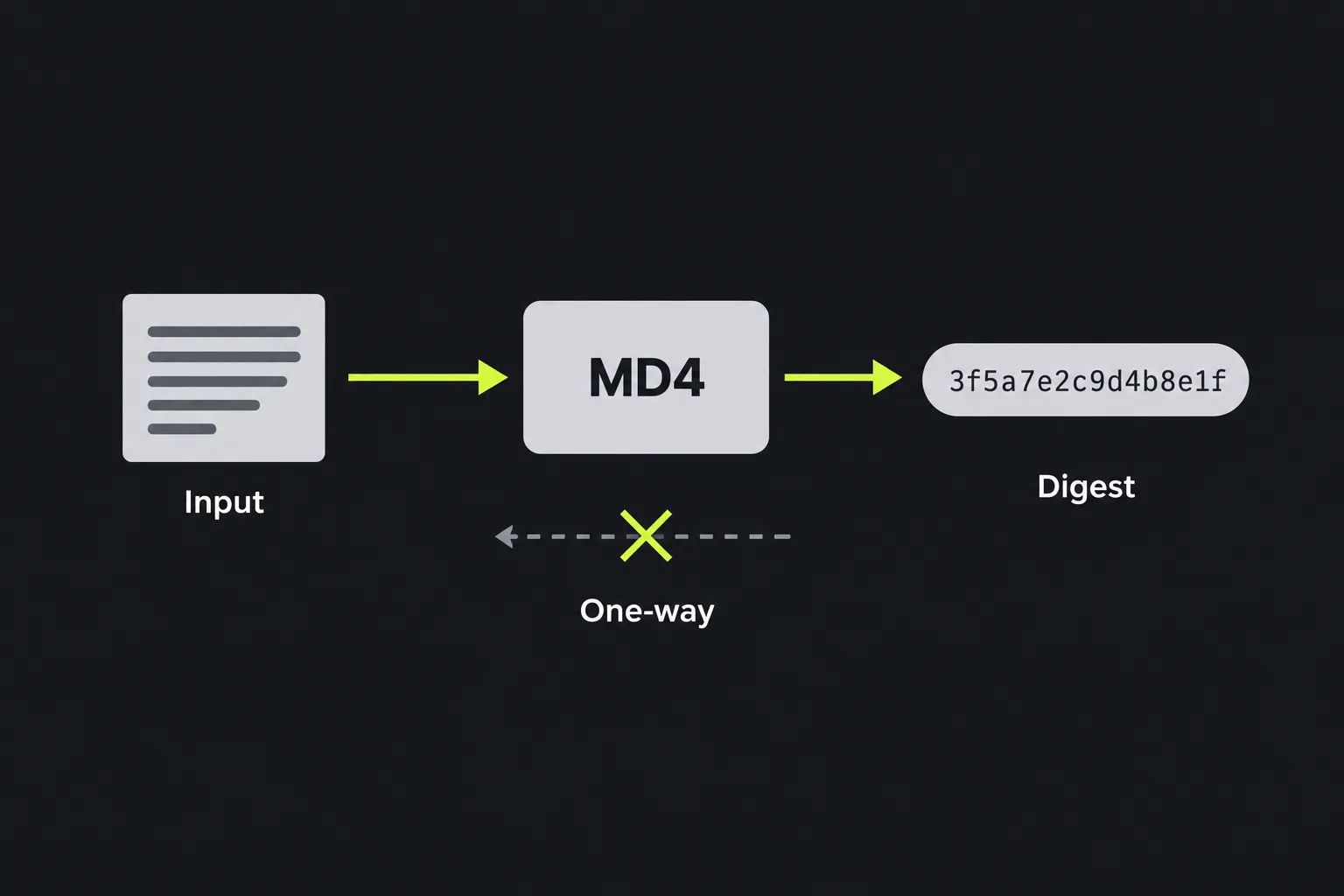
An MD4 hash is a fixed-length fingerprint of data, but MD4 is now cryptographically broken and should not be used for security-sensitive work. MD4 converts an input of any length into a fixed-length digest. MD4 is designed to work in one direction, so the original input is not included in the result.
Ronald Rivest designed MD4 in 1990. It produces a 128-bit digest, usually represented as 32 hexadecimal characters, and was designed to run quickly on 32-bit computers. MD4 influenced later algorithms, including MD5, but researchers found serious collision weaknesses soon after its release. Practical collision attacks mean an attacker can construct different inputs with the same MD4 digest.
MD4 is cryptographically unsuitable for digital signatures, certificates, authentication, software verification and any integrity check where an attacker could alter the data. It must not be used to store passwords. Modern password storage requires a salted, deliberately slow password-hashing function such as Argon2id, scrypt, bcrypt or PBKDF2.
How do I use the MD4 generator?
Enter the exact string you need to hash, generate the result, then copy the value shown under MD4 Hash. The MD4 digest will represent the input bytes supplied to the algorithm, so even a small change creates a different result.
- Check the text for unintended spaces, line breaks or copied formatting.
- Provide the string as input and run the generator.
- Copy the 128-bit result from MD4 Hash.
- When comparing it with another value, confirm that both systems used the same character encoding and input bytes.
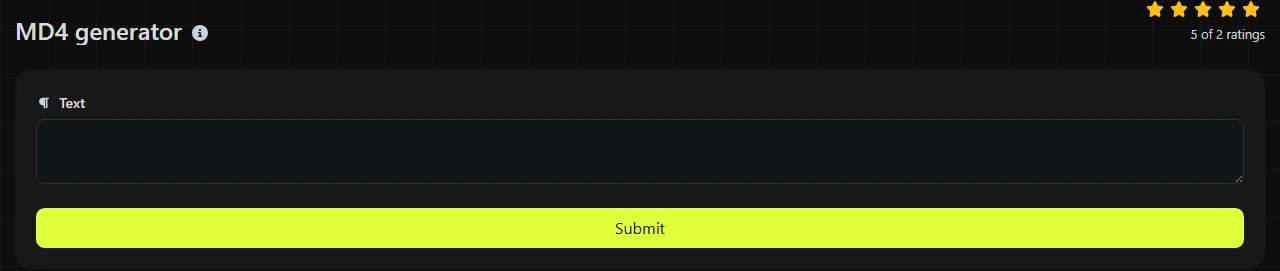
For example, the string invoice-042 produces one 128-bit MD4 digest, conventionally displayed as 32 hexadecimal characters. Changing the input to invoice-043 produces a different digest. The digest length remains the same even if the input contains a single character or a long passage of text.
The work takes place on the server. Your input travels to the server over HTTPS and is not stored. Because the text leaves your device for processing, do not submit passwords, authentication tokens, private keys or other secrets.
Can MD4 be decrypted or reversed?
An MD4 hash cannot be decrypted because hashing is not encryption and there is no decryption key. MD4 discards information while producing its fixed 128-bit result, so the digest does not contain a recoverable copy of the original input.
That does not make an MD4 digest confidential. An attacker can guess likely inputs, hash each guess and compare the results. Short passwords, common phrases, telephone numbers and predictable identifiers are often found through dictionary searches or precomputed lists. MD4 collision attacks are different from reversal attacks. A collision finds two inputs with the same hash, while a reversal attempt tries to identify the particular input behind a known hash.
Where MD4 still appears
MD4 still appears mainly in old systems and formats that cannot change without breaking compatibility. Its remaining uses do not make it suitable for new security designs.
- Legacy Windows authentication uses MD4 as part of the NT hash format. This is a compatibility requirement rather than a recommended password-storage design.
- eDonkey and eMule identifiers use MD4-based file and chunk hashes in the ed2k scheme.
- Old checksum records may require MD4 when checking archived files against previously published values.
- Closed deduplication workflows may retain MD4 where inputs are trusted and compatibility with an existing index matters more than resistance to malicious collisions.
For a new checksum or integrity system, use a current alternative to MD4 such as SHA-256 or SHA-3. Moving from MD4 to MD5 does not resolve the collision problem because MD5 is also broken. The MD5 generator is useful only when a legacy format explicitly requires MD5, while the Whirlpool generator is useful where an existing specification calls for Whirlpool.
Why do two MD4 results sometimes differ?
Two MD4 results differ when the underlying input bytes differ, even if the displayed text looks similar. Check encoding, whitespace and punctuation before assuming that either result is wrong.
- Leading and trailing spaces are data and change the digest.
- Windows and Unix line endings use different byte sequences, so copied multi-line text may hash differently.
- Upper-case and lower-case letters are different inputs.
- Accented characters can have composed and decomposed Unicode forms that look identical but use different bytes.
- Text depends on the character encoding used to convert it into bytes.
- A number such as 00123 is hashed as text when supplied as a string. Removing the leading zeros changes the input.
- The empty byte sequence has a valid MD4 digest, although an interface may require an input before it runs.
MD4 always returns 128 bits regardless of input length. For very long input, the fixed digest size does not indicate how much text or data was processed.
Frequently asked questions
Is MD4 the same as MD5?
No. MD5 is a later algorithm published by Ronald Rivest in 1992, although both MD4 and MD5 produce 128-bit digests. Their outputs are not interchangeable, and both have practical collision weaknesses.
Does the letter case of an MD4 digest matter?
Upper-case and lower-case hexadecimal representations can describe the same digest bytes. For example, hexadecimal letters A–F and a–f have the same numeric values. Some software performs case-sensitive text comparisons, so normalise the representation or compare decoded bytes when necessary.
Why are Windows NT hashes associated with MD4?
An NT hash is calculated from a password encoded as UTF-16LE and processed with MD4. The format is unsalted and fast to calculate, which makes captured hashes vulnerable to guessing attacks. It also supports pass-the-hash attacks in some legacy authentication contexts, where possession of the hash may be enough to authenticate without recovering the password.
Can MD4 be used as a message authentication code?
A plain construction that prepends a secret to a message and hashes it with MD4 is unsafe, partly because MD4 has a length-extension property. Some old specifications define HMAC-MD4, but it should remain limited to unavoidable compatibility work. New systems should use a current HMAC construction, such as HMAC-SHA-256.
Can this generator calculate MD4 for a file?
This tool is specified for string input, so do not assume that pasting file contents is equivalent to hashing the original file bytes. Binary files, character conversion and changed line endings can all produce a different result. For a legacy file checksum, use a local file-hashing utility that explicitly supports MD4, then verify whether the expected value covers the whole file or a chunked format such as ed2k.
Similar Tools
Generate MD2 hashes from any string input using our MD2 generator tool for data integrity verification.
Generate 32-character MD5 hashes from any string input with our MD5 generator tool for reliable data hashing.
Popular Tools
Create your own custom signature and download it easily with our signature generator tool for personalized e-signatures.
Calculate the size of any text in Bytes (B), Kilobytes (KB), or Megabytes (MB) using our text size calculator tool.
Use the reverse IP lookup tool to find the domain or host associated with any IP address quickly and easily.
Use our ping tool to check the status and response time of any website, server, or port quickly and efficiently.
Digily Link's IP lookup tool provides detailed information about any IP address. Use this free online service to get comprehensive IP data.
Generate your free WhatsApp link instantly with our WhatsApp Link Generator. Add a custom message and start chats in one click. No login or coding required.