PayPal link generator
PayPal link generator is a free tool that builds a PayPal payment link from a payment type, recipient email address, currency, price and redirect URLs.
What does a PayPal payment link contain?
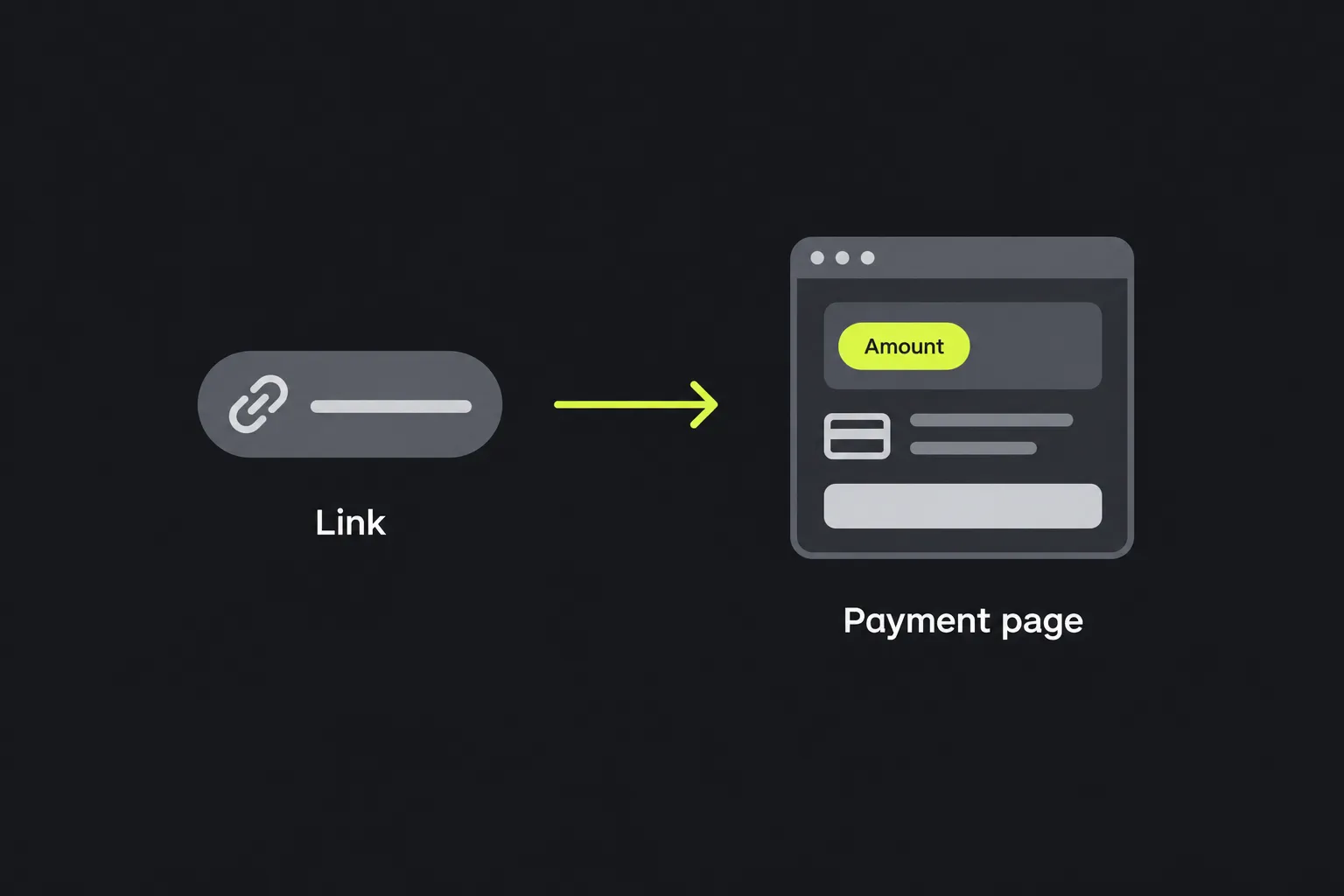
A PayPal payment link contains an endpoint followed by query parameters that tell PayPal what kind of payment to start, which account should receive it and how the checkout should behave. In the established PayPal Payments Standard format, the fields correspond to parameters such as these.
| Form field | Common parameter | Purpose |
|---|---|---|
| Buy now, Add to cart or Donation | cmd | Selects the payment flow. Common values include _xclick for Buy now, _cart for cart payments and _donations for donations. For an Add to cart submission, cmd=_cart is used together with add=1. |
| PayPal email | business | Identifies the PayPal account receiving the payment. |
| Currency code | currency_code | Sets the payment currency using an ISO 4217 code such as GBP, EUR or USD. |
| Price | amount | Sets the payment amount. It should contain a number rather than a currency symbol. |
| Thank you URL | return | Provides the page to which PayPal can send the customer after the payment flow. |
| Cancel URL | cancel_return | Provides the page to which PayPal can send the customer if they cancel and return to the merchant's site. |
The exact order of PayPal parameters such as business, amount, currency_code, return and cancel_return does not change their meaning. Their values must be URL-encoded where necessary. For example, the @ sign in the business email address can appear as %40, while characters in a nested return or cancel_return URL are encoded if they are disallowed or could alter parsing of the outer PayPal query string.
Which PayPal payment type should I choose?
Choose Buy now for one fixed purchase, Add to cart when the payment should be added to a PayPal shopping cart, and Donation when the payer is making a contribution rather than buying an item.
- Buy now fits a single service, ticket, download or other purchase with a stated price.
- Add to cart fits a shop flow in which a customer may collect more than one item before paying. A basic link alone does not provide stock control or a product catalogue.
- Donation identifies the transaction as a donation flow. Organisations should still check PayPal's account, eligibility and regulatory requirements for receiving donations.
The available fields do not include an item name, item number, shipping charge, tax rate or customer reference. If those details are needed, a fuller PayPal integration or another supported checkout format may be more suitable.
How do I create and use a PayPal payment link?
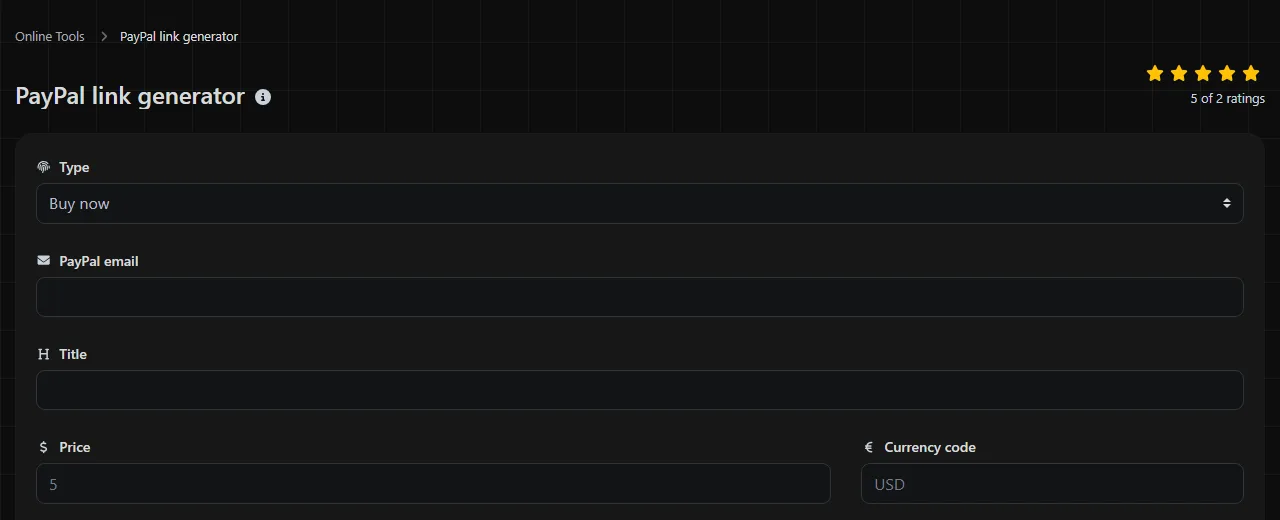
Choose the payment type, enter the receiving PayPal email address, set the currency and price, then add the pages customers should reach after completing or cancelling checkout.
- Select Buy now, Add to cart or Donation.
- Enter the account address in PayPal email. Check it carefully because this identifies the intended recipient.
- Enter an ISO currency code in Currency code, such as GBP.
- Enter the amount in Price without a pound sign or thousands separator.
- Use a complete web address, including https://, for Thank you URL and Cancel URL.
- Generate the link, open it in a private browser window and check the recipient, amount and currency shown by PayPal.
When somebody follows the result, the payment details become visible on the PayPal payment page or in the PayPal app if the device opens the link there. A completed transaction should later appear in the recipient's PayPal activity and reporting. The thank-you page only shows where the browser was redirected. It is not reliable proof that PayPal completed the payment.
Naming and formatting conventions
Consistent formatting makes a wrong PayPal recipient, currency, amount or redirect URL easier to spot when several payment links are kept in a spreadsheet, content management system or campaign document.
- Use uppercase ISO currency codes such as GBP, EUR and USD.
- Write prices as plain numbers. Use 25.00 rather than £25.00, and do not use a comma as a thousands separator.
- For new redirect paths you control, use lower-case letters and hyphens instead of spaces, such as /payment-thanks rather than /Payment Thanks.
- Use the same thank-you and cancellation path pattern across related links. For example, /payment/thanks and /payment/cancel are easier to distinguish than unrelated page names.
- Do not change the case of a recipient email address merely to tidy it. Copy the address associated with the PayPal account and verify it.
Spaces are not valid in a currency code. Characters in a redirect URL must be encoded when they are disallowed in the outer PayPal link or could alter parsing of its query string. Accented or non-Latin characters can be represented through URL encoding, but internationalised domain names and application support require care.
Very long redirect URLs produce a longer PayPal link. URL-length support and limits vary across browsers, servers and intermediary services, while messaging services, printed material and manual copying introduce additional practical problems. If a return URL contains its own analytics parameters, preserve and encode the entire nested URL rather than allowing its ampersands to become PayPal parameter separators.
Worked example and common mistakes
For a £25 Buy now payment to payments@example.co.uk, with separate completion and cancellation pages, the input can be written as plain text.
Payment type: Buy now
PayPal email: payments@example.co.uk
Currency code: GBP
Price: 25.00
Thank you URL: https://www.example.co.uk/payment/thanks
Cancel URL: https://www.example.co.uk/payment/cancel
A corresponding PayPal Payments Standard link can take this form.
https://www.paypal.com/cgi-bin/webscr?cmd=_xclick&business=payments%40example.co.uk¤cy_code=GBP&amount=25.00&return=https%3A%2F%2Fwww.example.co.uk%2Fpayment%2Fthanks&cancel_return=https%3A%2F%2Fwww.example.co.uk%2Fpayment%2Fcancel
The displayed parameter order may differ while representing the same instructions. Before publishing a link, avoid these common mistakes.
- Entering the wrong PayPal email address or using an address that is not attached to the intended receiving account.
- Putting GBP, £ or a comma inside the price instead of supplying a plain amount.
- Using a relative redirect path such as /thanks rather than a complete URL.
- Failing to encode a nested URL, especially one that already contains ?, & or = characters.
What are the limits of a generated PayPal link?
A generated link starts a PayPal payment flow, but it does not replace transaction verification, order management or a full checkout integration. The parameters are visible to anyone who receives or clicks the link, including the recipient email, amount, currency and redirect destinations. Do not add passwords, private customer data or secret internal identifiers to the PayPal link's exposed parameters.
A person can also edit exposed PayPal parameters such as amount, currency_code and business before opening the payment page. The receiving system must therefore use PayPal's transaction records, supported notifications or API data to confirm the paid amount, currency, recipient and transaction status. A visit to the thank-you URL is not enough.
Building individual links from form fields is manageable for a small set of fixed payments. It does not scale well to a large catalogue or campaign with many prices, currencies and references. For bulk work, a spreadsheet can compose URLs from columns, while a PayPal API or ecommerce integration can create and track orders programmatically.
Frequently asked questions
Does the customer need a PayPal account?
Not in every case. Guest card checkout availability depends on factors controlled by PayPal, including the receiving account, country, transaction and PayPal's own checks. Do not promise guest checkout until it has been confirmed for the intended payment flow.
Can I turn the payment link into a QR code?
Yes, a standard PayPal URL can be encoded in a QR code. Longer links create denser codes, so print it at a readable size and test it from the intended viewing distance. The visible destination should also be printed nearby for people who cannot scan it.
Can I use this link for PayPal Sandbox testing?
There is no Sandbox field among the listed form options. Sandbox testing requires the correct PayPal testing environment and sandbox accounts, so a production payment link should not simply be assumed to work as a test link.
How should I test a link before publishing it?
Open it on both a desktop browser and a mobile device, then check the recipient, payment type, amount and currency on the PayPal page. Test the cancellation route and, where practical, complete a controlled low-value transaction so that the return page and PayPal record can be checked together.
Popular Tools
Create your own custom signature and download it easily with our signature generator tool for personalized e-signatures.
Calculate the size of any text in Bytes (B), Kilobytes (KB), or Megabytes (MB) using our text size calculator tool.
Use the reverse IP lookup tool to find the domain or host associated with any IP address quickly and easily.
Use our ping tool to check the status and response time of any website, server, or port quickly and efficiently.
Digily Link's IP lookup tool provides detailed information about any IP address. Use this free online service to get comprehensive IP data.
Generate your free WhatsApp link instantly with our WhatsApp Link Generator. Add a custom message and start chats in one click. No login or coding required.