Number to words converter
Number to words converter is a free tool that turns a number into its written form using spelled-out words.
How does writing numbers in words work?
Numbers are written in words by separating them into place-value groups such as hundreds, thousands and millions. In British English, and normally appears between a hundred and the remaining tens or units, as in "one hundred and five". Compound numbers from twenty-one to ninety-nine are usually hyphenated.
Whole numbers use cardinal forms such as "forty-two" and "three thousand". Ordinal forms such as "forty-second" are different and indicate position in a sequence. Decimal digits are commonly read individually after the decimal point, so 3.06 may be spoken as "three point zero six". Currency follows separate conventions because £3.06 would normally be written as "three pounds and six pence".
How do I use the converter?
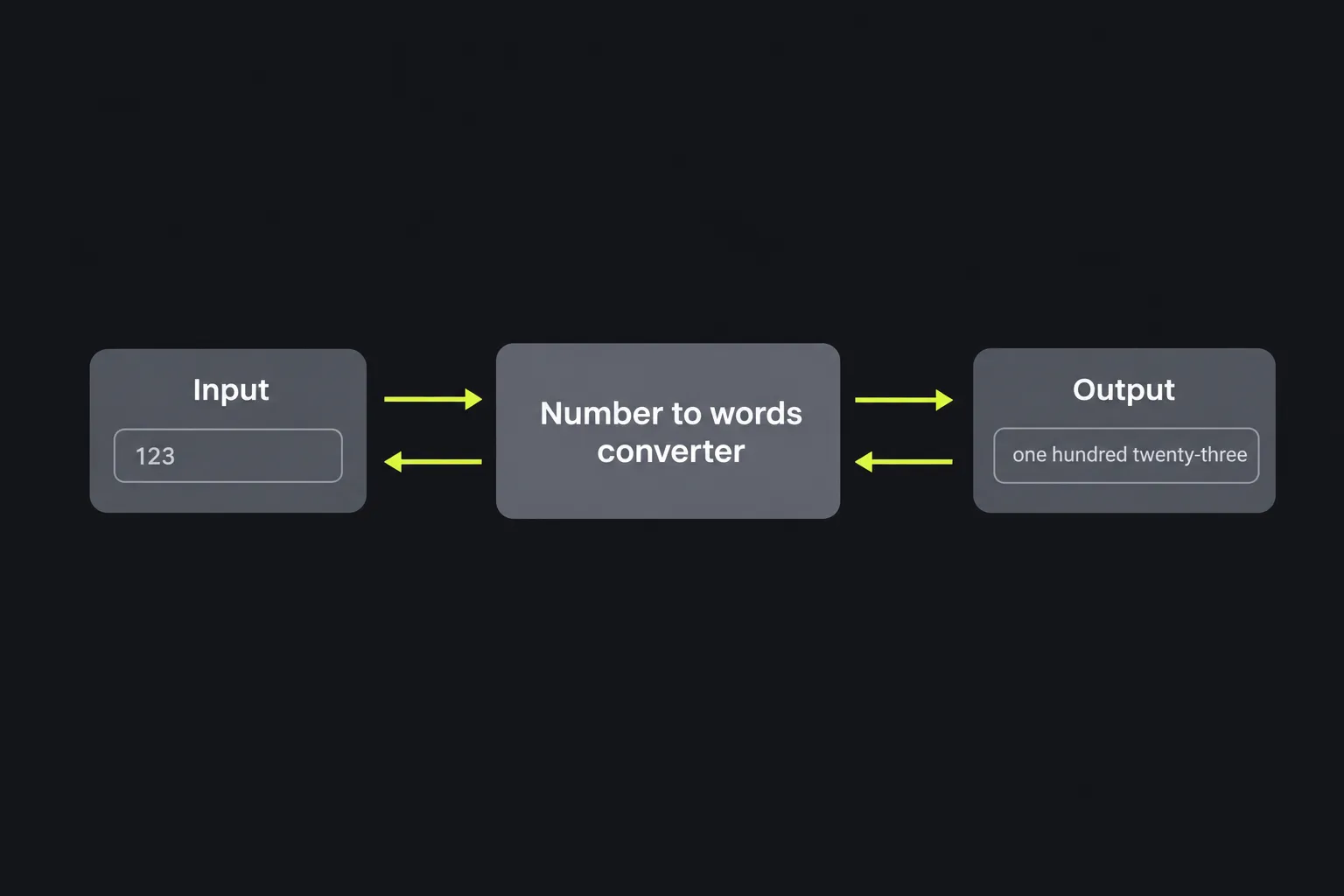
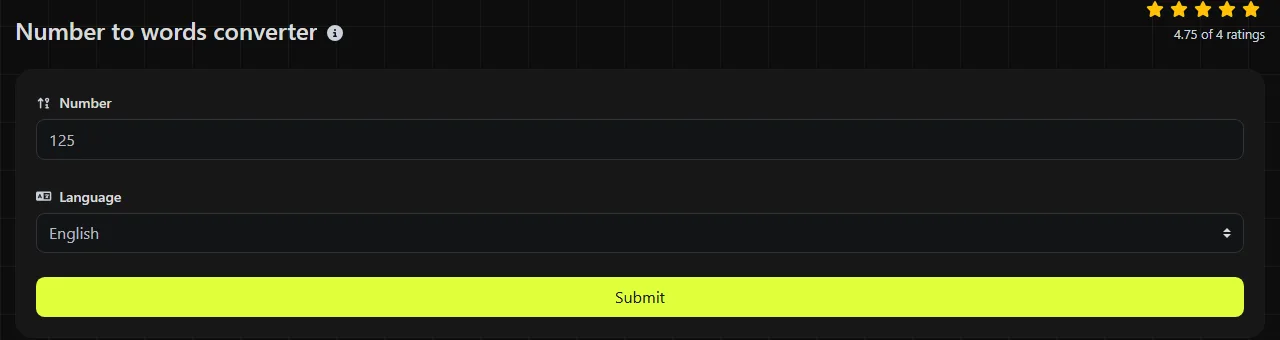
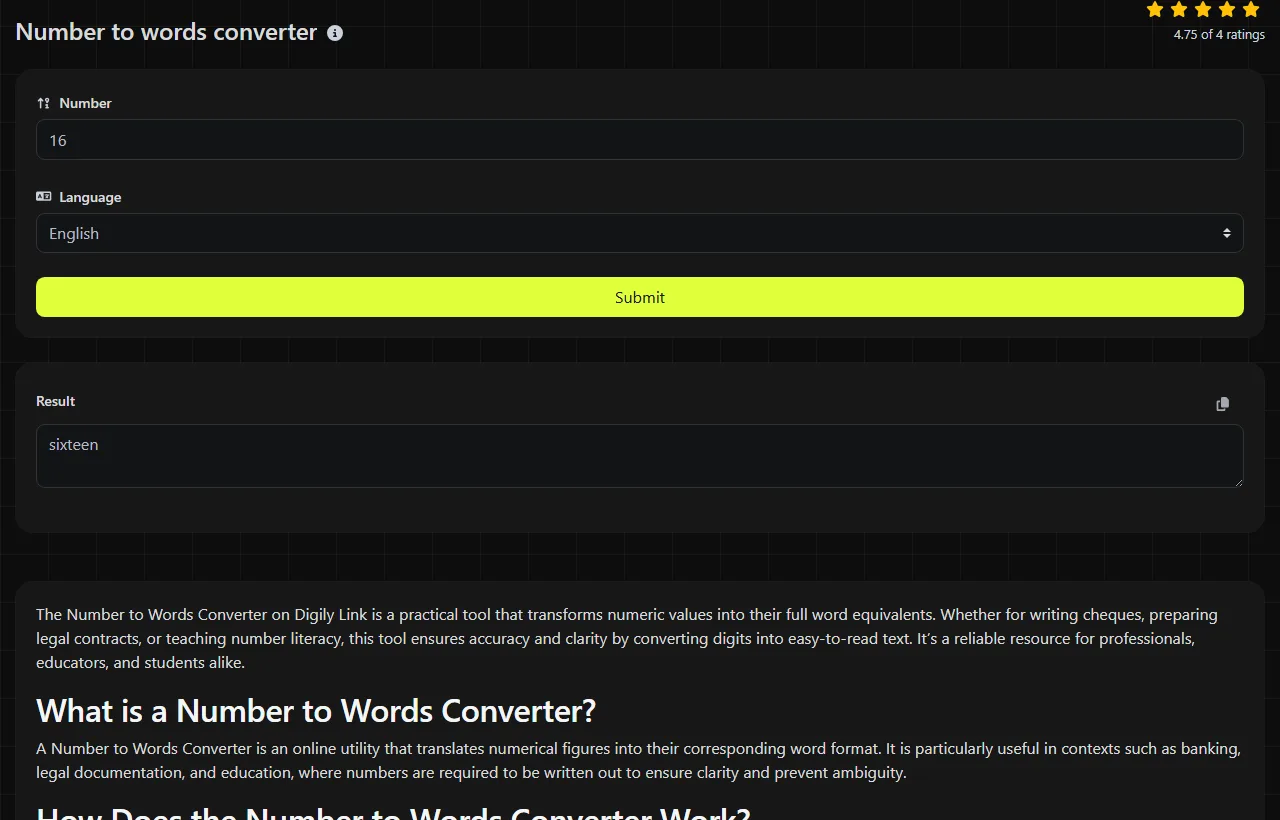
Enter a value in the Number field and run the conversion to obtain the number in words. The conversion takes place on the server. Your input travels to the server over HTTPS and is not stored.
For the clearest input, use an ordinary numeric value rather than surrounding it with explanatory text or units. Support for separators, decimal points, negative signs and extremely large values depends on the numeric formats recognised by the converter, so check the result before copying it into assessed work, financial paperwork or code.
Worked example and reference values
In standard British English, the input 1245 is written as "one thousand two hundred and forty-five". The place-value groups are one thousand, two hundred and forty-five. A common hand-conversion mistake is to skip a place value or omit and, particularly when the tens digit is zero.
| Value | Written form |
|---|---|
| 0 | zero |
| 17 | seventeen |
| 42 | forty-two |
| 105 | one hundred and five |
| 2,000 | two thousand |
Where are number words used in practice?
Written numbers appear in documents, teaching material and software, but some technical situations require a different reading style.
- Programming: generating labels, preparing test fixtures and checking number-localisation routines.
- Networking: documenting quantities such as packet counts or port ranges. IPv4 addresses use dotted-decimal components representing octets rather than one cardinal number.
- Electronics: writing component quantities or values in instructions. Units such as volts, ohms and farads still need to be added separately.
- Education: checking place value, spelling and the use of hyphens and and.
- Radio: ordinary number words may be unsuitable where each digit must be transmitted distinctly. Operators often follow a prescribed pronunciation system to reduce ambiguity.
For base-eight notation used in some programming and electronics work, an Octal converter answers a different question. A Morse converter can encode letters and digits for Morse communication, but it does not turn a quantity into English words.
Which number format should I use?
Use cardinal words for quantities, digit-by-digit wording for codes, and currency wording for monetary amounts. Choosing the wrong format can change how the number is expressed in words.
- Write 507 as "five hundred and seven" when it represents a quantity.
- Read 507 as "five zero seven" when it is a room number or reference code.
- Write 2.50 as "two point five zero" when every decimal digit matters.
- Write £2.50 as "two pounds and fifty pence" in a monetary context.
Punctuation, spaces, scientific notation and non-Latin numerals may also be rejected or interpreted differently by numeric parsers. This tool converts numbers into words; it does not decide the correct wording for a legal clause, measurement or identifier.
Frequently asked questions
Can I use the result when writing a cheque?
You can use it as a spelling reference, but check the wording against your bank's instructions. The amount in words must agree with the amount in figures, and the converter does not validate a cheque or resolve a discrepancy.
Does "billion" mean the same thing in British and American English?
Modern British and American English generally use the short scale, where one billion is 1,000,000,000. Older British documents may use the long-scale meaning of a million million, so historical material needs additional context.
Should leading zeroes be converted into words?
Leading zeroes matter in identifiers such as account references, PIN-like codes and serial numbers, even though they do not change a numeric quantity. Preserve them by reading the digits separately rather than treating the value as an ordinary whole number.
Can the converter add pounds, pence or measurement units?
The tool has a Number field and does not itself add units. Add the correct unit yourself and adjust the grammar where necessary, including singular forms such as "one pound" or "one metre".
Final checks
Check hyphens, the placement of and, decimal zeroes and any required units before using the wording. For codes, addresses and radio traffic, confirm that the value should be read digit by digit rather than as a single quantity.
Popular Tools
Create your own custom signature and download it easily with our signature generator tool for personalized e-signatures.
Calculate the size of any text in Bytes (B), Kilobytes (KB), or Megabytes (MB) using our text size calculator tool.
Use the reverse IP lookup tool to find the domain or host associated with any IP address quickly and easily.
Use our ping tool to check the status and response time of any website, server, or port quickly and efficiently.
Digily Link's IP lookup tool provides detailed information about any IP address. Use this free online service to get comprehensive IP data.
Generate your free WhatsApp link instantly with our WhatsApp Link Generator. Add a custom message and start chats in one click. No login or coding required.