Morse converter
Morse converter is a free tool that converts ordinary text to Morse code and translates Morse code back into text.
How does Morse code work?
Morse code represents letters, numbers and selected punctuation with short and long signals called dots and dashes. International Morse code uses a different sequence for each supported character, with upper- and lower-case forms sharing the same sequence. For example, A is .- and N is -.
Timing matters when Morse is sent by sound, light or electrical pulses. A dot lasts one unit, a dash lasts three units, the gap between parts of one character lasts one unit, and longer gaps separate letters and words. In written Morse, spaces usually separate letters and a forward slash often marks a word break.
| Character | International Morse code |
|---|---|
| A | .- |
| C | -.-. |
| T | - |
| 5 | ..... |
| ? | ..--.. |
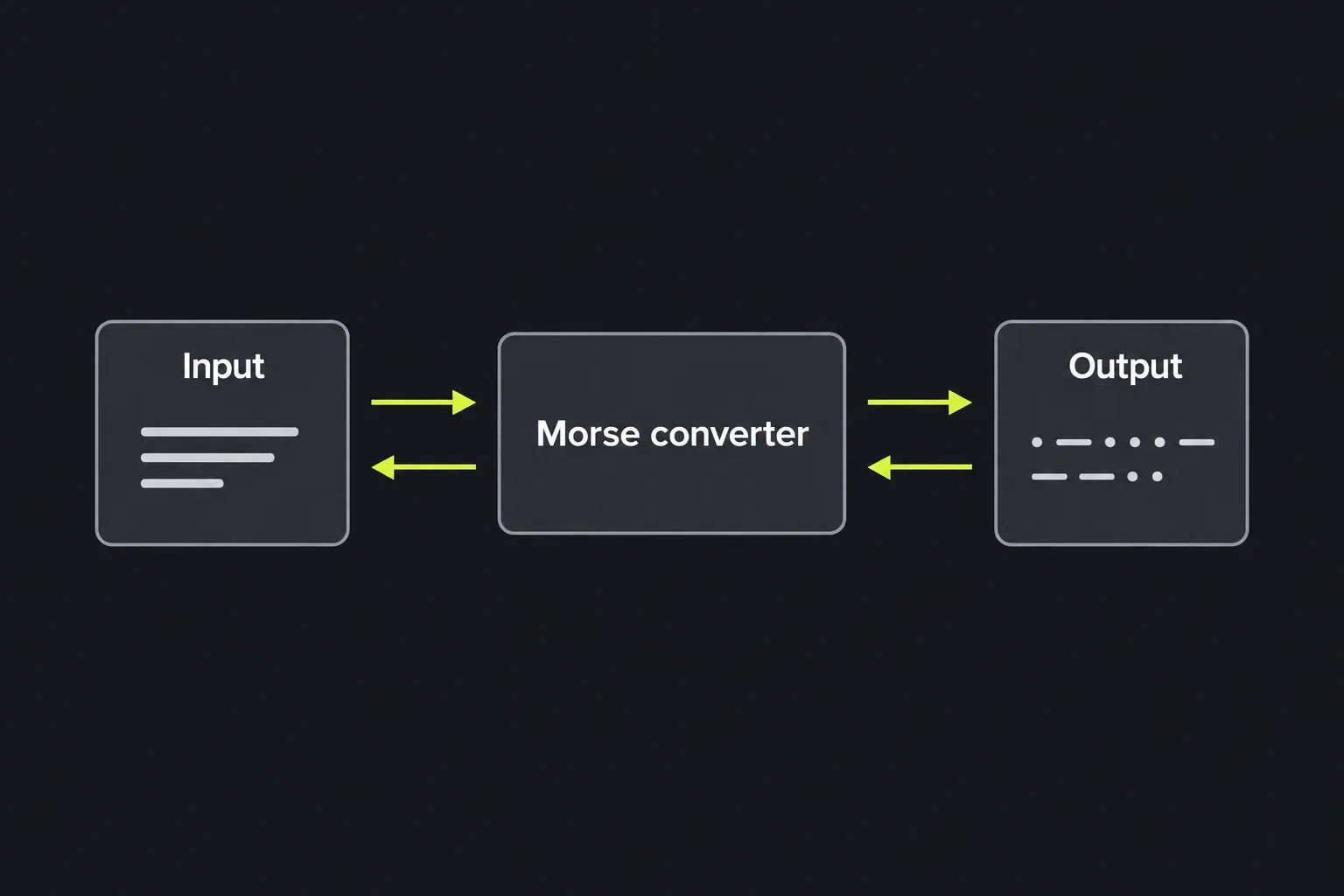
How do I use the Morse converter?
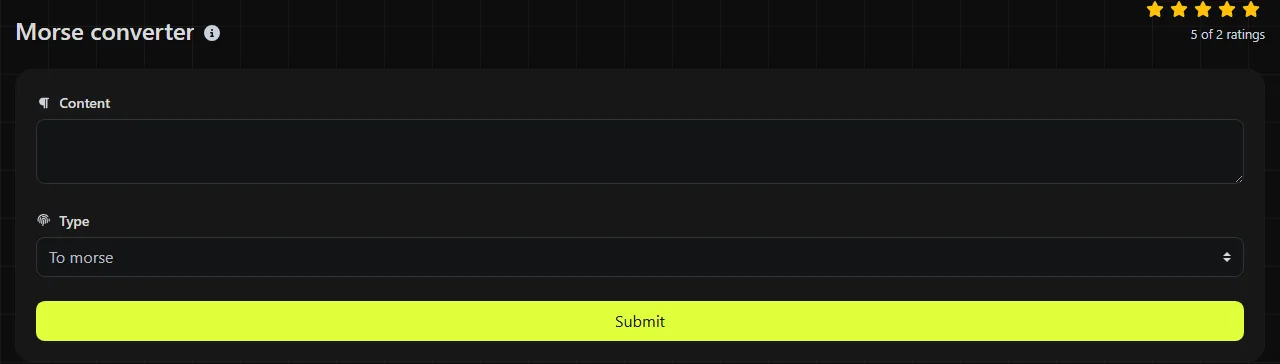
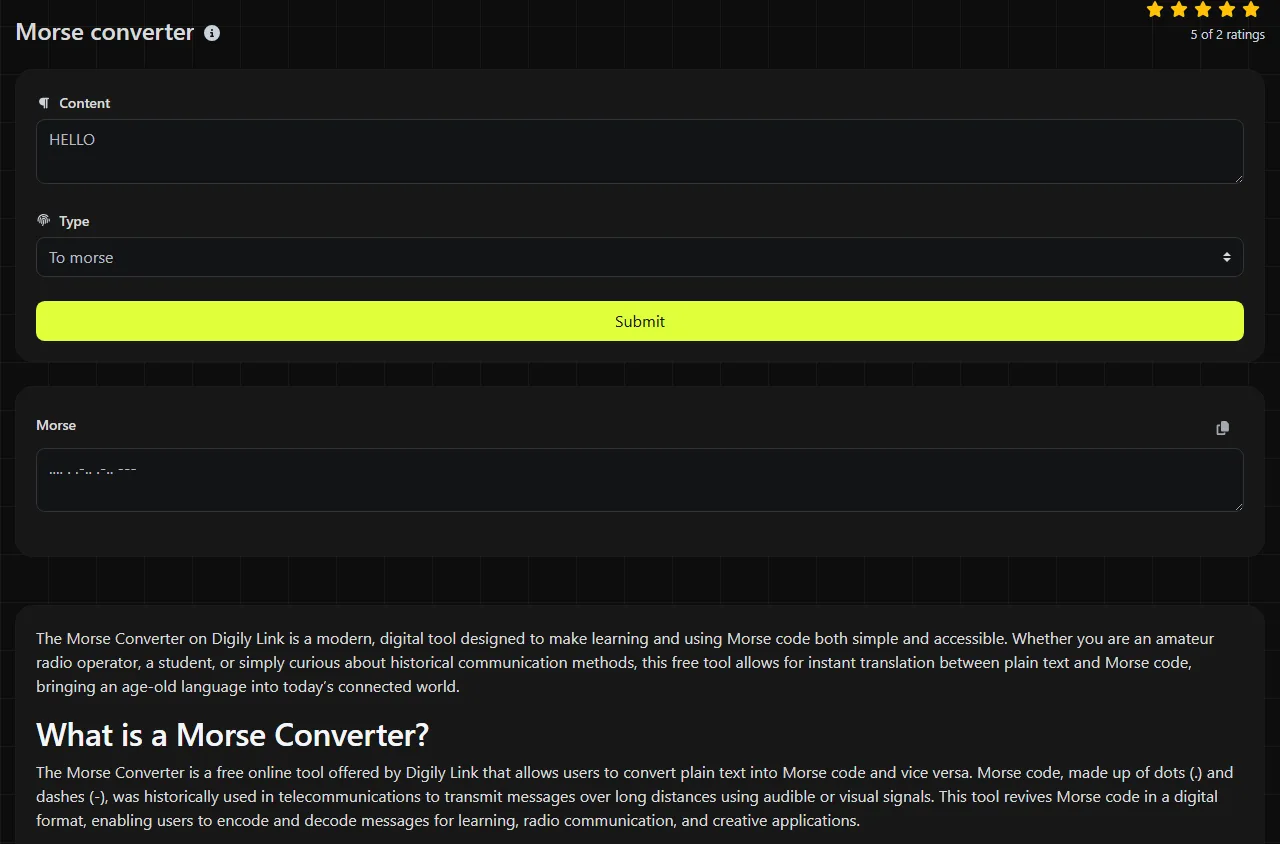
Use To morse to encode ordinary text, or To text to decode a sequence of dots and dashes. The returned value appears in the Morse result field.
The Morse conversion runs on the server. Your text or Morse input travels to the server over HTTPS and is not stored. Morse code is an encoding rather than encryption, so avoid entering confidential material merely because the result is less readable than plain text.
Standard International Morse covers the English alphabet, digits 0 to 9 and a limited set of punctuation marks. Consider the following points before converting:
- Spaces mark word boundaries, although written conventions may use either wider gaps or forward slashes.
- Numbers have defined Morse sequences and can be mixed with letters.
- Only selected punctuation has a standard representation.
- Accented letters and non-Latin scripts may require transliteration or an agreed extended alphabet.
A small worked example
Take the word CAT. C becomes -.-., A becomes .-, and T becomes -. Keeping spaces between the encoded letters gives the output -.-. .- -.
When decoding Morse, work in the opposite direction. Split the sequence at its letter boundaries first, then look up each complete group. Treating the entire line as one uninterrupted pattern will produce ambiguous or incorrect results.
Where is Morse code used in practice?
Morse code is still used in amateur radio, electronics projects, teaching exercises and some forms of accessibility communication. Its simple signals can be produced with a radio key, buzzer, lamp, switch or microcontroller output.
- Radio operators use continuous-wave, or CW, transmissions because narrow signals can remain readable under difficult reception conditions.
- Programming exercises use Morse dictionaries to practise string parsing, lookup tables and character-by-character conversion.
- Electronics projects can send status messages through an LED or piezo buzzer without a display.
- Education uses Morse to demonstrate variable-length codes, signalling and the effect of timing on meaning.
- Networking courses sometimes use it as a simple encoding exercise. Normal internet and local network protocols do not transmit data as Morse code.
What commonly goes wrong when converting Morse by hand?
The most common mistake is losing the boundaries between letters and words. Morse is a variable-length code, so .- could mean A, while . followed by - with a letter gap means E followed by T.
Another frequent error is reversing dots and dashes while copying. Preserve the original grouping, check each character separately and use one consistent word separator. Do not assume every symbol has a standard Morse equivalent, particularly when the source contains typographic quotation marks, emoji or characters from another writing system.
Frequently asked questions about Morse code
Is Morse code a secure cipher?
No. Anyone with a Morse chart or decoder can read it, and there is no secret key. Use recognised encryption rather than Morse when information needs protection.
Does Morse code distinguish between capital and lower-case letters?
No. Standard Morse uses the same sequence for A and a, B and b, and so on. Capitalisation must be restored from context after decoding if it matters.
What does SOS stand for?
SOS is the conventional representation of the continuous distress pattern ...---..., which was selected for its distinctive pattern rather than as an abbreviation of a particular phrase. Expressions such as "save our souls" were attached to it later as memory aids.
How is Morse transmission speed measured?
Operators normally measure speed in words per minute. Training commonly uses the standard word PARIS as a reference so that speeds can be compared consistently despite different letter patterns.
Can Morse code be sent with a flashing light?
Yes. Dots and dashes can be represented by short and long flashes, provided the sender and receiver use consistent timing. Before sending a practical message, agree how letter gaps, word gaps and any unsupported characters will be handled.
Popular Tools
Create your own custom signature and download it easily with our signature generator tool for personalized e-signatures.
Calculate the size of any text in Bytes (B), Kilobytes (KB), or Megabytes (MB) using our text size calculator tool.
Use the reverse IP lookup tool to find the domain or host associated with any IP address quickly and easily.
Use our ping tool to check the status and response time of any website, server, or port quickly and efficiently.
Digily Link's IP lookup tool provides detailed information about any IP address. Use this free online service to get comprehensive IP data.
Generate your free WhatsApp link instantly with our WhatsApp Link Generator. Add a custom message and start chats in one click. No login or coding required.