JPG to BMP
JPG to BMP is a free tool that converts a JPG image into a BMP file entirely in your browser, without ever uploading the image to a server.
How do I convert a JPG file to BMP?
Provide the JPG file, run the conversion and save the resulting BMP file to your device.
- Select a valid JPG image from your device.
- Allow the page to process the image in your browser.
- Save the converted BMP and open it in the application that requires it.
All processing takes place locally in your browser. The input image is never uploaded to a server, which is useful when the file contains private photographs, scans or internal artwork. A very large JPG can require substantial memory while it is converted to BMP in the browser.
What changes when JPG is converted to BMP?
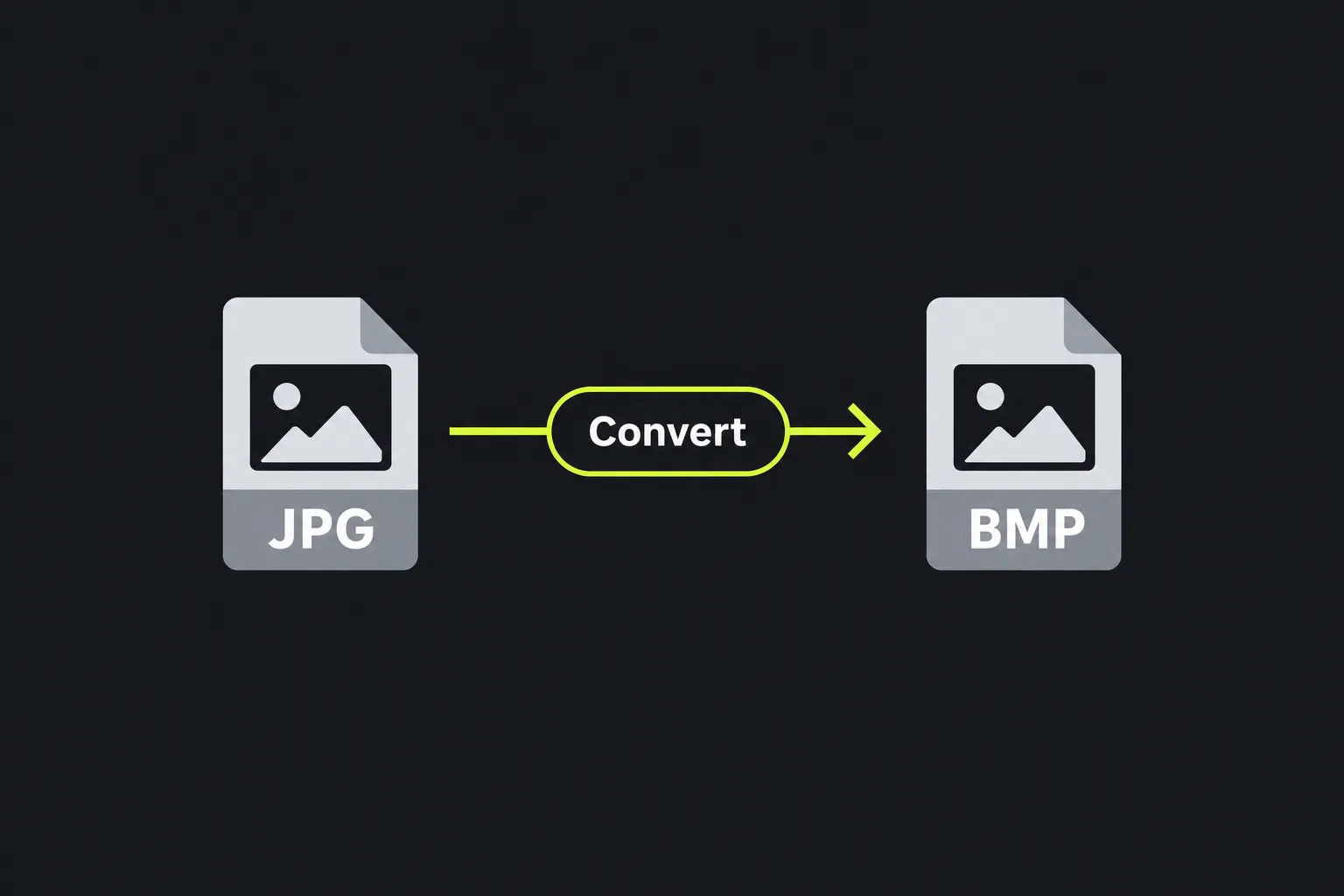
The compressed JPEG image is decoded into pixels and then written in the BMP format, which is commonly stored without lossy compression.
| Property | JPG | BMP |
|---|---|---|
| Compression | Lossy JPEG compression removes some image information to reduce file size. | Common BMP files contain uncompressed pixel data. Some BMP variants support lossless run-length encoding. |
| Transparency | Standard JPEG has no alpha transparency. | Some BMP variants can contain alpha data, but support is inconsistent. Converting a JPG cannot create genuine transparency because the source has none. |
| Animation | JPG is a static image format. | BMP is normally a static image format. Conversion does not create animation. |
| Typical file size | Usually relatively small, particularly for photographs. | Usually much larger because pixel values are often stored directly. |
| Browser support | Widely supported and suitable for ordinary web images. | Many browsers can display BMP, but it is inefficient for web delivery and is less consistently used. |
| Platform use | Supported across Windows, macOS, Linux, mobile devices and web platforms. | Closely associated with Windows and still accepted by many desktop and legacy applications. |
Converting to BMP does not recover detail discarded when the JPG was originally compressed. Blocking, ringing around edges and colour degradation remain in the decoded pixels. BMP can avoid another round of JPEG loss, but it cannot reconstruct the original photograph.
When should I convert JPG to BMP?
Convert JPG to BMP when a programme, device or older workflow specifically requires a bitmap file.
- A legacy Windows application accepts .bmp files but does not import JPEG.
- Software needs straightforward raster pixel data rather than JPEG-compressed input.
- A test fixture, game asset or embedded-system workflow specifies BMP as its required format.
- You need an intermediate image that will not undergo another generation of JPEG compression.
BMP is usually a poor choice for a website, email attachment or large photo collection because its files take more storage and bandwidth. For web delivery, JPG to WebP is generally a more suitable route. If you need lossless storage or dependable transparency support, JPG to PNG is usually easier to use across modern applications, although the converted image will remain opaque unless transparency is added separately, and it still cannot restore detail already lost from the JPEG.
How large will the BMP file be?
The BMP will normally be several times larger than the JPG, but the exact size depends mainly on its pixel dimensions, colour depth, row padding and BMP encoding.
For a typical 24-bit uncompressed BMP, each pixel needs three bytes. A 1,920 × 1,080 image therefore needs 6,220,800 bytes for pixel data, which is about 5.93 MiB, plus a small amount for headers. The original JPG might be much smaller, but its size cannot be predicted from dimensions alone because photographs compress differently according to detail and JPEG quality settings.
BMP rows are commonly padded to a four-byte boundary. This makes the calculation slightly less obvious for image widths that do not produce a whole multiple of four bytes per row. Other BMP colour depths and compression methods produce different totals, so treat the estimate as a guide rather than a promised output size.
JPG-to-BMP examples and awkward input
A file called product photo 01.jpg remains a single static raster image after conversion. Spaces, numbers, punctuation and accented characters in the filename do not change the pixels, although a receiving application may impose its own filename rules.
A 4,000 × 3,000 JPG contains 12 million pixels. If represented as a 24-bit uncompressed BMP, its raw pixel data occupies roughly 34.3 MiB before headers and any row padding. This explains why a modest JPG can produce a conspicuously large BMP.
Changing a file extension from .jpg to .bmp is not a conversion. The data inside remains JPEG data, and software that checks the file structure may reject it. Likewise, a zero-byte file, damaged JPEG or unrelated file merely named with a .jpg extension does not contain a valid image that can be meaningfully converted.
Frequently asked questions
Will the BMP keep Exif camera information?
Do not assume that camera details, GPS information, captions or other JPEG metadata will survive a raster conversion. BMP has different and more limited metadata conventions. Check the BMP before deleting or replacing the source JPG.
Can Windows Paint and macOS Preview open BMP files?
Windows Paint supports standard BMP files, and macOS Preview can open common BMP variants. More specialised encodings or unusual colour depths may be handled differently by other applications, so test the file in the programme where it will actually be used.
Will a CMYK JPEG keep exactly the same colours?
Support for CMYK JPEG input is unspecified. Colour can shift if an embedded ICC profile is missing, unsupported or handled differently by the viewing application. For colour-sensitive JPG-to-BMP conversion, compare the result in a colour-managed image editor.
Is BMP a good archival format for photographs?
BMP is openly documented and simple, but its large files and limited metadata handling often make it inconvenient for a photograph archive. Keep the original JPG as well as any converted copy. TIFF or PNG may be more practical where lossless storage is required, depending on the archive's compatibility rules.
Final checks
Open the BMP in its intended application, confirm the orientation and colours, and check that available storage can accommodate the larger file. Keep the original JPG until you have verified the result, especially when filenames, camera metadata or colour profiles matter.
Similar Tools
Easily convert JPG image files to PNG format with our JPG to PNG converter tool for high-quality images.
Easily convert JPG image files to WebP format with our JPG to WebP converter tool for efficient image compression.
Easily convert JPG image files to GIF format with our JPG to GIF converter tool for creating animated images.
Popular Tools
Create your own custom signature and download it easily with our signature generator tool for personalized e-signatures.
Calculate the size of any text in Bytes (B), Kilobytes (KB), or Megabytes (MB) using our text size calculator tool.
Use the reverse IP lookup tool to find the domain or host associated with any IP address quickly and easily.
Use our ping tool to check the status and response time of any website, server, or port quickly and efficiently.
Digily Link's IP lookup tool provides detailed information about any IP address. Use this free online service to get comprehensive IP data.
Generate your free WhatsApp link instantly with our WhatsApp Link Generator. Add a custom message and start chats in one click. No login or coding required.