Whois Lookup

Whois Lookup is a free tool that checks a domain name and returns its nameservers, registrar and registration dates, together with its age.
What is WHOIS and what does it check?
WHOIS is a system for retrieving registration information about internet domains. Traditional WHOIS uses a text-based query protocol, while many registries now also publish domain data through the newer Registration Data Access Protocol, known as RDAP.
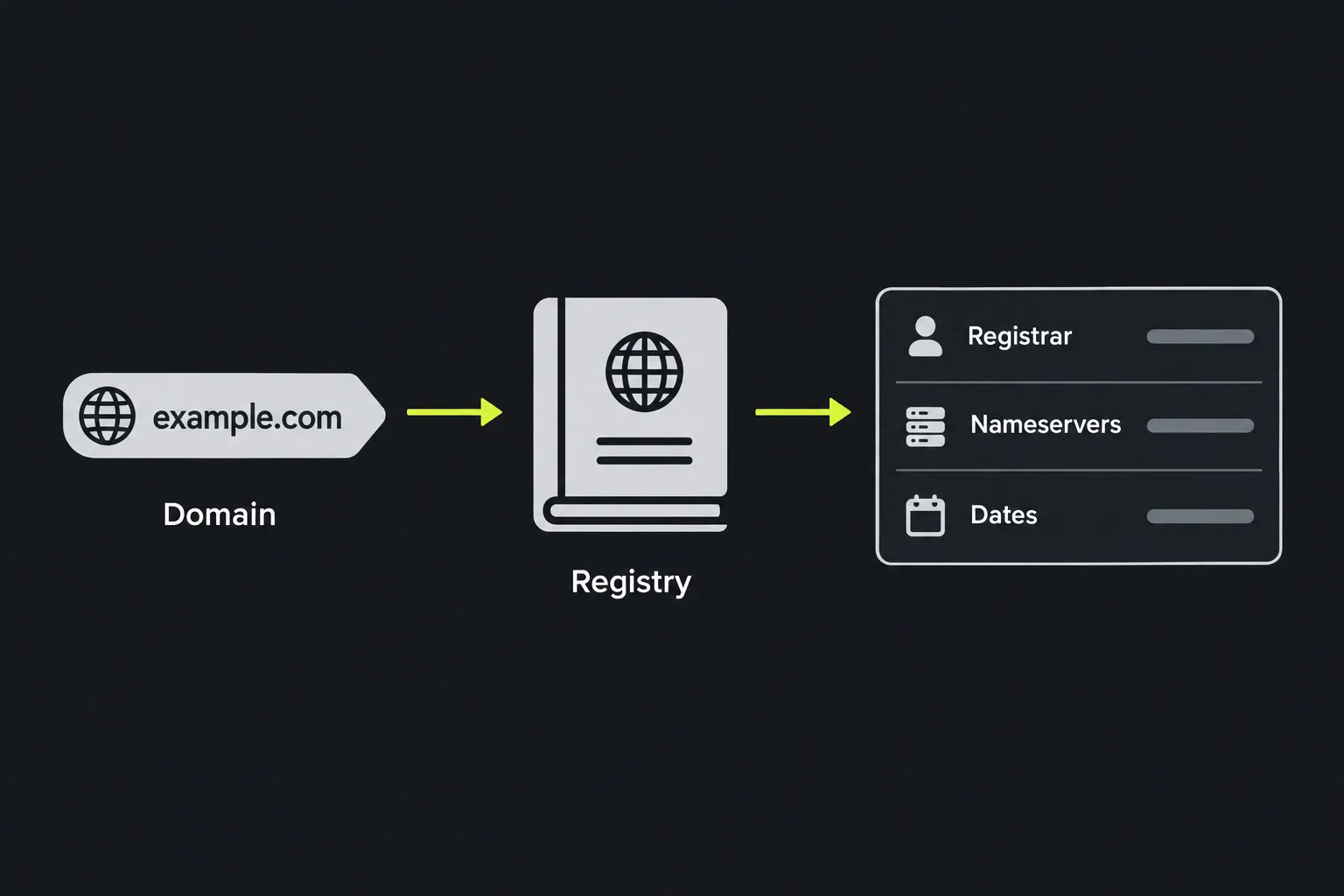
A registration record describes the domain itself rather than the website hosted on it. It can identify the registrar responsible for the registration, relevant dates and the nameservers recorded for the domain. Public contact information is often redacted because of data protection rules or registrar privacy services.
WHOIS is separate from DNS. A record can show which nameservers are registered, but it does not show the A, AAAA, MX or other DNS records stored on those servers.
How do I use Whois Lookup?
Enter a domain in the Domain name field and run the lookup. For the clearest input, use the bare domain, such as example.co.uk, rather than a full address containing https://, a page path or query parameters.
Domain names are case-insensitive, so EXAMPLE.CO.UK and example.co.uk refer to the same name. Numbers and hyphens can appear within labels, but spaces are invalid and a label cannot normally begin or end with a hyphen. Underscores may appear in specialised DNS record names, but they are not valid in an ordinary registrable hostname.
Accented and non-Latin domain names use Internationalised Domain Name encoding. An IDN label represented in ASCII is an A-label, which begins with xn-- and uses Punycode encoding. Acceptance and display rules vary between registries.
Reading the result
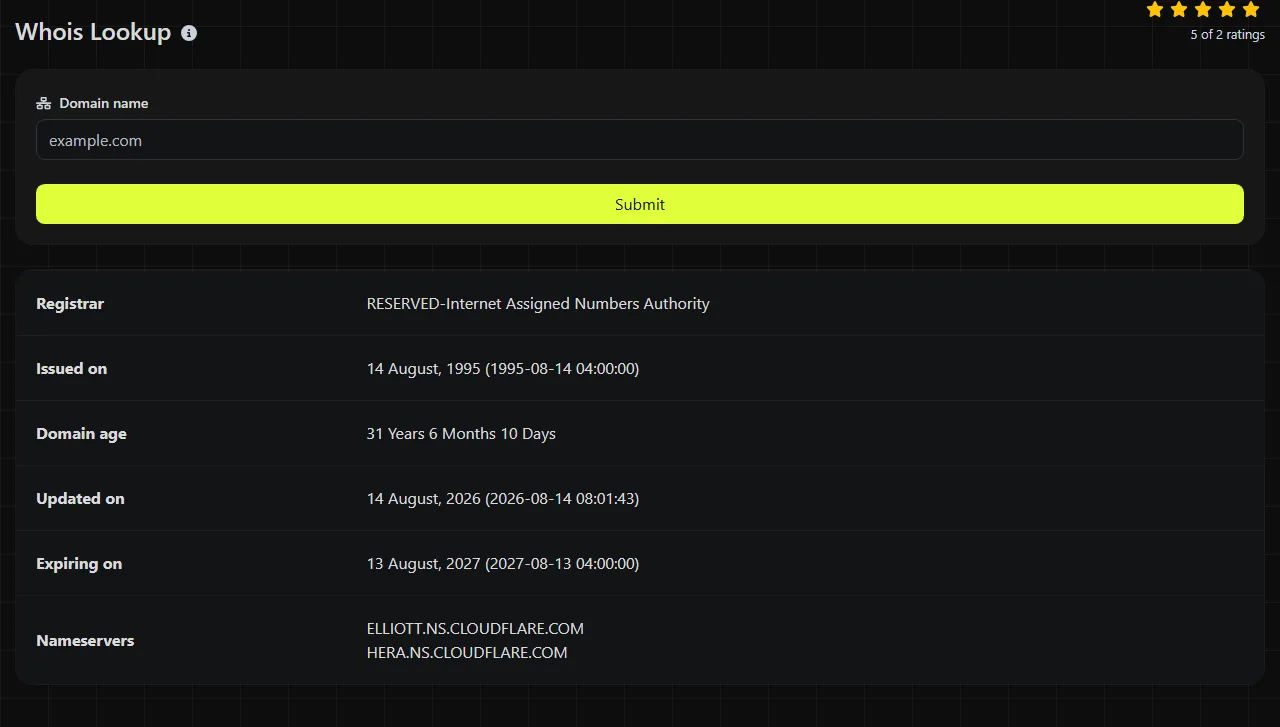
The result contains six fields, each describing a different part of the domain registration record.
- Nameservers lists the nameserver hostnames recorded for the domain. Compare these with the nameservers supplied by the current DNS or hosting provider.
- Registrar identifies the company managing the registration. The registrar is not necessarily the hosting company or the domain owner.
- Issued on gives the domain's registration or creation date as published in the record.
- Expiring on gives the recorded expiry date. Renewal, grace-period and registry policies can affect what happens on that date.
- Updated on shows when the registration record was last changed. It does not mean that the website's pages were updated then.
- Domain age reports how old the registration is according to the available registration dates. It does not establish how long the present owner has controlled it.
For example, an old Issued on date combined with a recent Updated on date may indicate a registrar change, renewal or nameserver update. The fields alone do not identify which change occurred.
Why can correct domain information look out of date?
Registration and DNS changes can take time to appear consistently because registrars, registries and DNS resolvers update different systems. A registrar may show a submitted change before the registry's public registration data reflects it.
Nameserver changes also have a DNS caching period. The WHOIS record may already list the new Nameservers while an internet provider or office network still uses cached information pointing towards the old servers. Conversely, a third-party WHOIS service may retain an earlier public record even after DNS resolution has changed.
Propagation is therefore not a single global event. Check again after the relevant DNS time to live has elapsed, and compare results from a different network or resolver before changing the configuration repeatedly.
When should I run a WHOIS check?
Run a WHOIS check when the fault may involve domain registration, delegation or an unexpected registrar-side change. Common cases include the following.
- A website no longer resolves. Check whether the listed nameservers match those supplied by the DNS provider. If they match, use Ping or inspect the individual DNS records because WHOIS cannot confirm the web server's address.
- Email stops arriving after a domain move. A nameserver change can send mail lookups to a DNS zone that lacks the correct MX records. WHOIS can report the registered nameservers, but confirming the current delegation requires a DNS query to the parent zone. It cannot display or validate the MX records themselves.
- A certificate warning appears after a hosting change. The listed nameservers can help you check whether they match those supplied by the intended provider. Use SSL Lookup to inspect the certificate because its issuer, hostname coverage and validity dates are not part of WHOIS.

Supplying the registrar, nameservers and relevant dates helps the registrar and hosting provider determine which organisation controls the part that may be failing.
Frequently asked questions
Can WHOIS tell me who owns a domain?
No, this result does not establish the legal owner of a domain. Registrant details may be redacted, replaced by a privacy service or withheld under registry policy, and the registrar name identifies the registration provider rather than the registrant.
Does an expiry date mean the domain will become available that day?
No, domains do not necessarily become available immediately after the displayed expiry date. Registrars and registries may apply auto-renewal, grace, redemption or deletion periods, with timings determined by the domain suffix and provider.
Can I use this lookup for an IP address?
The input field is for a domain name, not an IP address. For an address such as 192.0.2.10, an IP WHOIS service can identify the allocated network, while Reverse IP Lookup may help find domain associations.
Does a recent update date prove that a domain was transferred?
No, the Updated on value can change for several reasons, including renewal, contact changes, status changes or nameserver edits. Confirm a transfer through the relevant registrar account or registry process rather than inferring it from that date alone.
Is the domain I enter stored?
No. The lookup is performed on the server, the submitted domain travels to it over HTTPS, and the input is not stored.
Final checks
Copy the domain directly from the registrar account where possible, remove page paths and check for misspelt labels. If the nameservers are correct, continue with DNS, mail or certificate-specific checks rather than treating the WHOIS record as proof that the service itself is working.
Similar Tools
Use the reverse IP lookup tool to find the domain or host associated with any IP address quickly and easily.
Use our DNS lookup tool to quickly find A, AAAA, CNAME, MX, NS, TXT, SOA DNS records of any host and get detailed information.
Digily Link's IP lookup tool provides detailed information about any IP address. Use this free online service to get comprehensive IP data.
Popular Tools
Create your own custom signature and download it easily with our signature generator tool for personalized e-signatures.
Calculate the size of any text in Bytes (B), Kilobytes (KB), or Megabytes (MB) using our text size calculator tool.
Use the reverse IP lookup tool to find the domain or host associated with any IP address quickly and easily.
Use our ping tool to check the status and response time of any website, server, or port quickly and efficiently.
Digily Link's IP lookup tool provides detailed information about any IP address. Use this free online service to get comprehensive IP data.
Generate your free WhatsApp link instantly with our WhatsApp Link Generator. Add a custom message and start chats in one click. No login or coding required.