Unix Timestamp to Date
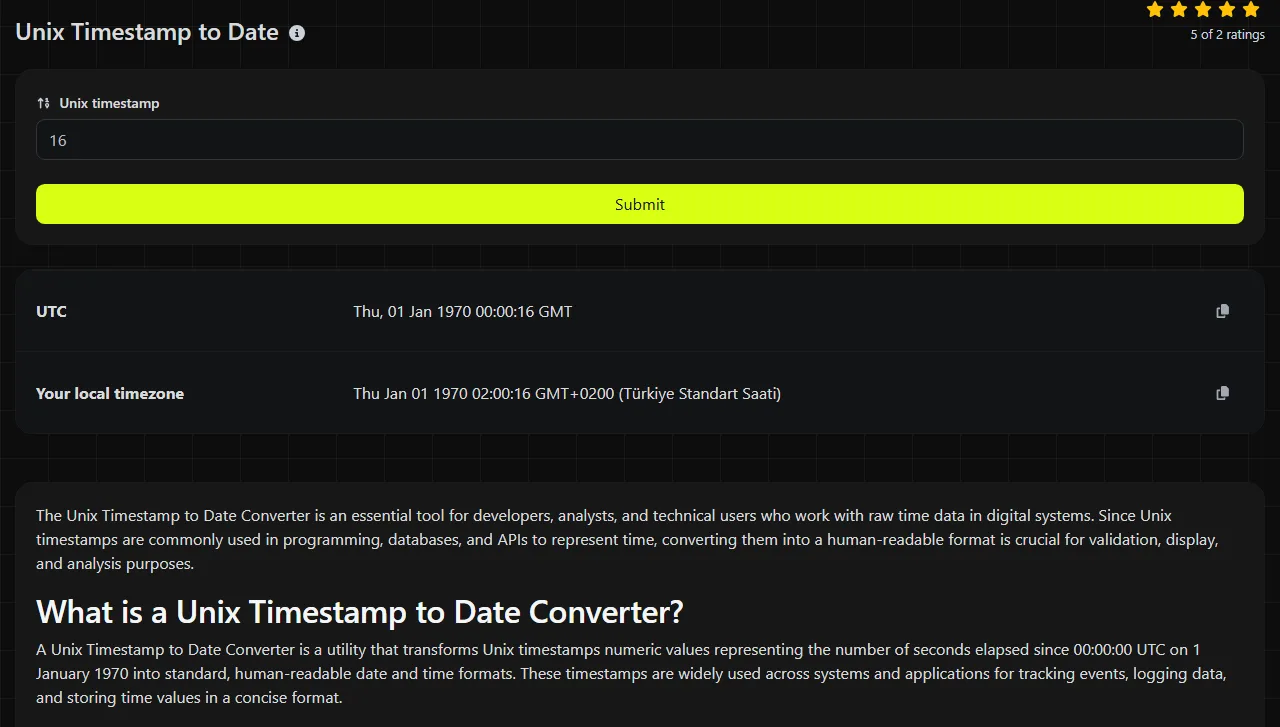
| UTC |
|
|
| Your local timezone |
|
Unix Timestamp to Date is a free tool that converts a Unix timestamp into a UTC date and the corresponding date in your local timezone.
What is a Unix timestamp?
A Unix timestamp is a numeric count of elapsed time since 00:00:00 UTC on 1 January 1970, known as the Unix epoch. It gives systems a compact, timezone-independent way to store and compare points in time.
Unix timestamps commonly count seconds, although some APIs and programming languages use milliseconds, microseconds or nanoseconds. The unit is not encoded in the number itself, so it must come from the surrounding documentation or data schema. A ten-digit value is commonly seconds for present-day dates, while a thirteen-digit value is commonly milliseconds, but digit count is only a useful clue rather than a formal guarantee.
Developers often need this conversion when reading third-party API responses, inspecting database records, checking log entries or debugging an expiry calculation. It is also useful before deployment when a configuration file contains activation, cache or token expiry times as integers rather than readable dates.
How do I convert a Unix timestamp to a date?
Enter the numeric value in Unix timestamp, then read the converted values for UTC and Your local timezone. UTC is the stable reference value, while the local result shows how that same instant appears under your timezone offset.
- Confirm that the source value is intended to be a Unix timestamp.
- Check whether its unit is seconds or a smaller unit such as milliseconds.
- Use the UTC result when comparing systems, logs or API data.
- Use the local result when checking what a person would have seen on a clock or calendar.

Use the integer alone where possible. Spaces, thousands separators, labels and copied punctuation are not part of the timestamp format. For example, 1,704,067,200 is formatted for human reading, but 1704067200 is the conventional machine-readable form. Accented letters and non-Latin characters have no meaning in a Unix timestamp.
The tool's exact handling of empty input, decimal values, separators and extremely long numbers is not specified. Remove surrounding text and verify the unit before treating any returned date as authoritative.
How should I read the UTC and local results?
Read the UTC value as the timezone-neutral reference and the local value as the same moment adjusted for your local timezone. They do not represent two different events.
In the UK, local time follows Greenwich Mean Time in winter and British Summer Time in summer. A UTC timestamp can therefore display the same clock time locally in winter but one hour later during the summer period. Historical and future timezone rules can also affect local rendering, particularly outside the UK.
If the result is unexpectedly decades away from the intended date, a seconds-versus-milliseconds mismatch is the first thing to check. If it is out by exactly one or several hours, inspect timezone assumptions rather than changing the timestamp. An off-by-one-day result often occurs when the UTC instant falls near midnight and the local offset moves it into the previous or following calendar day.
Invalid input may include letters, embedded labels, an empty value or a number outside the date range supported by the receiving system. The tool's exact error wording and supported numeric range are not documented, so an absent or implausible result should be checked against the source system rather than guessed at.
Worked timestamp conversions
These examples use timestamps measured in whole seconds.
Input 0
UTC output 1 January 1970 at 00:00:00 UTC
Zero marks the Unix epoch. A local display may differ where the applicable local offset is not UTC.
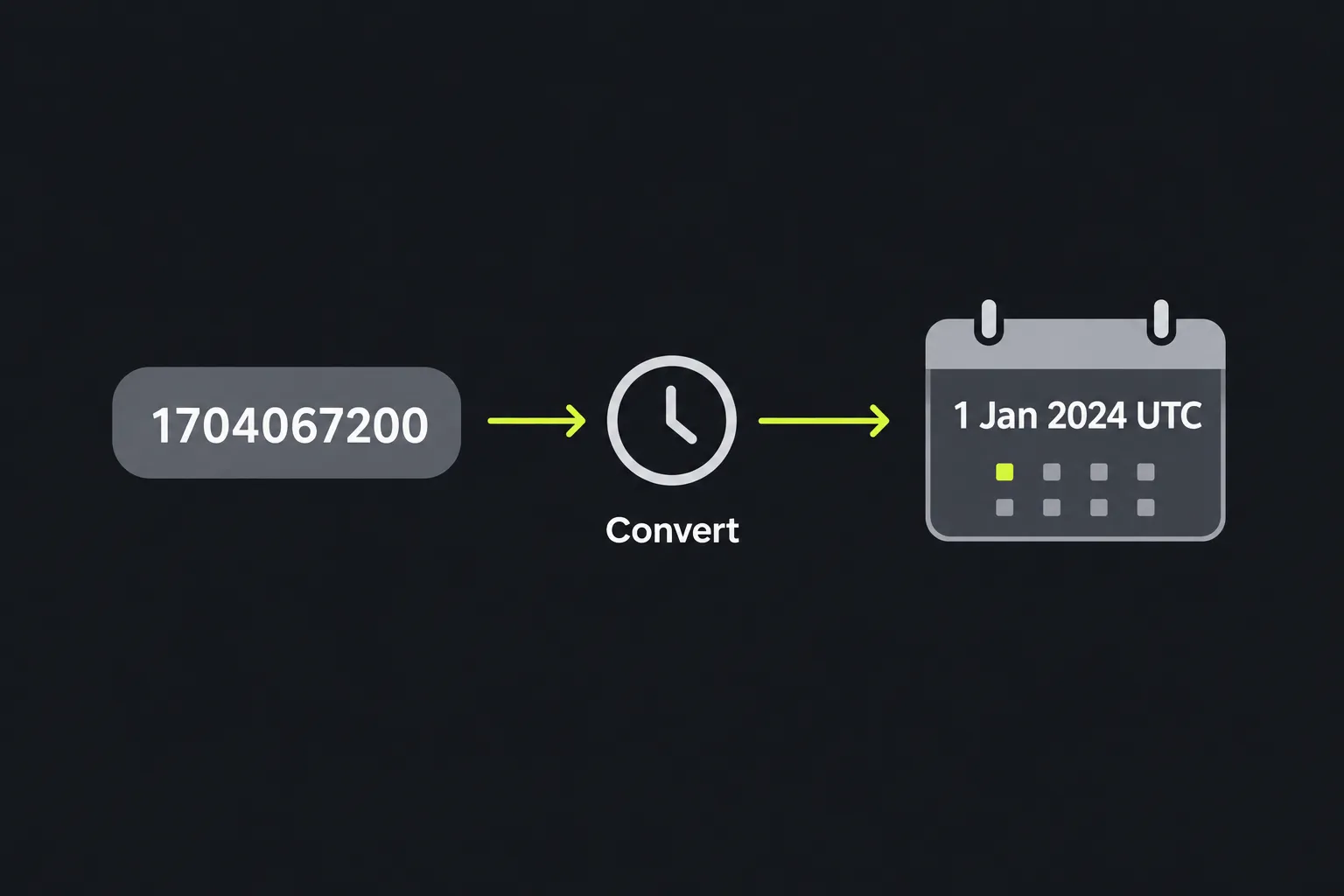
Input 1704067200
UTC output 1 January 2024 at 00:00:00 UTC
For the UK, that instant falls during GMT, so the UK local clock time is also midnight. The same timestamp shown in a timezone west of UTC would still fall on 31 December 2023.
Negative timestamps represent times before the Unix epoch. For example, -1 conventionally means one second before the epoch, or 31 December 1969 at 23:59:59 UTC. Support for negative values varies between software environments, databases and date libraries.
When is converting a timestamp unnecessary?
Conversion is unnecessary when only machines will read the value and every participating system already agrees on the unit and epoch. Keeping the numeric value avoids introducing formatted dates that might later be parsed with the wrong locale or timezone.
- Do not convert timestamps merely to compare their chronological order. Numeric timestamps using the same unit can be compared directly.
- Do not replace an API's required numeric timestamp with a formatted date unless its specification permits that format.
- Do not repeatedly convert and reparse timestamps during data processing. Keep the original value and format it at the presentation boundary.
- Do convert one when debugging an unfamiliar record, checking an expiry time or reviewing third-party data before import.
A readable conversion also does not prove that the source value is correct. A mistyped timestamp can still produce a perfectly valid date, so compare it with the business event, log sequence or source documentation.
Frequently asked questions
Can I use a 13-digit timestamp?
A 13-digit present-day timestamp usually means milliseconds rather than seconds. If a converter expects seconds, divide the millisecond value by 1,000 first, retaining any remainder only if the destination supports fractional seconds. This tool's handling of millisecond input is not specified, so verify the unit independently.
Do Unix timestamps include leap seconds?
Standard Unix time does not represent leap seconds as distinct numbered seconds. Systems normally map time onto a continuous count that treats each day as 86,400 Unix seconds, although clock synchronisation behaviour can differ between platforms. For ordinary application dates this rarely changes the displayed result, but it matters in specialised timing work.
Will the same timestamp give the same date everywhere?
It gives the same instant everywhere, but the local calendar date and clock time can differ by timezone. A timestamp close to midnight UTC may appear on different dates in London, New York and Tokyo. Exchange timestamps in UTC and apply local formatting only for display.
Why does a spreadsheet change my timestamp?
Spreadsheets may display long values in scientific notation or apply date formatting intended for their own date serial system. Import the timestamp column as text or an integer where precision permits, then use an explicit conversion formula. Check that the spreadsheet has not rounded the final digits before converting it.
Is the year 2038 a problem for Unix timestamps?
It can be a problem in systems that store Unix seconds as a signed 32-bit integer, whose positive range ends in January 2038. Modern 64-bit storage allows a much wider range, but older databases, embedded devices and libraries may still impose the narrower limit. Before deployment, check the storage type and the date library used by every system that receives the value.
Similar Tools
Easily convert any specific date to Unix timestamp format with our date to Unix timestamp converter tool.
Popular Tools
Create your own custom signature and download it easily with our signature generator tool for personalized e-signatures.
Calculate the size of any text in Bytes (B), Kilobytes (KB), or Megabytes (MB) using our text size calculator tool.
Use the reverse IP lookup tool to find the domain or host associated with any IP address quickly and easily.
Use our ping tool to check the status and response time of any website, server, or port quickly and efficiently.
Digily Link's IP lookup tool provides detailed information about any IP address. Use this free online service to get comprehensive IP data.
Generate your free WhatsApp link instantly with our WhatsApp Link Generator. Add a custom message and start chats in one click. No login or coding required.