ICO to GIF
ICO to GIF is a free tool that converts an ICO icon file into a GIF image in your browser.
How do I convert an ICO file to GIF?
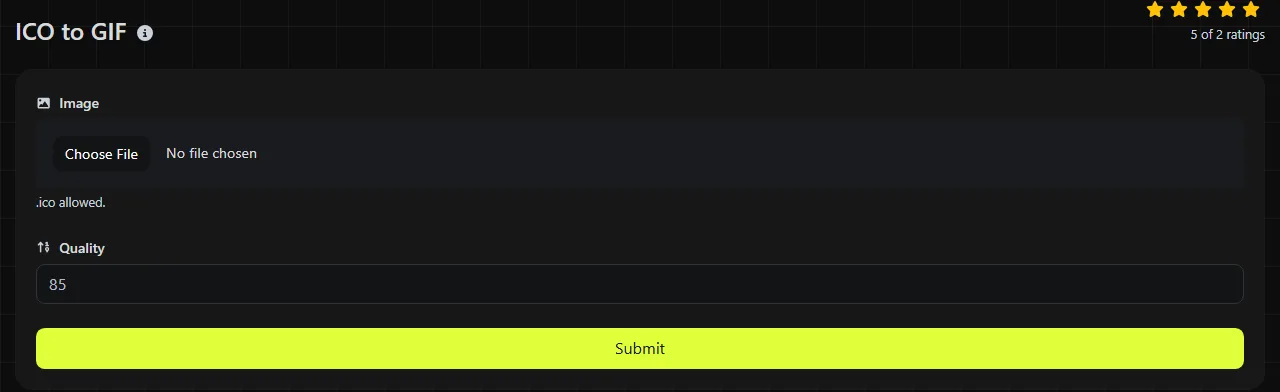
Select the ICO file, run the conversion, then save the resulting GIF. The work is done entirely in your browser, and the ICO file is never uploaded to a server.
- Provide the ICO file you want to convert.
- Let the browser process the icon and create a GIF version.
- Save the GIF and check it at its intended display size.
For example, an input file containing a small transparent application icon produces a GIF image rather than an ICO container. If the ICO contains several icon sizes, remember that GIF does not have the same built-in structure for storing alternative resolutions.
What changes when an ICO is converted to GIF?
The icon becomes a palette-based GIF image, so its transparency, colour range, compression and handling by software may change.
| Property | ICO | GIF |
|---|---|---|
| Primary purpose | Stores icons, often with several sizes for Windows applications or favicons | Stores a web image and can also contain timed animation frames |
| Colours | Depends on the images inside the container and may include full-colour PNG data | Limited to a palette of up to 256 colours per frame |
| Transparency | Can contain smooth alpha transparency, depending on the embedded image | Uses a transparent palette entry and cannot preserve partial transparency in the same way |
| Compression | May contain PNG-compressed data or bitmap-style icon data | Uses lossless LZW compression after the image has been reduced to an indexed palette |
| Animation | Its multiple images normally represent sizes or colour depths, not moments in an animation | Supports multiple timed frames |
| Support | Commonly recognised as an icon or favicon format | Widely displayed by browsers, image viewers, presentation software and messaging platforms |
GIF compression is lossless for the indexed pixels it stores, but reducing a full-colour ICO image to 256 colours can still discard visual information. Smooth shadows, gradients and semi-transparent edges are the areas most likely to change.
Images inside an ICO usually represent alternatives such as 16 × 16, 32 × 32 and 48 × 48 pixels rather than an animation sequence.
When is converting ICO to GIF a good idea?
Conversion makes sense when software accepts GIF images but does not recognise ICO files. It can also help when you need to place an icon in an older document, content management system or image field that expects a conventional web image.
- Use GIF for a flat icon with a small, controlled colour palette.
- Keep ICO for a Windows application icon that needs several resolutions in one file.
- Prefer PNG when smooth alpha transparency or more than 256 colours must be retained.
- Consider ICO to WebP when the image is intended for a modern website and does not need to remain an icon container.
Converting to GIF is not a way to improve a blurred or damaged source. If an ICO contains a low-resolution or already degraded image, changing it to a lossless GIF does not restore missing detail. Likewise, enlarging a 16 × 16 icon for the conversion only makes its pixels larger.
How large will the converted GIF be?
A small, simple icon will generally produce a modest GIF, but there is no fixed size ratio between ICO and GIF. The result depends on the dimensions, number of colours, transparency and amount of repeated detail.
A GIF may be smaller than an ICO that bundles several resolutions because the ICO stores more than one representation. However, an ICO containing one efficiently compressed PNG image may be smaller than the corresponding GIF. Flat areas and repeated patterns compress well in GIF, while photographic textures, gradients and noisy pixels tend to produce larger files and poorer colour reproduction.
Compare the ICO input and GIF output only after checking that their dimensions and visual content are equivalent. A smaller GIF is not a useful saving if palette reduction has introduced banding or rough edges.
Unusual ICO input and visual checks
ICO is a container format, so two files with the same extension can contain quite different image data. One might hold a single legacy bitmap icon, while another contains several PNG-compressed images at different sizes.
- Several embedded sizes: GIF cannot preserve the ICO mechanism that lets software choose a resolution automatically.
- Semi-transparent edges: soft shadows and antialiased curves may gain a hard outline because GIF has limited transparency.
- More than 256 colours: the image must use a reduced palette, which can create visible bands in gradients.
- Incorrect extensions: renaming another image to end in .ico does not make it a valid ICO file.
- Corrupt or empty files: an ICO decoder cannot recover image data that is missing or structurally invalid.
- Detailed artwork: GIF is still a poor choice for detailed artwork or photographs.
After ICO conversion, inspect the GIF against both a light and dark background. This makes pale fringes, opaque corners and changes caused by GIF's binary transparency easier to spot.
Frequently asked questions
Can I use the converted GIF as a website favicon?
Some browsers can display GIF favicons, but ICO and PNG are more conventional choices for broad favicon handling. Bookmark managers, operating-system shortcuts and older software may treat a multi-size ICO more predictably. Test GIF favicon compatibility in the browsers and devices relevant to the site.
Will changing the file extension from .ico to .gif work?
No. Renaming the extension does not rewrite the file's internal encoding, so software may reject it or identify it as ICO data. A proper conversion decodes the icon and encodes new GIF image data.
Can I convert the GIF back to ICO later?
Yes, with a suitable GIF-to-ICO process, but the original ICO structure will not return automatically. Any discarded colours, partial transparency and alternative icon sizes remain lost unless they are recreated from another source.
Is GIF suitable for an icon with a drop shadow?
Usually not if the shadow uses gradual transparency. GIF cannot represent the full range of alpha values needed for a soft edge, so the shadow may look jagged or acquire a visible background fringe. PNG is generally a more suitable output for that type of icon.
Why does the GIF look different on a coloured background?
The source ICO may use partially transparent edge pixels blended for smooth curves. GIF reduces transparency to a palette-based form, which can expose a halo when the background changes. Before using the file, preview it on the actual page colour rather than only on a chequerboard transparency view.
Similar Tools
Easily convert ICO image files to PNG format with our ICO to PNG converter tool for high-quality images.
Easily convert ICO image files to WebP format with our ICO to WebP converter tool for efficient image compression.
Easily convert ICO image files to JPG format with our ICO to JPG converter tool for versatile image usage.
Popular Tools
Create your own custom signature and download it easily with our signature generator tool for personalized e-signatures.
Calculate the size of any text in Bytes (B), Kilobytes (KB), or Megabytes (MB) using our text size calculator tool.
Use the reverse IP lookup tool to find the domain or host associated with any IP address quickly and easily.
Use our ping tool to check the status and response time of any website, server, or port quickly and efficiently.
Digily Link's IP lookup tool provides detailed information about any IP address. Use this free online service to get comprehensive IP data.
Generate your free WhatsApp link instantly with our WhatsApp Link Generator. Add a custom message and start chats in one click. No login or coding required.