Case converter
Case converter is a free tool that changes text into lowercase, UPPERCASE, Sentence case, camelCase, PascalCase and several separator-based naming formats.
How do I use the case converter?
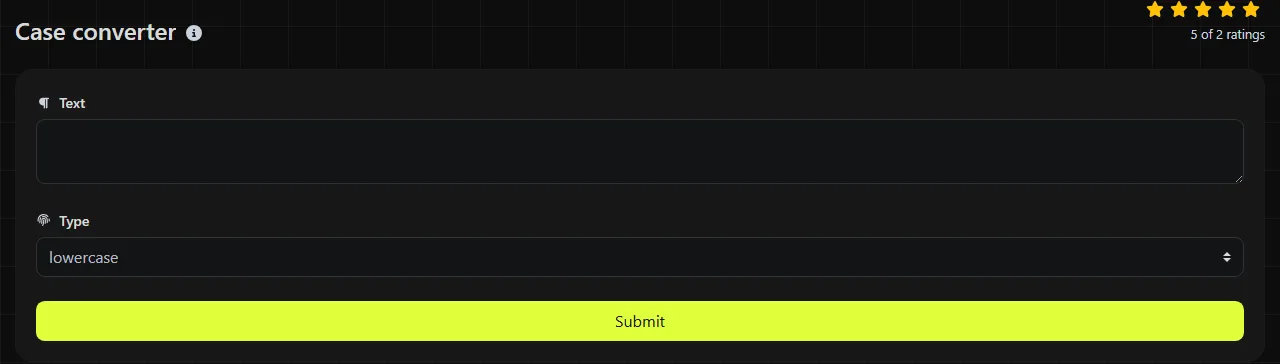
Paste or type your text, then choose the case you need.
- Select lowercase, UPPERCASE, Sentence case, camelCase, PascalCase, Capital Case, CONSTANT_CASE, dot.case, snake_case or param-case.
- Copy the converted result and check it in its destination.
If you are converting code, a filename or a field name, review the converted name in context. Seeing the text in context makes stray spaces and missing separators easier to spot.
Which text case should I choose?
Choose the case required by the system, style guide or programming language where the text will be used.
- lowercase is useful for normalising search terms, tags and text that must use lower-case letters.
- UPPERCASE suits short labels, reference codes and headings where the relevant style permits capitals.
- Sentence case is appropriate for ordinary headings and interface labels where only the opening word, proper nouns, acronyms and similar terms need initial capitals.
- Capital Case capitalises words and is commonly used for titles or named fields.
- camelCase is common for JavaScript variables and JSON object member names.
- PascalCase is widely used for class, type and component names in languages such as C# and TypeScript.
- snake_case is common in Python, SQL column names and data exports.
- CONSTANT_CASE is a familiar convention for constants and environment variable names.
- param-case uses hyphens, which suits many URL slugs, command options and CSS class names.
- dot.case can be used for configuration keys and hierarchical labels where the receiving system accepts full stops.
Worked case conversions
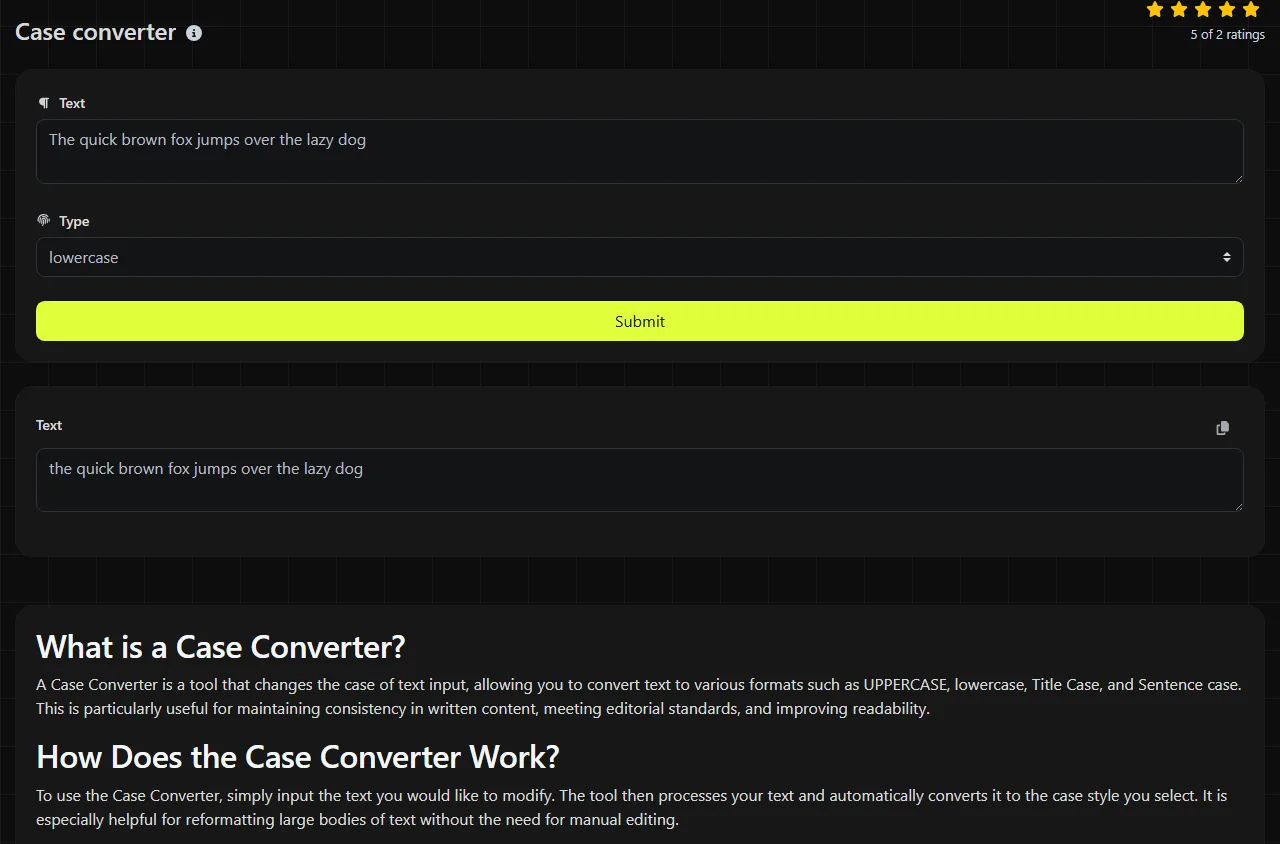
Using the input quarterly sales report gives these straightforward examples:
- lowercase produces quarterly sales report.
- UPPERCASE produces QUARTERLY SALES REPORT.
- Sentence case produces Quarterly sales report.
- camelCase produces quarterlySalesReport.
- PascalCase produces QuarterlySalesReport.
- Capital Case produces Quarterly Sales Report.
- CONSTANT_CASE produces QUARTERLY_SALES_REPORT.
- dot.case produces quarterly.sales.report.
- snake_case produces quarterly_sales_report.
- param-case produces quarterly-sales-report.
Where does case conversion save time?
Case conversion saves time when the same labels must be reformatted for another platform, file or naming convention.
- Clean column headings copied from Microsoft Excel or Google Sheets before importing a CSV file into a database.
- Turn a content title into a candidate hyphenated slug for WordPress, while checking punctuation, accented characters and other unsupported characters separately.
- Convert API field names to camelCase for JavaScript or snake_case for Python.
- Standardise headings before preparing mail-merge data in Microsoft Word, Mailchimp or another system that relies on consistent field names.
- Create readable environment variable names for a deployment configuration using CONSTANT_CASE.
- Normalise copied headings before placing them in Jira tickets, GitHub issues or internal documentation.
Changing letter case does not usually reduce the number of ordinary Latin characters. If the destination has a character limit, such as a social media post or form field, use a Character counter after conversion rather than assuming the text now fits.
What happens with spaces, punctuation and unusual characters?
Spaces and punctuation need a final visual check, especially when converting text into a programming or URL-style format.
Numbers have no upper or lower case, so case conversion does not change the digits themselves. Separator-based formats conventionally replace word boundaries with underscores, hyphens or full stops, but punctuation within real text can create results that are unsuitable for code or URLs.
Accented letters and non-Latin scripts are more complicated because uppercase and lowercase mappings depend on Unicode and, in some cases, language-specific rules.
How is my text handled?
Your input is sent to the server over HTTPS, processed there and not stored.
Because the conversion does not happen solely in your browser, avoid entering passwords, private keys, unpublished personal data or other sensitive material. HTTPS protects the connection in transit, but case conversion is unnecessary for secrets and may make them invalid.
Frequently asked questions
Does changing case alter a password or reference number?
Yes, it can alter any value that contains letters. Passwords, API keys, product references and database identifiers may be case-sensitive, so do not convert them unless the receiving system explicitly requires it.
Will camelCase always produce a valid programming identifier?
No. An identifier can still be invalid if it begins with a number, contains unsupported characters or matches a reserved word in the language. Run the result through your editor, compiler or linter before using it in code.
Can CONSTANT_CASE be used for environment variables?
It matches the usual visual convention, but each shell, hosting platform and configuration format can impose additional rules. A leading digit, punctuation mark or non-ASCII character may still be rejected.
Can I convert an entire spreadsheet column automatically?
For a one-off list, copying the cells into a text utility may be convenient. For a recurring spreadsheet process, Excel functions such as LOWER, UPPER and PROPER, or a Power Query transformation, are easier to repeat and audit.
Does case conversion translate the text?
No. It changes capitalisation and, for naming formats, word separators. It does not translate words, correct spelling or rewrite grammar.
Final checks
Paste the result into its destination and check leading spaces, punctuation, acronyms, accented letters and any naming restrictions. For code and imported data, validate one sample before converting the rest of the list.
Popular Tools
Create your own custom signature and download it easily with our signature generator tool for personalized e-signatures.
Calculate the size of any text in Bytes (B), Kilobytes (KB), or Megabytes (MB) using our text size calculator tool.
Use the reverse IP lookup tool to find the domain or host associated with any IP address quickly and easily.
Use our ping tool to check the status and response time of any website, server, or port quickly and efficiently.
Digily Link's IP lookup tool provides detailed information about any IP address. Use this free online service to get comprehensive IP data.
Generate your free WhatsApp link instantly with our WhatsApp Link Generator. Add a custom message and start chats in one click. No login or coding required.