Base64 encoder
Base64 encoder is a free tool that converts a string into standard Base64 text.
What is Base64 and why does it exist?
Base64 is a binary-to-text encoding that represents data using letters, numbers and a small set of symbols. It exists because some systems can transport text reliably but may alter or reject raw binary data.
The standard Base64 alphabet contains uppercase and lowercase letters, digits, plus signs and forward slashes. An equals sign may appear at the end as padding. The encoded value is usually longer than the original because each group of three input bytes becomes four Base64 characters.
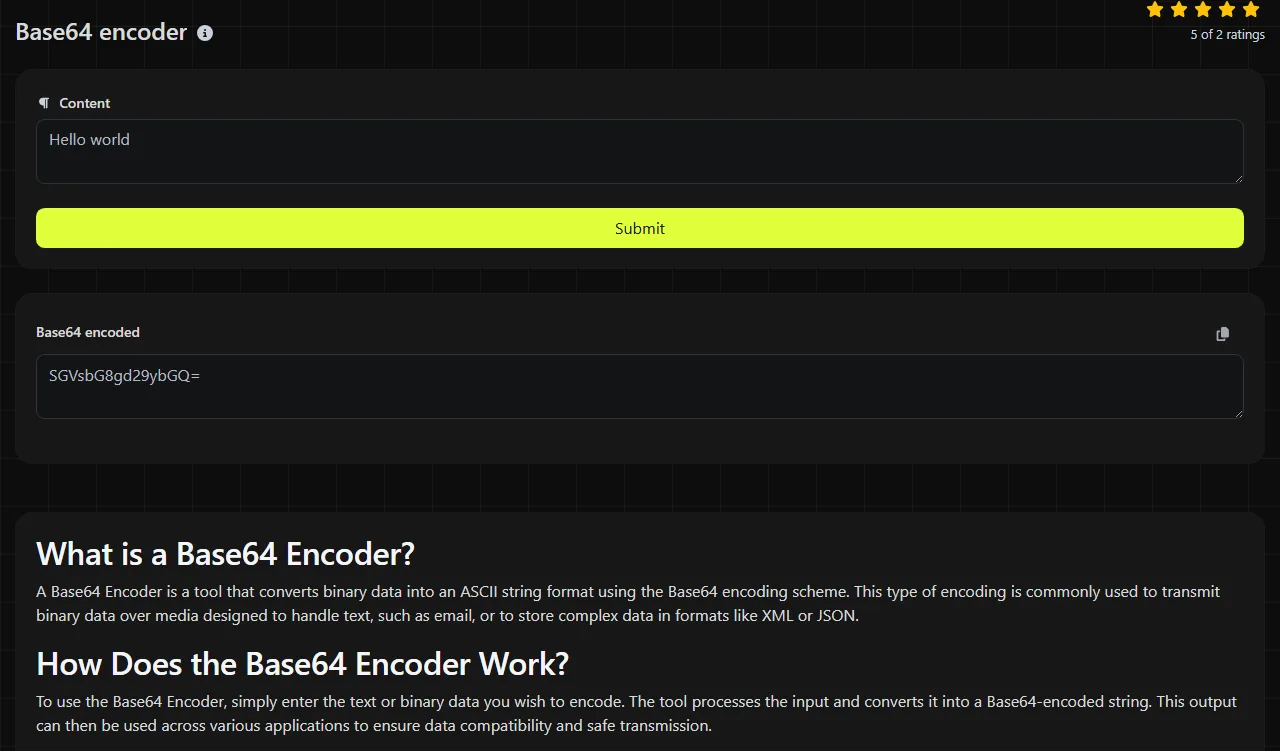
The input is Hello.
The output is SGVsbG8=.
Base64 works on bytes rather than human-readable characters. Spaces, punctuation and numbers are encoded like any other input. Accented letters, emoji and non-Latin scripts must first have a character encoding, usually UTF-8, and different byte encodings produce different Base64 results. Empty input produces an empty encoded value, while very long input produces a proportionally longer string.
Base64 is encoding, not encryption. Anyone with a decoder can recover the original data, so it provides no secrecy and is unsuitable for hiding passwords, API keys or personal information.
How do I use the Base64 encoder?
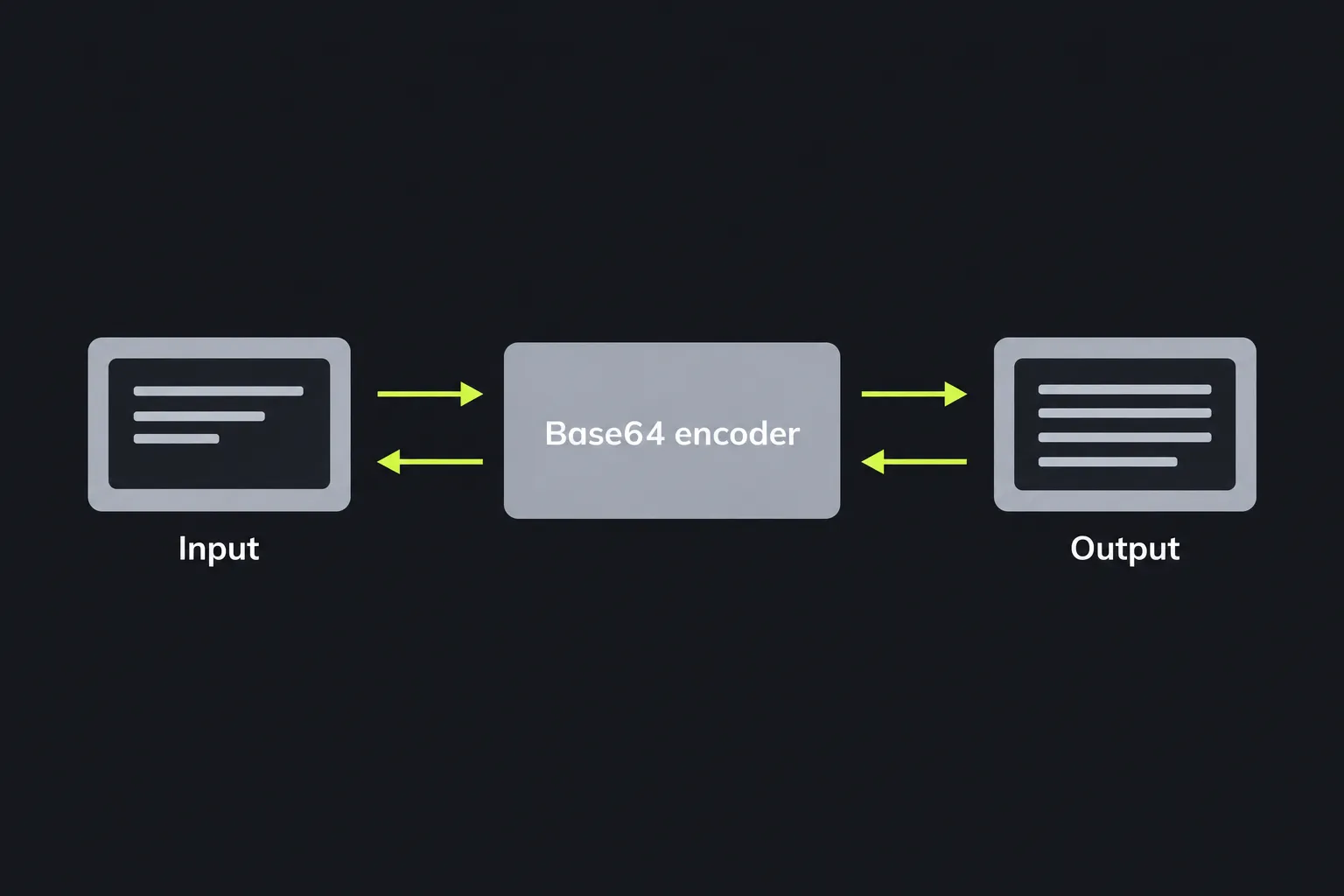
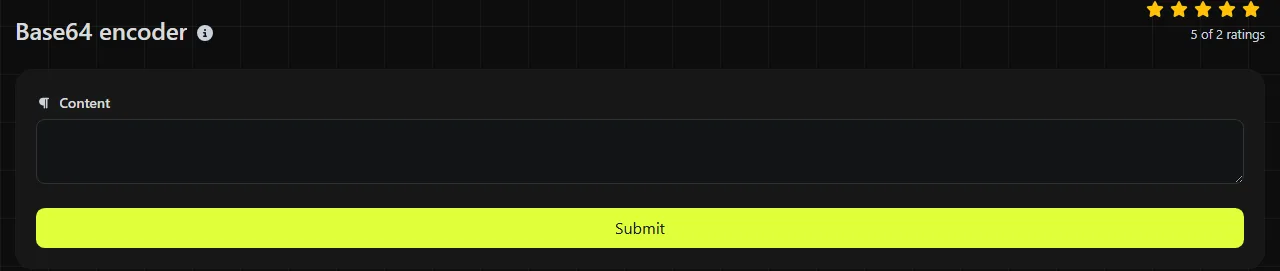
Enter the string that needs encoding and read the converted value from the Base64 encoded result field. The tool uses standard Base64 encoding through PHP's base64_encode function.
- Copy the exact source string, including any spaces or line breaks that need to be retained.
- Copy the returned Base64 value without adding quotation marks or extra whitespace.
The work is done on the server. Your input travels to the server over HTTPS and is not stored. Although HTTPS protects the request while it is in transit, avoid submitting secrets unless Base64 is genuinely required by the system receiving them.
Where is Base64 used in practice?
Base64 is used where binary data or arbitrary bytes must pass through a text-based format. The receiving system must know that the value is Base64 and decode it at the appropriate stage.
- Data URLs place Base64-encoded images, fonts or other files directly inside HTML or CSS alongside a media type.
- Query strings sometimes carry encoded tokens or structured data, although the URL-safe Base64 variant is normally more suitable.
- Email uses Base64 as one of the MIME transfer encodings for attachments and message parts that cannot be sent safely as plain text.
- JSON payloads may represent image bytes, documents or cryptographic material as strings because JSON has no native binary type.
- HTTP authentication uses Base64 for the username and password in Basic authentication. The value remains readable after decoding, so transport security is still required.
Choosing standard Base64 or Base64url
This tool produces standard Base64, which is appropriate for MIME email, many JSON APIs and systems that explicitly request the usual Base64 alphabet. Standard output can contain +, / and trailing = padding.
Choose Base64url when the value will form part of a URL, filename, cookie or JSON Web Token. That variant replaces + with - and / with _, and often omits padding. Do not switch variants without checking the receiving system's specification. A decoder expecting one alphabet may reject the other.
Why does Base64 fail to decode or produce gibberish?
Base64 usually fails to decode because the input uses an unexpected variant or has been changed in transit. Valid Base64 may decode to binary bytes that look like gibberish when displayed as text.
- Wrong alphabet is common when Base64url input is sent to a strict standard Base64 decoder, or the reverse.
- Missing padding can cause an error in decoders that require the length to be completed with one or two equals signs.
- Double encoding happens when an already encoded value is encoded again. The first decode then returns another Base64-looking string rather than the original content.
- Changed characters may occur when a plus sign in a query string is interpreted as a space, or when copying introduces line breaks and spaces.
- Binary output can look like gibberish when displayed as text. The decoded bytes may be an image, compressed archive, PDF or encrypted file that must be opened by the correct application.
The Base64 decoder can reverse standard Base64 text. If the decoded bytes represent an image, Base64 to Image may be the more direct next step.
Frequently asked questions
Does Base64 preserve capital letters and line breaks?
Yes, Base64 preserves the underlying bytes, including letter case and newline characters. However, Windows and Unix-style line endings use different byte sequences, so visually identical multi-line text can produce different encoded values.
Can I paste Base64 directly into HTML or CSS?
Only if you add the syntax required by the document. A data URL normally needs a media type and the ;base64 marker before the encoded payload, and this encoder returns the payload rather than constructing that full URL.
Will the same text always produce the same Base64 value?
It will produce the same value when the input bytes are identical. A different character encoding, an invisible trailing space, a byte order mark or a changed line ending will alter the result.
Is Base64 case-sensitive?
Yes. Uppercase and lowercase characters represent different values in the Base64 alphabet, so changing the case can corrupt the decoded data even when the string still looks valid.
Can this tool encode a file?
This tool is specified for strings rather than file uploads. Pasting a textual representation of a file is not the same as encoding the file's raw bytes. If another application requires a file's bytes as Base64, use a file-capable encoder and follow that application's requirements for the Base64 alphabet and padding.
Similar Tools
Decode Base64 input back to its original string format with our Base64 decoder tool for easy data retrieval.
Popular Tools
Create your own custom signature and download it easily with our signature generator tool for personalized e-signatures.
Calculate the size of any text in Bytes (B), Kilobytes (KB), or Megabytes (MB) using our text size calculator tool.
Use the reverse IP lookup tool to find the domain or host associated with any IP address quickly and easily.
Use our ping tool to check the status and response time of any website, server, or port quickly and efficiently.
Digily Link's IP lookup tool provides detailed information about any IP address. Use this free online service to get comprehensive IP data.
Generate your free WhatsApp link instantly with our WhatsApp Link Generator. Add a custom message and start chats in one click. No login or coding required.