Base64 to Image
Base64 to Image is a free tool that converts Base64-encoded image data back into an image.
How does Base64 represent an image?
Base64 represents an image by translating its binary bytes into a restricted set of printable text characters. It exists because some systems are designed to carry text rather than raw binary data, so encoding the bytes makes them easier to place in email, JSON, HTML or other text-based formats.
The standard Base64 alphabet uses uppercase letters, lowercase letters, digits, plus signs and forward slashes. An equals sign may appear at the end as padding. Every three input bytes normally become four Base64 characters, so the encoded form is roughly one-third larger than the original data.
A tiny text example shows the operation clearly:
- Original bytes interpreted as text: Man
- Base64 output: TWFu
An image follows the same process, but its original bytes describe a PNG, JPEG, GIF, WebP or another image format rather than readable text. Raw Base64 does not itself state the image type. That information may instead appear in a data URL or be inferred from the decoded file signature.
How do I convert Base64 back into an image?
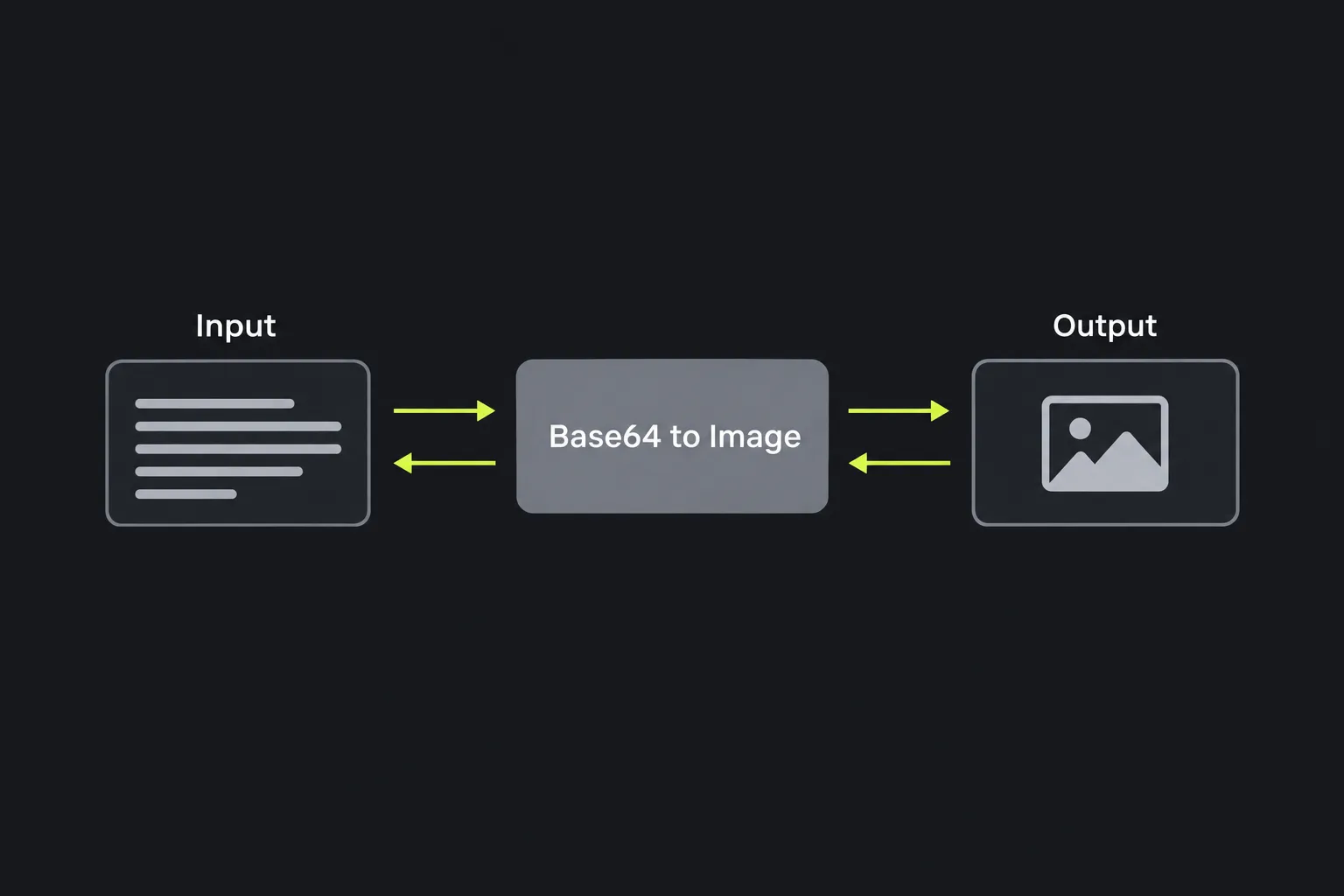
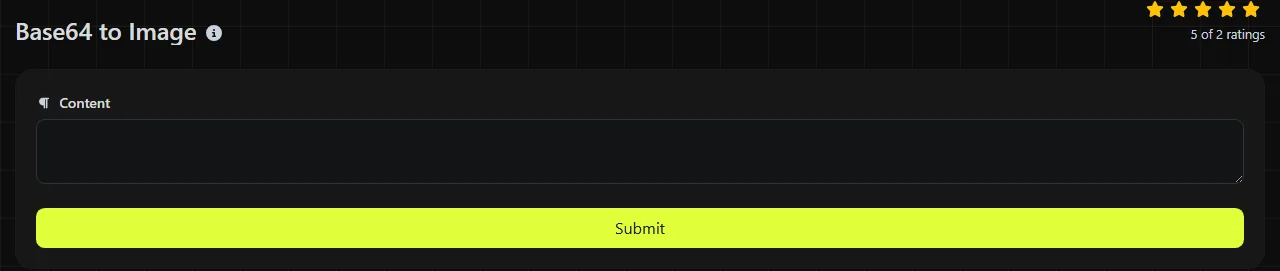
Paste the Base64 image data into the tool and submit it for conversion; the returned result is an image. Before doing so, check whether the value is raw Base64 or a complete data URL.
- Find the encoded value and copy it without surrounding quotation marks from JSON, CSS or source code.
- Look for a data URL prefix such as data:image/png;base64,. The actual Base64 payload begins after the comma.
- If a complete data URL is rejected, remove the prefix and submit only the encoded payload, since decoders differ in whether they accept the wrapper.
- Check that the resulting image has the expected content, dimensions and format before using it elsewhere.
Spaces and line breaks sometimes appear when email software wraps a long Base64 value. Some decoders ignore this whitespace, while stricter ones reject it. Do not add punctuation or explanatory text to the payload. Numbers are valid Base64 characters, but a string made only from valid characters is not necessarily an image.
An empty Base64 value represents no bytes, so it cannot produce a usable image. Very long values are also bulky because Base64 expands the original data, and processing them requires the complete encoded string to be transferred and decoded.
Why will my Base64 image not decode?
A Base64 image usually fails to decode because the text is malformed or incomplete, uses the wrong alphabet or does not contain image bytes. If its source encoded it more than once, double encoding can also be the cause. The position and appearance of the failure can help identify the cause.
- Truncated input. Copying from logs, database viewers or messaging systems can cut off the end of a long value. Missing characters usually make the decoded bytes incomplete.
- Wrong variant or alphabet. Standard Base64 uses + and /, while Base64url commonly uses - and _. A decoder expecting the other variant may reject the input.
- Missing padding. Base64 values may end in one or two equals signs. Some systems omit this padding and some decoders reconstruct it, but strict implementations may require it.
- Binary data that is not an image. Base64 can represent a PDF, archive, font or any other bytes. Valid Base64 therefore does not guarantee a valid image.
- Text encoding confusion. Accented letters, emoji and non-Latin characters are not part of the Base64 alphabet. Such characters must first be represented as bytes, commonly with UTF-8, before Base64 encoding.
- Double encoding. If the first decode produces another long string containing only Base64 characters, the source may have been encoded twice. Decode the intermediate value once more only if its origin confirms that this is expected.
If a general Base64 decoder produces gibberish, that does not necessarily mean the decode failed. Image bytes are binary and are not expected to look readable as text. Use Base64 decoder when you need to inspect a non-image payload, and Image to Base64 when you need to perform the reverse operation.
Where is Base64 image data used?
Base64 image data appears wherever binary files need to travel through a text-oriented field or document. Common examples include embedded images in HTML or CSS data URLs, image properties in JSON API payloads, and MIME email parts.
It can also appear in query strings, where application query parsers may mishandle standard Base64 characters, particularly form-style parsers that treat plus signs as spaces or equals signs as delimiters. Base64url replaces the troublesome alphabet characters and often omits padding, which makes it more suitable for URLs and tokens.
Internationalised domain names do not use Base64. In the IDNA system, ASCII labels are unchanged, while non-ASCII U-labels may be represented as A-labels using Punycode. A Base64 value may occur elsewhere in a URL, such as its query string. This distinction matters when diagnosing a value copied from a browser address.
JSON has no native binary type, so APIs sometimes place Base64 image content inside a quoted string. This is convenient for text-based interchange, but it increases payload size. For large or frequent uploads, a normal binary file upload is often more appropriate.
Base64 encoding, secrecy and server processing
Base64 is encoding, not encryption, and it provides no secrecy. Anyone who has the value can decode it without a password or key, so credentials, private photographs and confidential documents should not be protected merely by converting them to Base64.
For this tool, the work is done on the server. Your input travels to the server over HTTPS and is not stored. HTTPS protects the connection while data is in transit, but it does not turn the Base64 value into encrypted content or make an untrusted source safe.
Decoding also does not check whether an image is benign. Treat images decoded from Base64 values received from unknown senders with the same care as other downloaded images.
Frequently asked questions
Can I identify the image format from raw Base64?
Sometimes, but the Base64 alphabet alone does not declare a format. Decoded files contain signatures, often called magic bytes, that software can use to distinguish formats such as PNG, JPEG and GIF. A data URL may also declare a media type, though that label can be wrong and should not override the actual bytes.
Does Base64 decoding reduce image quality?
No, a correct Base64 decode restores the original bytes and does not recompress the image. Image quality, colour data and embedded metadata remain unchanged unless another program subsequently edits or converts the decoded file.
Can Base64 contain an SVG image?
Yes, SVG data can be Base64-encoded, although support for displaying it depends on the receiving software. SVG is an XML-based format and can contain scripts, links or external references, so do not assume that Base64-encoded SVG from an unknown source is safe to open.
Why is a Base64 image larger than the original file?
Base64 emits four text characters for each three bytes of source data, and the final quantum may contain padding. RFC 4648 requires padding unless the referring specification explicitly permits its omission. The result is therefore about one-third larger before any data URL prefix, JSON quoting or transport overhead is added. Where a system accepts ordinary file uploads, sending the original binary image usually uses less data.
Similar Tools
Convert your image into a Base64 string with our image to Base64 tool for efficient data encoding.
Popular Tools
Create your own custom signature and download it easily with our signature generator tool for personalized e-signatures.
Calculate the size of any text in Bytes (B), Kilobytes (KB), or Megabytes (MB) using our text size calculator tool.
Use the reverse IP lookup tool to find the domain or host associated with any IP address quickly and easily.
Use our ping tool to check the status and response time of any website, server, or port quickly and efficiently.
Digily Link's IP lookup tool provides detailed information about any IP address. Use this free online service to get comprehensive IP data.
Generate your free WhatsApp link instantly with our WhatsApp Link Generator. Add a custom message and start chats in one click. No login or coding required.