Upside down text generator
Upside down text generator is a tool that reverses the input byte by byte. Because UTF-8 characters can use multiple bytes, non-ASCII input may be corrupted.
How do I turn text upside down?
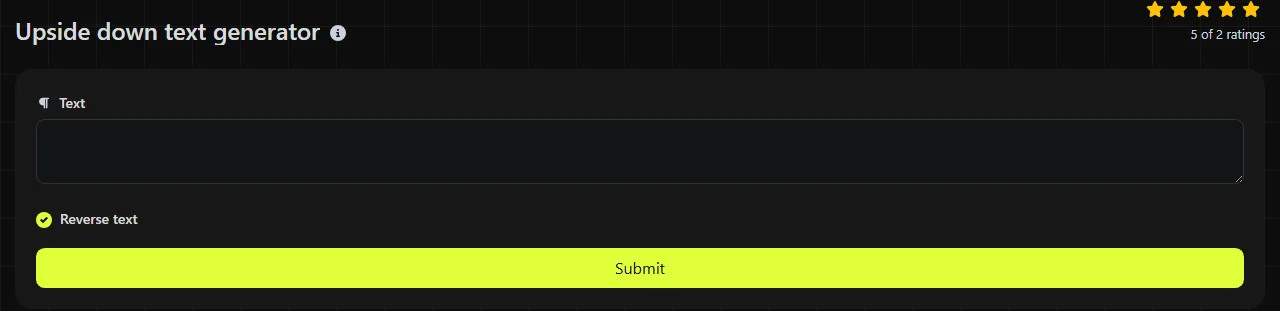
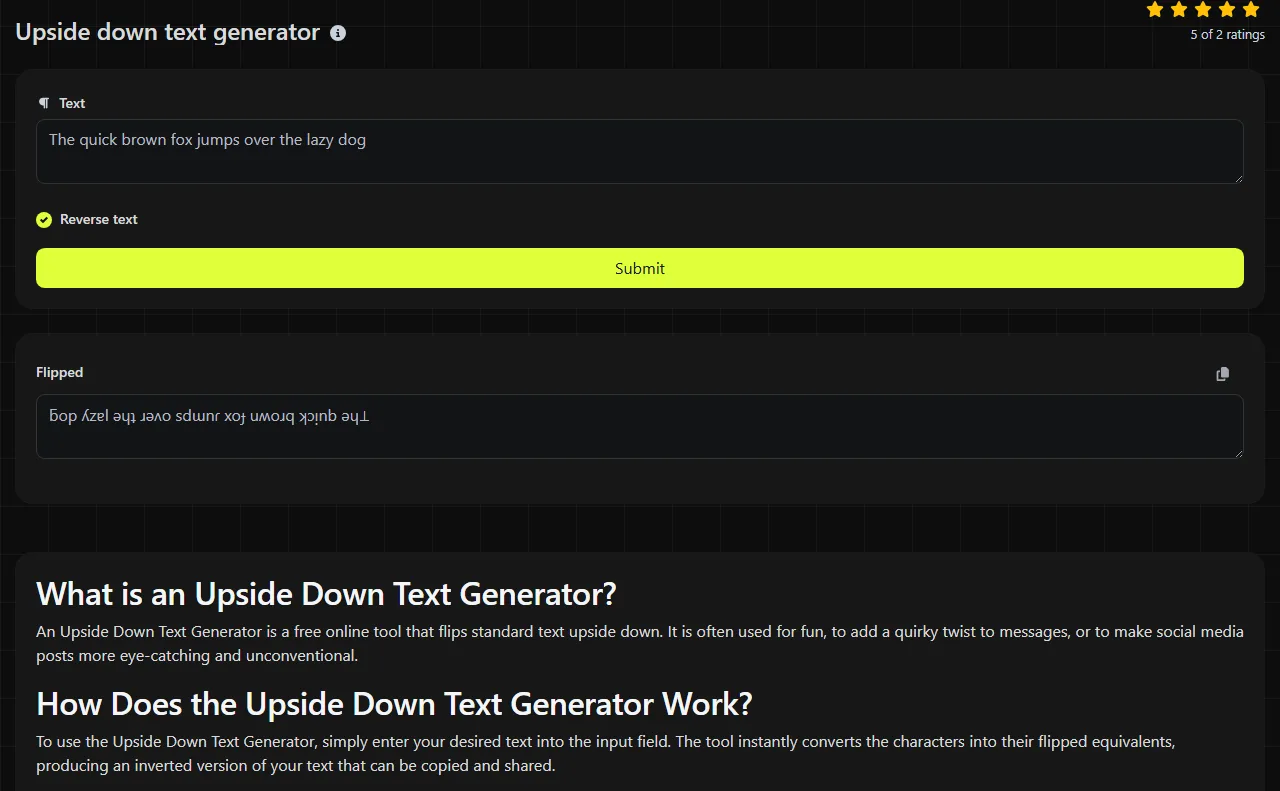
Enter or paste the text to reverse, then copy the reversed result.
- Type or paste the original into Reverse text.
- Read the reversed version in Flipped.
- Copy the reversed result and paste it into the destination, then check how it appears there.
The conversion happens on the server. Your input travels to the server over HTTPS and is not stored.
Where can upside-down text save time?
It saves time when you want to reverse a short piece of text. Possible uses include:
- a playful line in an Instagram or TikTok bio;
- a display name or short message on Discord;
- a WhatsApp group description or status;
- a heading in a social post on X, Facebook or LinkedIn;
- a clue, answer or reveal in a quiz document;
- a label on a party invitation, poster or informal presentation.
Because the tool reverses bytes, try a short non-ASCII sample before reversing a long passage. A practical habit is to write and proofread the plain version first, keep a copy, and only flip the final wording. Editing reversed characters directly is slow and makes spelling mistakes harder to spot.
How does text reversal work?
The tool reverses the input byte sequence. It does not replace characters with upside-down Unicode lookalikes.
For example, reversing the ASCII input Hello produces olleH. For ASCII input, the result contains the same characters in reverse order.
This distinction matters for non-ASCII input. Because UTF-8 characters can use more than one byte, byte-wise reversal may corrupt them and produce invalid UTF-8.
What happens with spaces, accents and other awkward input?
ASCII spaces, punctuation and other characters take part in the reversed sequence without being replaced. Multibyte characters may be corrupted by byte-wise reversal.
- Numbers: digits are reversed without being replaced.
- Punctuation: punctuation marks are reversed without being replaced.
- Accented letters: these may use multiple bytes and may be corrupted.
- Non-Latin scripts: multibyte characters may be corrupted.
- Emoji: multibyte emoji may be corrupted.
- Empty input: there is nothing meaningful to flip.
Very long passages are also difficult to read and check when reversed. Reverse a sentence at a time if line order or punctuation needs close checking.
Why does the result break on some websites?
If the input contains multibyte UTF-8 characters, byte-wise reversal can produce invalid text before it reaches another website. A destination may also reject the value, alter it or count it differently.
Reversed text is also a poor choice for information that must remain accessible or searchable. Screen readers may announce the reversed characters in their output order or encounter malformed non-ASCII text. Search engines and in-app search may not match the reversed version when somebody searches for the original words.
Avoid using reversed text for email addresses, website addresses, legal wording, account recovery details or any field that requires an exact plain-text value.
Frequently asked questions
Will upside-down text count towards a platform's character limit?
For ASCII input, reversal preserves the same characters and underlying length. For non-ASCII input, byte-wise reversal may corrupt the text, so a platform may not count or display it as expected. Check the destination's counter after pasting rather than relying on the length of the original text.
Can I use upside-down text in an email subject line?
Reversed ASCII text can be pasted into an email subject line like other ASCII text. If the original input contains non-ASCII characters, byte-wise reversal may corrupt it before it is pasted. Keep the essential meaning in ordinary text and send a test message to another account before using it for a real mailing.
Will the effect remain when I copy and paste it?
Reversed ASCII text copies and pastes normally. With non-ASCII input, the output may already have been corrupted by byte-wise reversal before you copy it.
Can I convert the result back to the original text?
Applying byte-wise reversal twice restores the original byte sequence. However, if malformed intermediate non-ASCII output is copied through another system, that system may alter or reject it before it is reversed again. Keep the original whenever accuracy matters.
Is upside-down text suitable for passwords or programming code?
Reversed ASCII consists of ordinary ASCII values, but reversal changes their exact order and may make them harder to read. Non-ASCII input may be corrupted by byte-wise reversal. Use reversed text only where the resulting exact value is intended and accepted by the relevant password policy, compiler, configuration file or data field.
Popular Tools
Create your own custom signature and download it easily with our signature generator tool for personalized e-signatures.
Calculate the size of any text in Bytes (B), Kilobytes (KB), or Megabytes (MB) using our text size calculator tool.
Use the reverse IP lookup tool to find the domain or host associated with any IP address quickly and easily.
Use our ping tool to check the status and response time of any website, server, or port quickly and efficiently.
Digily Link's IP lookup tool provides detailed information about any IP address. Use this free online service to get comprehensive IP data.
Generate your free WhatsApp link instantly with our WhatsApp Link Generator. Add a custom message and start chats in one click. No login or coding required.