Text to speech
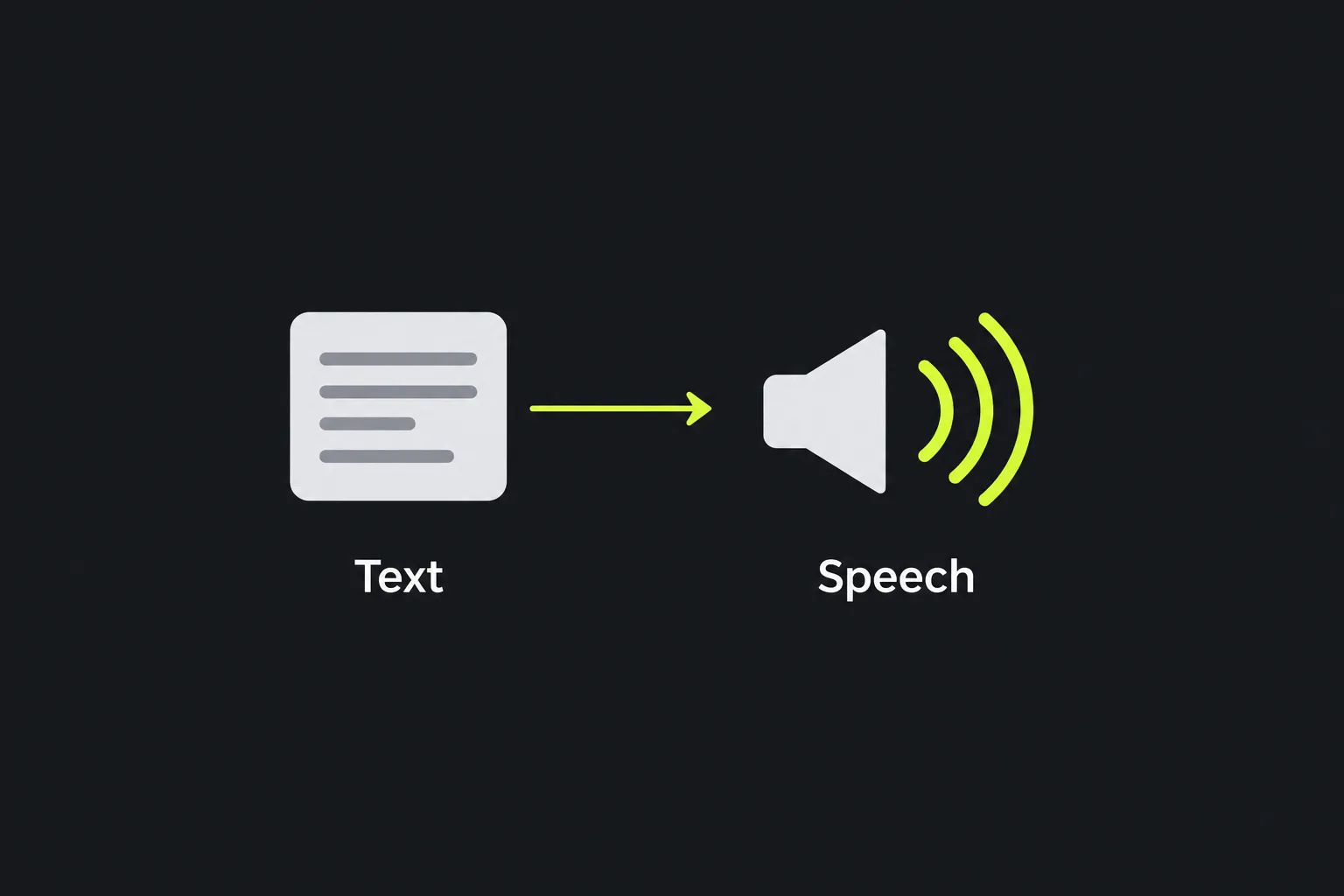
Text to speech is a free tool that sends your text and chosen language code to a server, uses the Google translator API to generate speech audio, and lets you listen to the result.
How do I turn text into speech?
Supply the appropriate language code, then generate the audio and listen to the result. The language code tells the speech service how to interpret and pronounce the text.
- Prepare the wording exactly as you want it read.
- Enter a language code that matches the language of the text.
- Generate the speech audio.
- Listen for mispronounced names, abbreviations, dates and numbers.
- Edit the wording and generate it again if the spoken version is unclear.
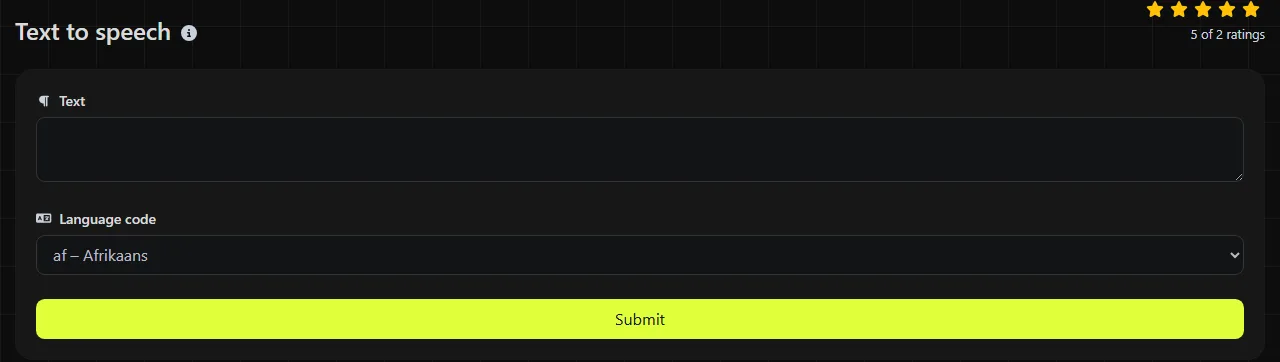
For example, the input Please close the window. with an English language code produces audio that reads the sentence aloud. If the input is French, use a French language code rather than relying on an English voice to interpret French spelling.
The tool returns audio rather than a rewritten or translated version of the text. If you need another language, translate the wording first and then generate speech using the corresponding language code.
What does the language code change?
The language code changes the pronunciation rules used to produce the speech. It can affect sounds, rhythm and the way numbers or abbreviations are interpreted, even when the visible text remains unchanged.
The documented user-filled field is Language code. The code should match the language of the text.
A language code is not a translation instruction. Entering English text with a French code does not reliably convert the sentence into French. It asks the speech engine to read the existing characters using French pronunciation rules, which may produce an unnatural result.
When is generated speech audio useful?
Generated speech is useful when you need to hear written wording without recording a person reading it. Common practical uses include checking scripts, preparing accessibility alternatives and reviewing how text sounds when read aloud.
- Video drafts can use temporary narration while timing scenes, captions or a YouTube edit.
- Pronunciation checks can reveal awkward wording in announcements, instructions and language-learning exercises.
- Accessibility reviews can help authors notice sentences that are difficult to follow when heard rather than read.
- Telephone scripts can be checked for long sentences, unclear numbers and abbreviations before recording the final message.
Synthetic speech may be suitable for a draft or simple listening task. It does not replace a human recording where emotion, careful emphasis, character or an exact regional accent matters.
Input details and awkward text
The implementation calls PHP's strlen function, which returns a string's length in bytes, and uses URL encoding when sending values, so spaces and reserved URL characters can be transmitted as data rather than mistaken for part of a web address. HTML-sensitive characters are also escaped during processing. These technical steps do not determine how the speech engine will pronounce the text.
Punctuation often influences pauses, so a full stop or comma can make a sentence easier to follow. Excess punctuation may cause odd pauses or may be ignored. Numbers can also be ambiguous. For example, 03/04/2026 may be read as separate numbers, and its intended date is unclear outside a stated convention. Writing 3 April 2026 gives the engine clearer material.
Accented and non-Latin characters should be paired with a suitable language code. Their pronunciation still depends on support in the underlying service. An empty input cannot produce meaningful speech. Split long copy into sentences or short paragraphs when necessary.
What are the limitations of text-to-speech output?
The output cannot guarantee correct pronunciation, emphasis or regional accent. Personal names, place names, initialisms and specialist terms are common sources of errors because their pronunciation may not be clear from spelling alone.
The documented input includes a language code, but it does not provide grounds to assume controls for voice selection, speaking speed, pitch or audio format. Do not plan a production workflow around those options unless they are visibly available when you use the tool.
Processing happens on the server. Your input travels to the server over HTTPS and is not stored. The service relies on the Google translator API, so avoid entering confidential, legally restricted or personally sensitive material unless its use is permitted under the rules that apply to your organisation and the external service.
Frequently asked questions
Can I use the generated audio commercially?
The tool does not establish commercial usage rights for text-to-speech audio generated using the Google translator API. Check the applicable Google service terms and any contractual requirements for the publication, advert, course or product in which you intend to use the audio.
Can text to speech read emoji?
Emoji handling varies by speech engine, language and symbol. An emoji may be described, ignored or pronounced unexpectedly, so replace it with ordinary words if its meaning needs to be heard clearly.
Why are abbreviations pronounced incorrectly?
A speech engine may treat an abbreviation as a word or read its letters separately. Add spaces or full stops between letters, or write the term in full, then compare the results. For example, spelling out a department name is often clearer than relying on an unfamiliar acronym.
Does the tool support SSML markup?
No SSML input is identified in the documented fields, so do not assume that tags for pauses, emphasis or pronunciation will be interpreted. Use ordinary punctuation and clearer wording instead, or choose a dedicated speech platform that explicitly supports Speech Synthesis Markup Language.
Which form field do I need to fill in?
The documented user-filled form field is Language code.
Final checks
Listen to the complete result before using it. Check names, addresses, prices, times and dates against the source text, and rewrite anything the engine reads ambiguously. Keep the original wording available so that you can correct and regenerate short sections without reconstructing the whole script.
Popular Tools
Create your own custom signature and download it easily with our signature generator tool for personalized e-signatures.
Calculate the size of any text in Bytes (B), Kilobytes (KB), or Megabytes (MB) using our text size calculator tool.
Use the reverse IP lookup tool to find the domain or host associated with any IP address quickly and easily.
Use our ping tool to check the status and response time of any website, server, or port quickly and efficiently.
Digily Link's IP lookup tool provides detailed information about any IP address. Use this free online service to get comprehensive IP data.
Generate your free WhatsApp link instantly with our WhatsApp Link Generator. Add a custom message and start chats in one click. No login or coding required.