GIF to WebP
GIF to WebP is a free tool that converts GIF image files into WebP files entirely in your browser.
How do I convert a GIF to WebP?
Choose a GIF file, allow the browser to process it, then save the resulting WebP file.
- Select the .gif file you want to convert.
- Wait while the conversion runs in your browser.
- Save the converted file with its .webp extension, then open it to check the image or animation.
The input file is never uploaded to a server. This matters when the GIF contains unpublished artwork, internal diagrams or other material that should not be sent to a third-party conversion service. Browser-based processing can use substantial memory for a long animation, particularly when the image has large dimensions or many frames.
What changes when GIF is converted to WebP?
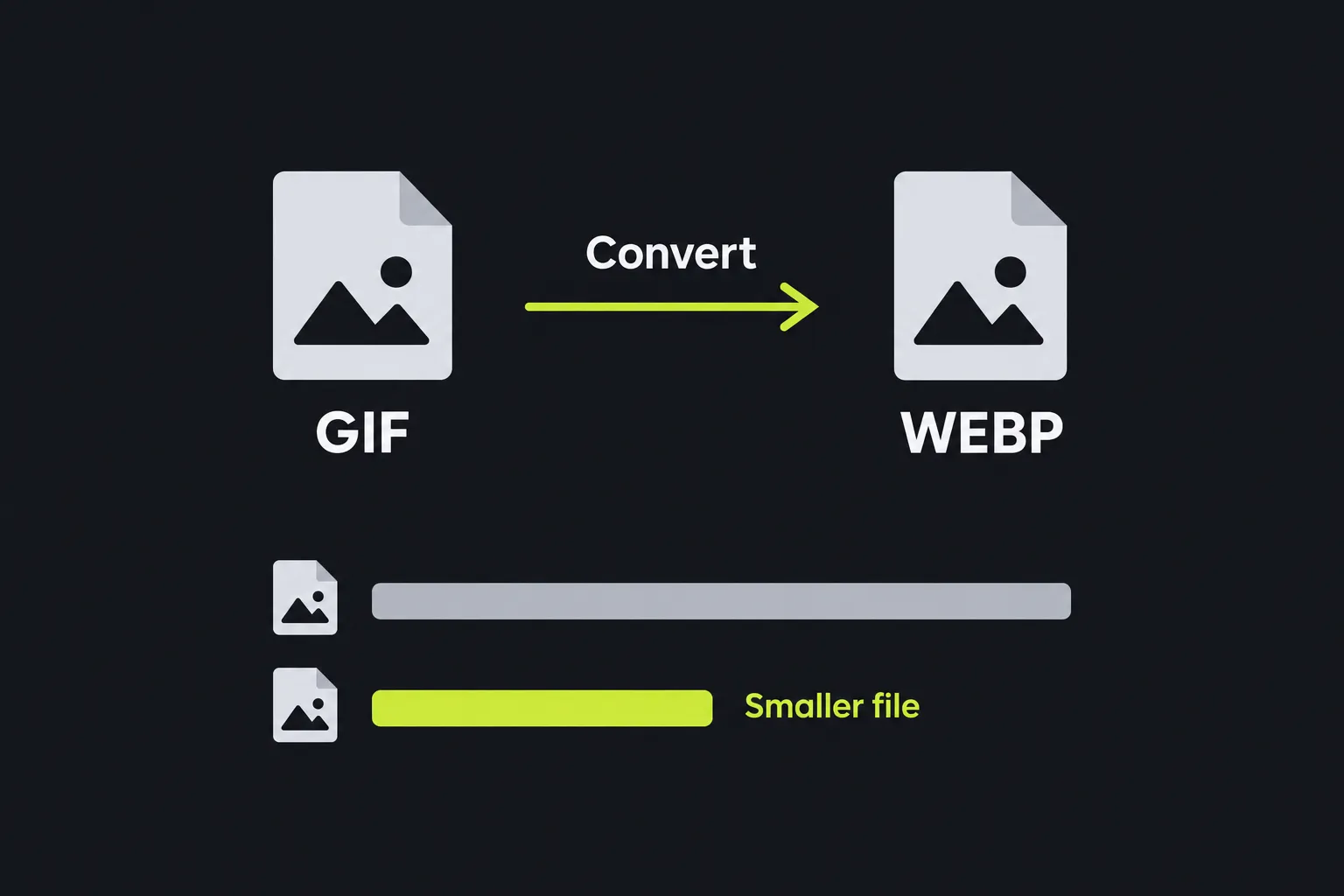
The image data is re-encoded using the WebP format, which supports more colours, more flexible transparency and typically more efficient compression than GIF.
| Property | GIF | WebP |
|---|---|---|
| Colour | Up to 256 colours in each frame | Full-colour images without GIF's 256-colour palette limit |
| Transparency | One palette entry can be fully transparent | Supports full alpha transparency, including partially transparent pixels |
| Animation | Supports multiple timed frames and looping | The format supports animation, frame timing and looping |
| Compression | Lossless LZW compression of indexed-colour data | Supports both lossy and lossless compression |
| Typical file size | Can become large for long or photographic animations | Often smaller for equivalent visual content, though this is not guaranteed |
| Support | Very widely supported by browsers, editors and messaging software | Supported by current major browsers, but some older applications and specialist workflows may reject it |
WebP's animation support does not by itself guarantee that every converter preserves every GIF frame. Animation preservation is not guaranteed, so check that the downloaded file still moves, loops correctly and retains the expected frame timing before replacing the original.
Will the WebP file be smaller than the GIF?
The WebP file will often be smaller, especially for photographic or long animated content, but there is no fixed reduction that applies to every GIF.
File size depends on the pixel dimensions, frame count, changes between frames, colour complexity and the compression mode used. A small flat-colour icon may already compress efficiently as GIF, leaving little room for reduction. A large reaction GIF with photographic frames will usually give WebP more scope to reduce the file size.
- A static 200 × 200 pixel logo with a short palette may produce only a modest saving.
- A 1,280 × 720 pixel animation with dozens of detailed frames is more likely to become substantially smaller.
- A single-frame GIF exported from a photograph may shrink, but its original palette banding and dithering may remain visible.
- A WebP encoded with conservative lossless settings can occasionally be similar in size to, or larger than, a simple GIF.
Compare the GIF and WebP files in bytes rather than assuming the new extension means a smaller result. Also inspect fine text, sharp edges and gradients if the output uses lossy WebP compression.
When should I convert GIF to WebP?
Convert GIF to WebP when you need a web image or animation with a smaller file size and your target browsers or publishing platform accept WebP.
It is a sensible choice for website animations, illustrated product instructions, loading graphics and decorative loops where page weight matters. WebP can also represent smooth transparency around shadows and curved edges, while GIF transparency is limited to fully transparent or fully opaque palette entries.
Conversion is less suitable when the file must work in an older desktop application, an email client with uncertain WebP support, or a system that specifically requires GIF. Keep the original GIF as a fallback until the WebP has been checked in its intended destination.
Converting a poor-quality GIF to lossless WebP does not restore missing detail or colours. GIF's palette reduction happened when the source was made, and a later lossless conversion merely preserves that reduced image accurately. If the original artwork, video or full-colour image is available, create the WebP from that source instead.
Compatibility and awkward files
A valid file extension is not proof that a file contains valid GIF data. A renamed JPEG, an incomplete download or a damaged GIF may fail to decode, regardless of the conversion format.
Spaces, punctuation, accented letters and non-Latin characters in the filename do not alter the pixels during GIF-to-WebP conversion. However, a website, content management system or older application may change such filenames or reject them, so a short filename using letters, numbers and hyphens is often safer for publishing.
Very large animated GIFs can place considerable demand on browser memory because frames may need to be decoded during conversion. If processing fails, try closing memory-heavy tabs or start from a smaller source. An animation containing unusual disposal instructions should be checked frame by frame for visual differences.
If the destination requires a static format rather than animation, GIF to JPG can be suitable for a photographic frame, while GIF to ICO is intended for favicon and icon workflows. Those conversions have different transparency and animation trade-offs.
Frequently asked questions
Can I change the filename from .gif to .webp instead?
No. Renaming the extension does not change the encoded image data, so software may still identify the file as GIF or report that it is invalid. A genuine conversion must decode the GIF and encode new WebP data.
Does converting remove GIF metadata?
Metadata preservation depends on the encoder and is not specified for this tool. Comments, application blocks and other non-image information in a GIF may not have a direct WebP equivalent. If that information matters, inspect the converted file with a metadata utility and retain the original.
Can I use animated WebP in an email?
You can attach it, and some email systems allow you to embed it, but display support varies between email clients and security settings. GIF remains the safer choice when an animation must appear for recipients using a wide range of mail software. A static fallback image is useful when WebP support is uncertain.
Why does my WebP open in a browser but not an image editor?
The editor may use an older image library without WebP decoding support. Update the application or open the file in a current browser to confirm that the conversion produced readable image data. Before deleting the GIF, check that the WebP is supported in the exact website, application or publishing system where it will be used.
Similar Tools
Easily convert GIF image files to ICO format with our GIF to ICO converter tool for creating favicons.
Easily convert GIF image files to PNG format with our GIF to PNG converter tool for high-quality images.
Easily convert GIF image files to JPG format with our GIF to JPG converter tool for versatile image usage.
Popular Tools
Create your own custom signature and download it easily with our signature generator tool for personalized e-signatures.
Calculate the size of any text in Bytes (B), Kilobytes (KB), or Megabytes (MB) using our text size calculator tool.
Use the reverse IP lookup tool to find the domain or host associated with any IP address quickly and easily.
Use our ping tool to check the status and response time of any website, server, or port quickly and efficiently.
Digily Link's IP lookup tool provides detailed information about any IP address. Use this free online service to get comprehensive IP data.
Generate your free WhatsApp link instantly with our WhatsApp Link Generator. Add a custom message and start chats in one click. No login or coding required.