List alphabetiser

List alphabetiser is a free tool that orders separate lines of text alphabetically from A to Z or from Z to A.
How do I alphabetise a list?
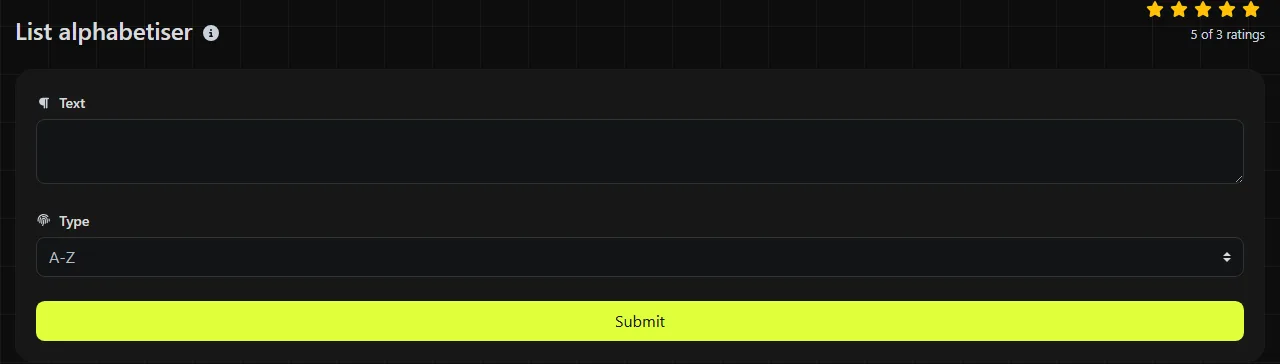
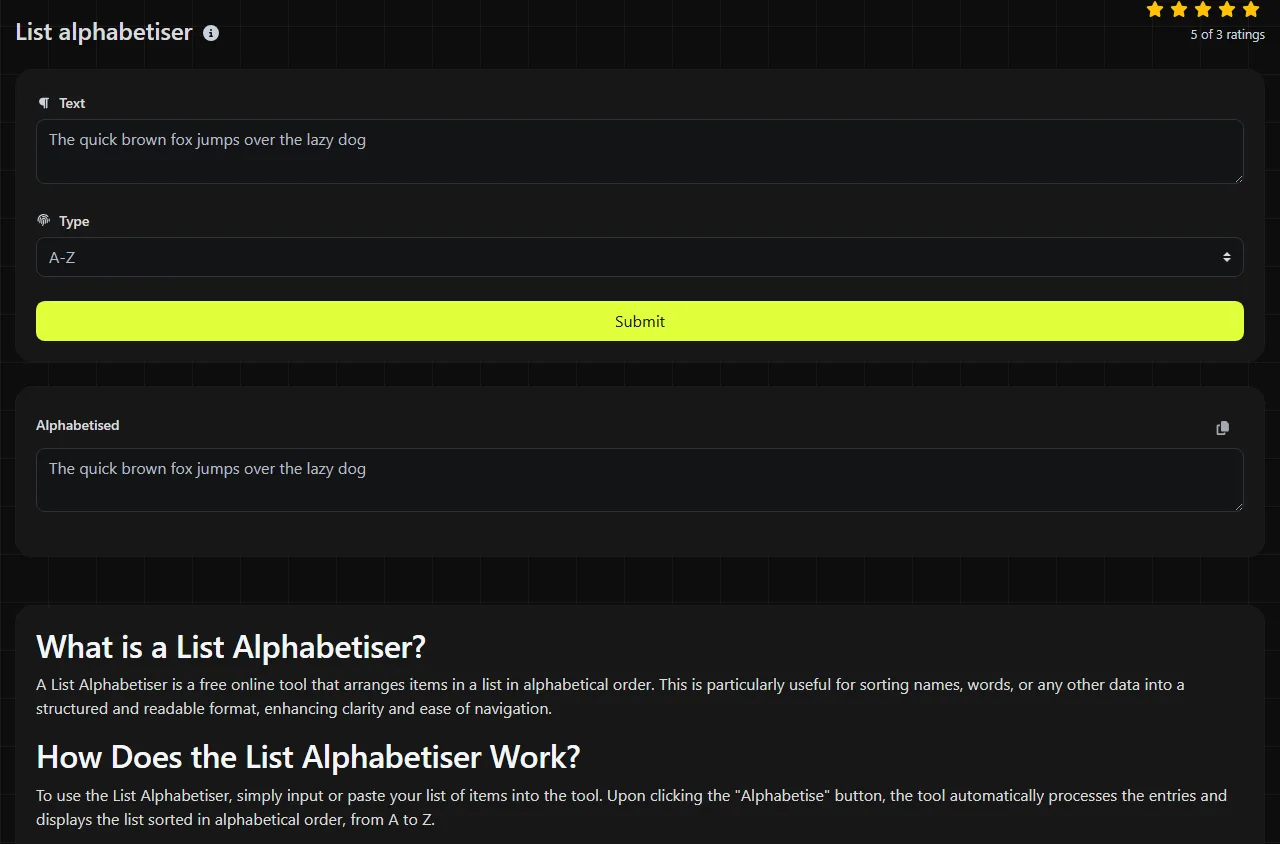
Enter one list item per line, choose the required direction, then copy the ordered lines from the Alphabetised result.
- Paste or type the list with each item on its own line.
- Choose A-Z for ascending order or Z-A for descending order.
- Check the alphabetical order before copying it into your document, spreadsheet or form.
Keep any column heading out of the input and add it back afterwards. Otherwise, a heading such as "Customer name" may be sorted among the actual records.
Where does alphabetical sorting save time?
Alphabetical sorting saves time whenever you have a line-based list that needs a predictable order before it is published, checked or reused.
- Excel and Google Sheets exports: sort a copied column of supplier names, stock labels or office locations before pasting it elsewhere.
- Mail merge preparation: order address labels or recipient records when each complete record occupies one line. If surname order matters, place the surname at the start of each line.
- WordPress: arrange a draft list of categories, contributors or glossary terms before entering them into the administration area.
- Shopify: tidy product type or tag lists so that repeated and oddly spelt entries are easier to spot by eye.
- Microsoft Forms: put long choice lists into alphabetical order before adding them as answer options.
Alphabetising can also make proofreading easier because near-matches such as "Birmingham", "Birmingam" and "Birmingham Office" appear close together.
What happens with capitals, numbers and punctuation?
Capitals, numbers and punctuation can affect text sorting, so inspect mixed-format lists rather than assuming they will follow human dictionary order.
A basic alphabetical operation compares the written characters in each line. Numbered items may therefore appear in text order, where "10" can come before "2", rather than numerical order. Leading quotation marks, brackets, spaces or symbols can also change where a line belongs.
Accented letters and non-Latin scripts require language-specific collation rules to produce an order appropriate to a specified language or locale. Capitalisation can matter too, depending on the sorting rules in use. For predictable results, use consistent capitalisation, remove accidental leading spaces and apply one numbering format, such as 01, 02 and 10.
Blank lines and duplicate entries are easy to miss in a long result. Check for both before using the list as final data.
A worked sorting example
For an A-Z sort, this input:
pear
apple
banana
becomes:
apple
banana
pear
For a Z-A sort, this input:
Bristol
Inverness
Edinburgh
becomes:
Inverness
Edinburgh
Bristol
The operation sorts whole lines. With entries such as "Smith, Aisha" and "Smith, David", the text after the shared surname determines their relative position.
Does the List alphabetiser keep my data private?
The input is sent to the server over HTTPS for processing and is not stored.
This means the list does not stay entirely within your browser. Do not submit lists containing confidential customer records, passwords, health information or other restricted data to the List alphabetiser if your organisation requires local-only processing. For sensitive spreadsheet data, use the sort function in an approved application that processes the data locally instead.
Frequently asked questions
Can I use it to sort CSV data?
You can paste CSV rows as separate lines, but alphabetical line sorting is not the same as sorting a chosen CSV column. For records containing several comma-separated fields, use a spreadsheet or CSV-aware application so that you can select the correct field and keep quoted values intact.
Will alphabetising remove duplicate lines?
No duplicate-removal behaviour is specified, so do not use the result as proof that every item is unique. Review adjacent matches or use a dedicated deduplication method after sorting, as duplicates are usually easier to see once grouped together.
Can I paste the result into Excel?
Yes, line-based text can normally be pasted into a spreadsheet column, with each line placed in a separate row. Check entries containing embedded line breaks first because a spreadsheet may split one intended record across several rows.
Should I choose Z-A or use Reverse list?
Choose Z-A when the items need descending alphabetical order. Use Reverse list when you simply need to flip the existing sequence, regardless of the wording on each line.
How should I sort names containing titles?
Remove or move titles such as Dr, Mr or Professor if you want the order based on the person's name. For surname sorting, use a consistent format such as "Patel, Meera" before alphabetising, then restore the required display format afterwards.
Popular Tools
Create your own custom signature and download it easily with our signature generator tool for personalized e-signatures.
Calculate the size of any text in Bytes (B), Kilobytes (KB), or Megabytes (MB) using our text size calculator tool.
Use the reverse IP lookup tool to find the domain or host associated with any IP address quickly and easily.
Use our ping tool to check the status and response time of any website, server, or port quickly and efficiently.
Digily Link's IP lookup tool provides detailed information about any IP address. Use this free online service to get comprehensive IP data.
Generate your free WhatsApp link instantly with our WhatsApp Link Generator. Add a custom message and start chats in one click. No login or coding required.