Random number generator
Generate random numbers within a specified range using our random number generator tool for diverse applications.

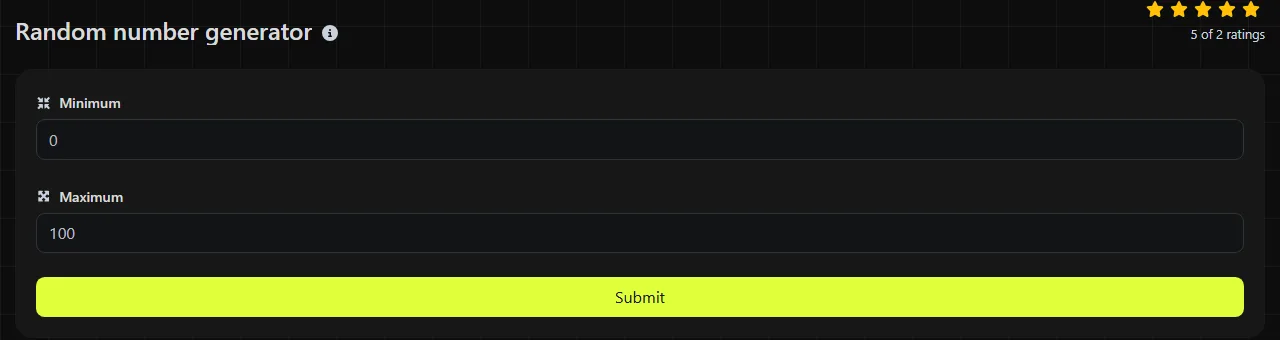
The Random number generator is a free tool that returns one number from a range defined by the minimum and maximum values you enter.
What does a random number generator actually do?
A random number generator selects a number within specified boundaries. A particular output cannot be specified as the guaranteed result of an example.
Most software-based random generators produce pseudo-random values. These come from a computational process rather than a physical source such as radioactive decay. A properly implemented pseudo-random generator is suitable for everyday draws, games, test data, and choosing between options, as long as the outcome does not protect money, accounts, or confidential information.
This tool does not claim to use a cryptographically secure random source. Do not use its results for encryption keys, password reset tokens, authentication codes, or other security-sensitive values.
How do I use the random number generator?
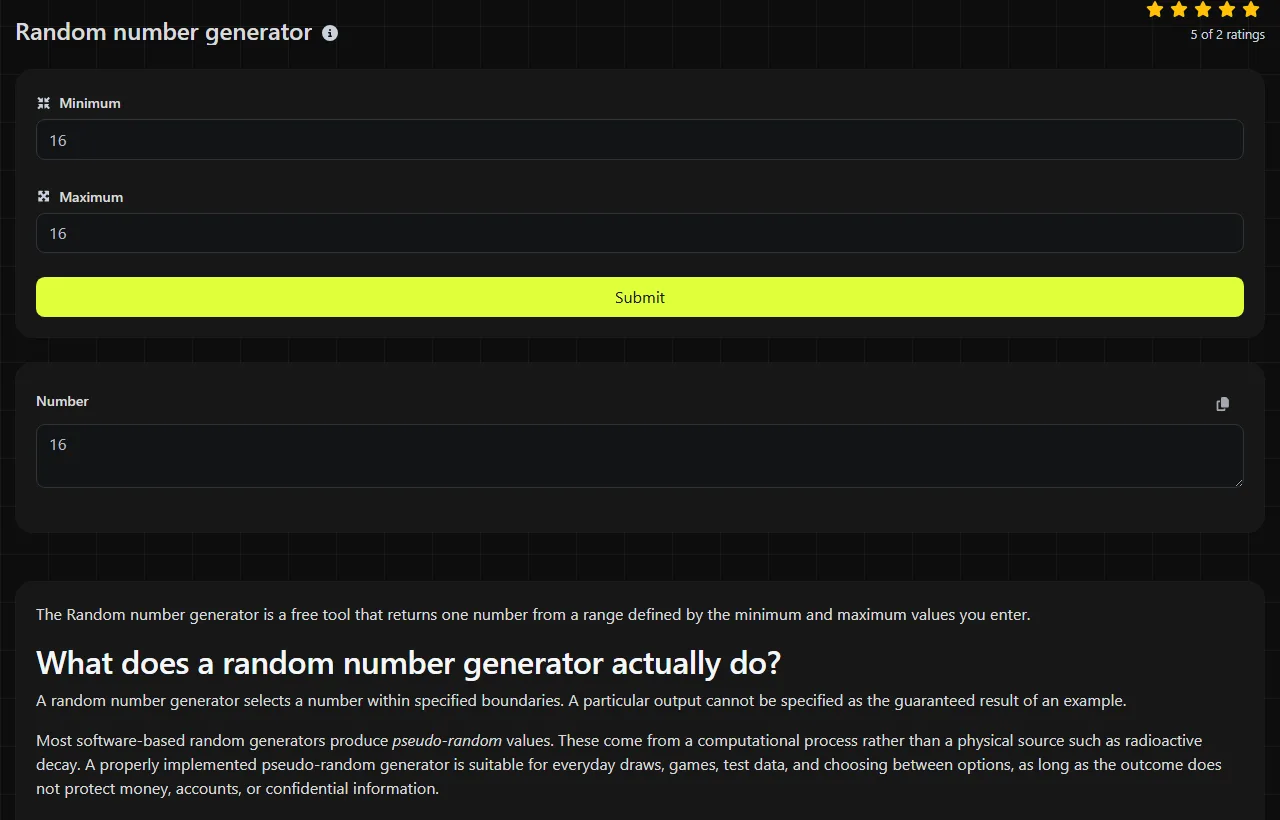
Enter the lower boundary in Minimum and the upper boundary in Maximum, then generate the result displayed in Number. Choose the boundaries before running a draw, and keep them unchanged if multiple people or items are being handled under the same rules.
The result contains one number. If you need several winners or choices, generate separate results and decide in advance whether repeated numbers are allowed. For a draw without replacement, record each selected number and exclude it from later rounds using a spreadsheet or another suitable process.
Privacy and security boundaries
Generation takes place on the server. Your minimum and maximum values are sent to the server over HTTPS and are not stored. The process does not remain entirely on your device.
Range boundaries are rarely sensitive, but they can reveal internal numbering systems if copied from live systems. When possible, use neutral ranges instead of account numbers, case references, or other operational identifiers.
A random number is also different from a purpose-built credential. If you need a login secret, use a Password generator and save the result in a password manager rather than a notes file. For software identifiers, a UUID v4 generator creates identifiers in the expected UUID format and is a better choice than an arbitrary number.
What can I use random numbers for?
You can use random numbers for casual selections, games, classroom exercises, mock data, and low-stakes draws. The range should map clearly to the available choices so someone else can understand how the outcome was determined.
Common uses include selecting who goes first in a board game, assigning one of several test scenarios, choosing a meal from a numbered list, or drawing a prize from entries that already have unique numbers. Random values are also useful in software testing when developers need varied numerical inputs instead of the same fixed values in every test.
This tool should not be treated as proof that a regulated or high-value draw was independently fair. Such draws may require documented procedures, witnesses, specialized software, or an auditable source of randomness. A server-generated result displayed on a screen does not provide that record by itself.
How should I handle ranges and unusual input?
Use plain numerical boundaries and confirm that the minimum is less than or equal to the maximum. The accepted numeric formats are not documented. Number the original items first, then enter only those numbers.
The documented fields do not specify whether decimal values are accepted, whether both endpoints are included, or how empty and reversed ranges are validated. They also do not document limits for extremely large numbers. If endpoint handling affects the result, do not rely on the tool without confirmed documentation of that behavior.
Be careful when copying values from spreadsheets. Thousands separators and decimal punctuation vary by locale. In the US, 1,500 normally means one thousand five hundred and 1.5 means one and a half, but an input field may expect an unformatted value such as 1500. Remove currency symbols, units, and surrounding words before entering a value.
Frequently asked questions
Can the same random number come up more than once?
Yes. Repeated random selections can produce the same value unless the system explicitly samples without replacement. This tool returns one number and does not document a history or duplicate-prevention rule. Keep your own record when every selection must be unique.
Can I generate a negative random number?
A numerical range can mathematically include negative values, such as -10 to -1. However, the available tool information does not confirm how negative boundaries are validated. Check the result before relying on negative ranges in a workflow.
Can I generate random decimal numbers?
Decimal support and precision are not documented for this tool. If you need values with a fixed number of decimal places, a spreadsheet function can generate and round them using an explicit formula. Record the rounding rule because it can affect how outcomes are distributed.
Can I use the result for a raffle?
It can be used for an informal, low-stakes raffle when every entry has a unique number and the rules are agreed on in advance. For a public, paid, or regulated promotion, check the applicable US rules and use a process that creates the required audit trail. Keep a record of the entry list, range, time, and selected result.
Is a random number safe to use as a password or API key?
No. The tool does not provide a cryptographic security guarantee, and a short numerical range has too few possible outcomes to serve as a secure secret. Use a dedicated cryptographic generator for API keys and a Password generator for login credentials.
Final checks
- Confirm that every option has exactly one number.
- Check the minimum and maximum before generating the result.
- Decide whether endpoints and duplicate results matter for your task.
- Record the tool's Minimum, Maximum, and returned Number if you may need to explain the selection later.
- Use a security-specific or audited system when the result controls access, money, or a regulated decision.
Popular Tools
Create your own custom signature and download it easily with our signature generator tool for personalized e-signatures.
Calculate the size of any text in Bytes (B), Kilobytes (KB), or Megabytes (MB) using our text size calculator tool.
Use the reverse IP lookup tool to find the domain or host associated with any IP address quickly and easily.
Use our ping tool to check the status and response time of any website, server, or port quickly and efficiently.
Generate your free WhatsApp link instantly with our WhatsApp Link Generator. Add a custom message and start chats in one click. No login or coding required.
Digily Link's IP lookup tool provides detailed information about any IP address. Use this free online service to get comprehensive IP data.